A Star is Born....? Determination.... Man of the World.... Happiness.... Confusion.... [four dot ellipsis in original]
Here are just four reasons why First Sergeants get that way – This character is known in the Army as Pvt Melvin Kaminsky, and to be expected, he hails from Brooklyn. Head of the entertainment crew for Special Services, Kaminsky is very much in demand as an M.C. His stage name is Melvyn Brooks. His last appearance before entering the Army was in the play, "Bright Boy", so he says and he adds "I had three lines in that show, was on the stage about two minutes, what a part!" A member of the Combat Engineers before coming to Dix, Kaminsky expects to be discharged in June
Showing posts with label photo. Show all posts
Monday, August 17, 2015
Melvin Kaminsky
From the movie Mel Brooks : Make a Noise (2013)
Sunday, November 9, 2014
Chuck Close at work part 2
(see also the post Chuck Close at work part 1 that showed the process of his post-photorealistic, prismatic grid work)
![]() | ||
|
![]() |
| Chuck Close painting Mark 1978-79 (108 x 84 inches or 9 x 7 feet) from Chuck Close Work page 86 |
Notice the 5 reference photos : magenta color separation, cyan color separation, then magenta+cyan color separation so he can check his progress, yellow color separations and magenta+cyan+yellow (the full color photo).
Chuck Close's approach to photorealistic painting is not what I expected. To achieve a slick photorealistic you pretty much have to approach it from a strict mechanical process but this wasn't what I expected. But it seems like a sensible approach : simplification and the use of technology.
He appears to begin, from top to bottom dividing the image into sections. A section is then painted from the magenta separation and once that is done that section is painted from the cyan separation with the magenta+cyan proof as an added reference. Then the section is painted guided by yellow separation. Only once the section is completed does he move on to another section
Personally, I prefer his later "prismatic grid" works. Once you've seen a couple giant portraits they lose their uniqueness. They become enlarged photos. Photos enlarged by a very time consuming mechanical process like Chuck Close is an Epson printer. That is the point some might say but …
Pictures from the book Chuck Close Work by Christopher Finch (2010).
Tuesday, February 18, 2014
Chuck Close at work
Chuck Close at work. From Graphis Magazine #313 (no date printed but I think it is from around 1998) It is an interesting insight to how he works. It looks like a two inch square grid at a 45º angle, he starts at the top blocking color in several rows, and then each grid tile is given a "dot."
At first it might appear to be that he fills in a band of the grid from the top down but compared to the finished piece and there were changes made in the corners. Aside from the background there is a little use of line that extends outside of an individual grid box. For example, part of his glasses and part of the shirt collar.
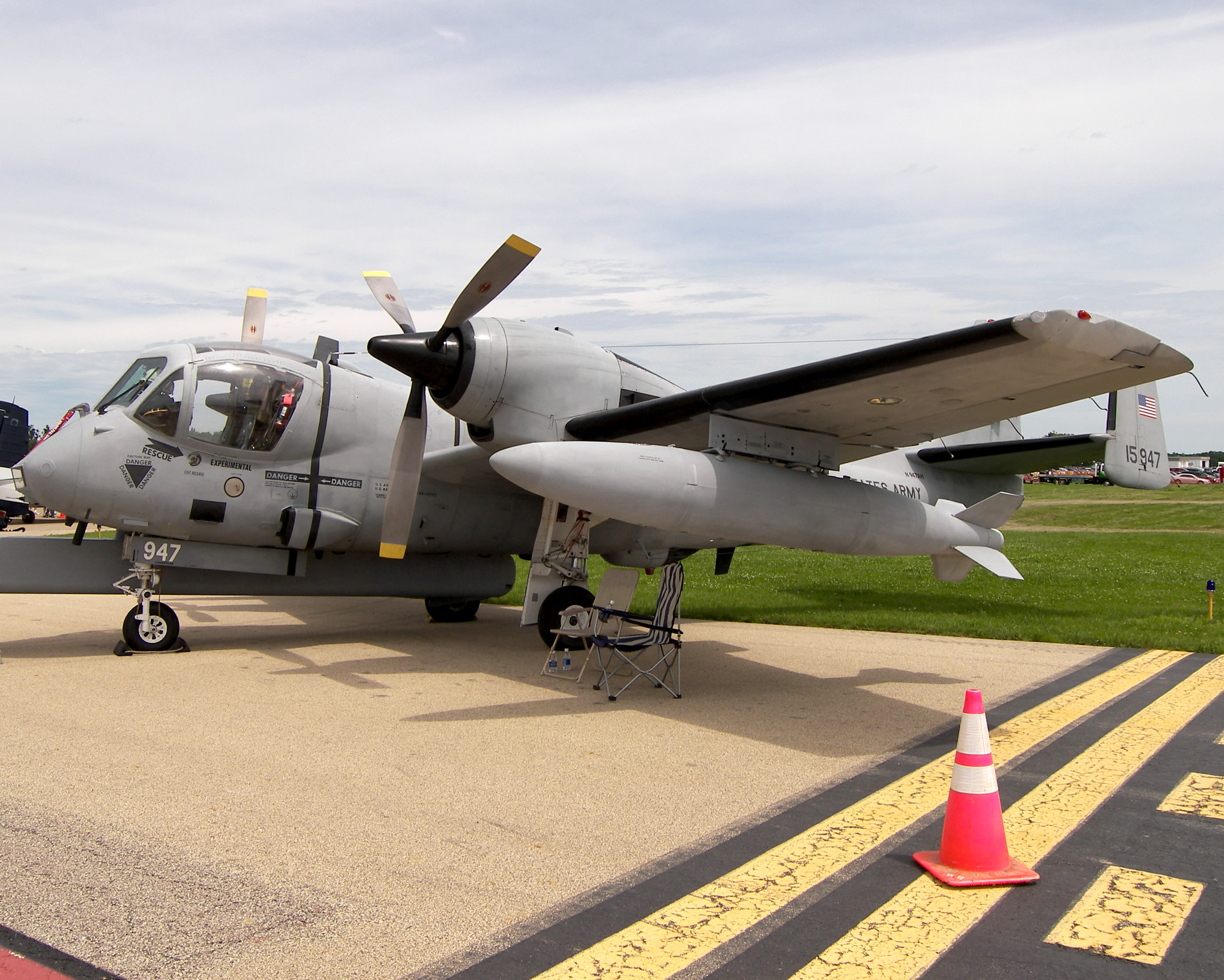
The lift he uses to raise himself to paint higher portions of the painting appears to be a Big Joe Lift In-Between Handling Manual Stacker IBH1018 or a very similar model.
Another photo in the article shows Close working in a different workspace where the painting can be lowered down into a hole in the floor. When he moved studios he retired his Big Joe lift and started moving the painting.
Below is the finished painting.
Saturday, February 15, 2014
Alphonse Mucha's wife and the painting Woman in the Wilderness
![]() |
| detail of Alphonse Mucha's painting Woman in the Wilderness, 1923 juxtaposed with the photograph of his wife Maruška posing for the painting. (click to embiggen) |
seen here
![]() |
| Woman in the Wilderness, 1923, oil on canvas, 201.5 x 299.5 cm (79.3" x 117.9") (click to embiggen) |
![]() |
| an attempt to show the scale of the painting |
Labels:
animatedGIF,
art,
photo,
photoshop,
women
Saturday, June 8, 2013
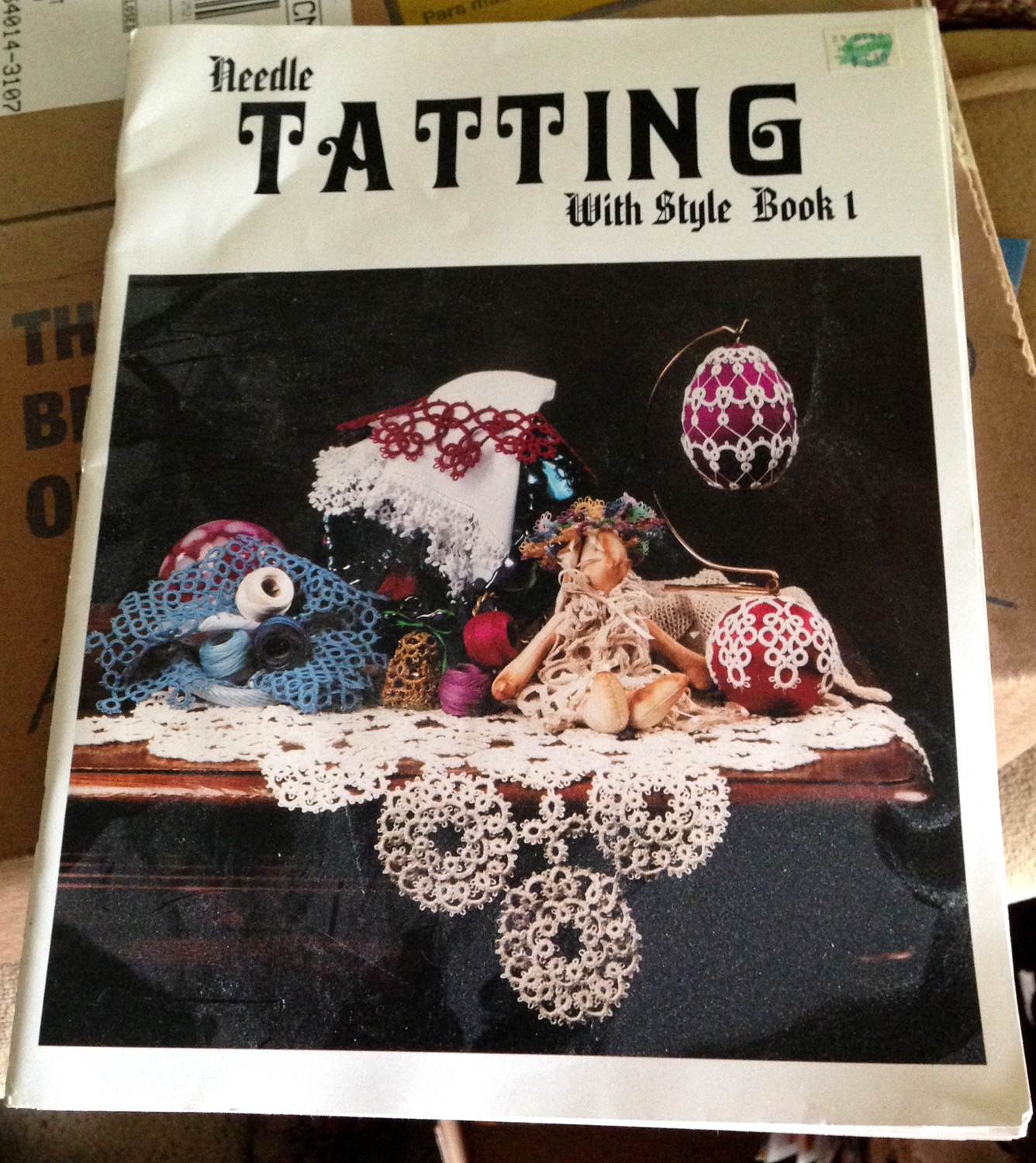
Tatting With Style
Monday, January 21, 2013
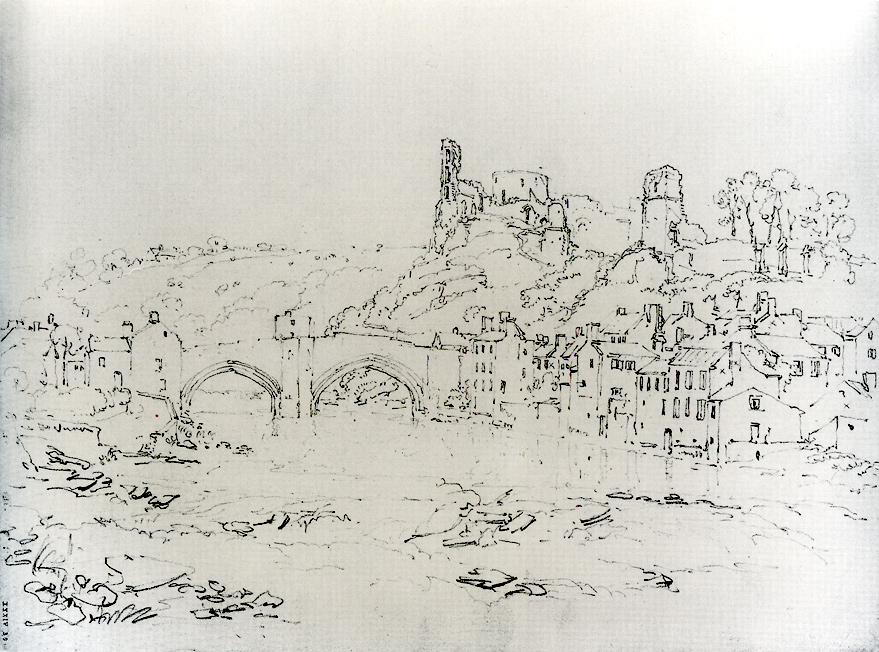
a shortcut in fine art
Barnard Castle and Bridge, from downstream by Joseph Mallord William Turner, 1797
Pencil, 230 x 270mm (9" x 10.6"), North of England sketchbook
from the book Turner in the North p 49
The photo below of the same castle (built 1093) and bridge from a similar view is from Turner in the North page 48 :
Some of the differences between the drawing and the photo is due to them being created 200 years apart.
One detail I would call attention to is the "x" on the buildings on the lower right probably as a little shortcut to note shadowed areas for future reference.
| detail of the lower right of the image above with several 'x' highlighted in red |
Thursday, January 17, 2013
Not a painting
It has that look of someone imitating a photo where they carefully transcribe each small detail they see in the photo but then the hair is given a different, less detail conscious treatment. It happens a lot.
The expression is also a photographic moment frozen in time. People don't see one another that way; we see the start point and end point of an expression and a blur and an approximation of what we think the transition expression is. Consequently, I think it looks less natural and I think most people can tell instinctively when it is based on a photograph.
As a photo, it isn't that bad (although it probably be better in black & white) but as a painting it lacks. It lacks charm and panache (In contrast, Feliks Topolski painted the British monarchy
with what some might call an overdose of panache). Maybe there is a painterly quality when someone stands in front of it but I have my doubts.
This guy refers to it as "[a] jowly face that will now be staring at us… Is that scratchy rug atop her head really meant to be Kate's famously silken locks? And what's going on with the mean, wierdly [sic] spaced eyes? And don't get me started on the nose." (Is a writer who refers to himself as "the Royalist" required to write like a Drama Queen?)
![]() |
| The photographic basis of the painting. If the photocopier hadn't been invented he could have gotten a job at Xerox. |
![]() |
| Kate Middleton's official portrait with the artist Paul Emsley (I suspect her head isn't really that large in person) |
Wednesday, November 21, 2012
Erasing the Past part 2
(This post is continued from Erasing the Past part 1)
Grigorii Petrovsky is squeezed out (1922)
Grigorii Petrovsky was the Head of the Ukrainian Central Committee, an organizer of the Ukrainian famine and in 1939 he was criticized for condoning "enemies of the people" and removed from all posts. He survived Stalin and died in 1958.
Of those remaining in the photo : Officially, Grigory "Sergo" Ordjonikidze died of a heart attack but Nikita Khrushchev claimed he committed suicide due to his conflicts with Stalin.
Mikhail Kalinin survived the purges, retired in 1946 and died that same year. His wife, however, had been arrested in 1938, tortured until she confessed to counter-revolutionary activities and sent to a labor camp.
Emilian Yaroslavsky had long been an active supporter of Stalin and had written a book titled "On Comrade Stalin" where Stalin is described as "leader of the people" and he repeatedly emphasizes the "ruthlessness of Stalin's enemies." IT seems his sycophancy paid off and he survived the 1930s and didn't die until 1943.
The New Yorker and New York Times change who bombed the "Napalm Girl" (1972)
At the University of Wisconsin Madison, Diallo Shabazz was photoshopped onto the cover of the UW admission application's cover (among other material).
Diallo did attend the University of Wisconsin Madison but if they wanted to show him at the football game then they should have invited him. While other ads do photoshop elements in or out, most ad photos are created to be illustrations while this was put forward as reality.
Bellesiles tried to explain that he inadvertently cited the 1792 act instead of the 1803 Militia Act but while the latter includes the phrase "constantly provided" it doesn't match his quotation either. (the 1803 Militia Act [bold added to highlight the difference from the Bellesiles quote] : "That every citizen duly enrolled in the militia, shall be constantly provided with arms, accoutrements, and ammunition."
An example from the Emory University report :
"The most egregious misrepresentation has to do with his handling of the more than 900 cases reported by Alice Hanson Jones. When critics pointed out that Jones’ data disagreed with his, Bellesiles responded by explaining that he did NOT include Jones’s data in his computations because her inventories, taken during the build-up to the American revolution, showed a disproportionately high number of guns! Here is a clear admission of misrepresentation, since the label on column one in Table One clearly says "1765-1790." If Professor Bellesiles silently excluded data from the years 1774-1776, as he asserts, precisely because they failed to show low numbers of guns, he has willingly misrepresented the evidence. "
Additionally, Bellesiles supposedly counted guns listed in San Francisco County probate inventories on microfilm at a Georgia archive, changed his story when the Georgia archive didn't have the microfilm, then he claimed to have read them at the San Francisco library but that the library he cited says they were destroyed in 1906, he claimed to have read probate records in courthouses that hadn't housed those records in years, falsely claimed travel narratives didn't mention guns when they did, misrepresented sources, misrepresented militia records and miscounted guns listed in probate records. Many problems with Arming America are listed by Cramer, the Emory report and by Jim Lindgren's review of Bellesiles's errors.
As a postscript, in 2010, Bellesiles's new publisher tried to rewrite history to present Bellesiles as a victim of "an infamous ‘swiftboating’ campaign by the National Rifle Association" and not as the Emory investigation found (Emory p18) that "Professor Bellesiles contravened these professional norms, both as expressed in the Committee charge and in the American Historical Association’s definition of scholarly “integrity”…"
---------------------------
Michelangelo's Last Judgement and Il Braghettone (the breeches maker) (1564)
Daniele Ricciarelli (c. 1509 – April 4, 1566), better known as Daniele da Volterra, was an Italian mannerist painter and sculptor who, after Michelangelo's death, was was hired to cover the genitals in Michelangelo's Last Judgment with vestments and loincloths. This earned him the nickname "Il Braghettone" ("the breeches maker")
During restoration between 1980 and 1994, some of Il Braghettone's censorship/coverings were removed.
---------------------------
A fig leaf for copy of Michelangelo's David (1857)
A plaster cast of Michelangelo's David was given to the South Kensington Museum (now the Victoria and Albert Museum). Supposedly, Queen Victoria was shocked by the nakedness of the figure so a fig leaf was commissioned to be affixed to the statue during Royal visits. Interestingly, while the museum has other nude statues, it seems only David had received a fig leaf.
The statue of David is larger than life size at 17 feet tall (5.17m) and the fig leaf is equally large at 30cm x 40cm x 17cm and stored on the back of David's plinth.
![]() |
| a fig leaf for David |
Here is a photo of the statue of David with the fig leaf attached circa 1858. So, the answer is yes, you can bowdlerize a statue.
---------------------------
Trotsky, L.B. Kamenev and A.B. Khalatov disappear (1920s)
Trotsky (saluting while in military cap to the right of Lenin), L.B. Kamenev (who was in glasses and beard to the left of Lenin), Artashes Khalatov (the bearded man who was standing in front of the child and Trotsky) an unknown man between Lenin and Trotsky.
Original from the 1920s with Lenin at the center
|
If the USSR had lasted longer eventually Lenin probably would have been the only person left in the picture.
|
Besides being airbrushed from photos, there were other consequences to a totalitarian society. Lev Borisovich (L.B.) Kamenev was kicked out of the Communist Party several times, was readmitted after a public displays of contriteness and in 1936 he, along with 15 other Old Bolsheviks, was interrogated, told that he and his life and his son's life would be spared if he confessed, he was subject to a show trial and (contrary to the previous promises) executed.
Leon Trotsky was expelled from the Communist Party in 1927, deported from the Soviet Union in 1929 (deported doesn't seem like the right word for getting kicked out your own country – exiled might be better), and killed by a Soviet NKVD agent with an ice ax to the head in 1940.
A.B. Khalatov, the man in charge of the Soviet state publishing house Goszidat, was executed in 1938.
Leon Trotsky was expelled from the Communist Party in 1927, deported from the Soviet Union in 1929 (deported doesn't seem like the right word for getting kicked out your own country – exiled might be better), and killed by a Soviet NKVD agent with an ice ax to the head in 1940.
A.B. Khalatov, the man in charge of the Soviet state publishing house Goszidat, was executed in 1938.
---------------------------
Lenin and Gorky and others (1920)
![]() |
| detail of above photo to better contrast to the edited photo below |
![]() |
| Everyone except Lenin and Gorky have either been cropped or airbrushed away. |
Note that some of the posts supporting the porch fence have been repaired by the retoucher but have been poorly drawn making them appear unevenly spaced.
Scans from The Commissar Vanishes p74-75. The top photo is from an album given to foreign delegates to the Second Congress of the Communist International July 19, 1920 taken at the Uritsky Palace.
What happened to the people in the photo?
- Vladimir Lenin (center - died 1924 of stroke)
- Maxim Gorky (behind Lenin - died in 1936, possibly killed by the NKVD)
What happened to those disappeared from the photo :
- Lev Mikhailovich Karakhan (far left in hat & beard - arrested and executed in 1937)
- Karl Radek (with cigarette - arrested and killed by the NKVD while in a labor camp in 1939)
- Nikolai Bukharin (cigarette in hand - arrested and executed in 1938)
- Mikhail Lashevich (in uniform - expelled from the Central Committee in 1926, expelled from the Communist Party in 1927, died in 1928 from, it is said, either a car accident or suicide, and had his grave marker removed in the 1930s)
- Maxim Peshkov (behind pillar - Gorky's son, died 1934)
- Sergei Zorin (hat - fate unknown)
- Zinoviev (white tie - arrested and executed in 1936)
- M.N. Roy (black tie & jacket - returned to India)
- Maria Ulyanova (Lenin's sister - died 1937)
- Abram Belenky (foreground in sunhat - arrested and executed in 1939)
---------------------------
![]() |
| Grigorii Petrovsky disappears and Sergo Ordjonikidze slides over to stand next to Stalin. |
From the book on Soviet and specifically Stalin's censorship The Commissar Vanishes by David King page 83. The retoucher seems to have been unsure of where Grigorii Petrovsky's arm ends and Sergo Ordjonikidze's arm begins. Another version of this photo exists cropped so that only Stalin is visible.
Grigorii Petrovsky was the Head of the Ukrainian Central Committee, an organizer of the Ukrainian famine and in 1939 he was criticized for condoning "enemies of the people" and removed from all posts. He survived Stalin and died in 1958.
Of those remaining in the photo : Officially, Grigory "Sergo" Ordjonikidze died of a heart attack but Nikita Khrushchev claimed he committed suicide due to his conflicts with Stalin.
Mikhail Kalinin survived the purges, retired in 1946 and died that same year. His wife, however, had been arrested in 1938, tortured until she confessed to counter-revolutionary activities and sent to a labor camp.
Emilian Yaroslavsky had long been an active supporter of Stalin and had written a book titled "On Comrade Stalin" where Stalin is described as "leader of the people" and he repeatedly emphasizes the "ruthlessness of Stalin's enemies." IT seems his sycophancy paid off and he survived the 1930s and didn't die until 1943.
The altered photo's implication is that Russians can't make evenly spaced wallpaper.
---------------------------
noted by W. Joseph Campbell
![]() |
| "Napalm Girl" |
From the New Yorker in 2012 : " …shots of screaming schoolkids fleeing down a lonely road disturbingly presage the iconic news image of Vietnamese children escaping from American napalm attacks"
From the New York Times (May 12, 2012) : "…the aftermath of one of the thousands of bombings in the countryside by American planes: a group of terror-stricken children fleeing the scene, a girl in the middle of the group screaming and naked, her clothes incinerated by burning napalm." (since corrected)
On June 8, 1972, napalm was dropped near the village Trang Bang in Vietnam not by Americans but by the South Vietnamese Air Force. Campbell contacted the Times and the initial response by the NYTimes was “You are correct that the bombing in question was conducted by the South Vietnamese Air Force. However, the obituary referred only to ‘American planes,’ and there does not seem to be any doubt that this plane was American –- a Douglas A-1 Skyraider, to be precise.”
Hypothetically, if Canadian contractors had built 50.1% of the plane would the Times really refer to them as "Canadian planes?"
---------------------------
Dr. David Abraham's The Collapse of the Weimar Republic: Political Economy and Crisis (1981)
University of Wisconsin Madison photoshopping diversity (2000)
Princeton professor Dr. David Abraham's book The Collapse of the Weimar Republic: Political Economy and Crisis was found by Yale's Dr. Henry A. Turner and UC Berkeley's Gerald Feldman to contain quotations that could not be supported by his cited works. From the New York Times Dec 23, 1984 :
For example, on page 320 of Dr. Abraham's work, an exchange is quoted between two powerful German executives - Hjalmar Schacht, a former president of the Reichsbank, and Paul Reusch, head of a heavy-industry empire based in Oberhausen. Dr. Abraham presents the exchange after saying that Germany's leading industrialists had concluded by early 1932 ''that Nazi participation in or control of the government would provide the best way out of the political crisis while providing auspicious possibilities for a profitable economic recovery.''
Dr. Abraham wrote, ''The following exhange between Schacht and Reusch was characteristic:
The Nazis are not to be circumvented. More than that, they are the positive force. We should contribute to them and their efforts and assist them in altering some of the utopian aspects of their economic policies. (Schacht) After a productive two-hour talk with Hitler yesterday, I fully and completely agree with your suggestions . . . I find myself in complete sympathy with the National Socialists, though they are a bit tactless. (Reusch) (I have begun) a collection for the purpose of supporting them and enlightening them on economic issues. (Schacht)''
The original letters are quite different. [some differences bolded above] Mr. Schacht nowhere in his first letter calls the Nazis ''the positive force.'' Nor does he say, ''We should contribute to them and their efforts.'' He instead proposes to Reusch that they help finance some economists to persuade the Nazis to abandon the ''nonsense'' in their economic ideas.
Mr. Reusch, in his actual response, does not call his talk with Hitler ''productive,'' and he is agreeing to another proposal than the one implied. Mr. Reusch does not say, ''I find myself in complete sympathy with the National Socialists, though they are a bit tactless.''
And Mr. Schacht's later statement that he has begun a collection for the purpose of ''supporting them'' does not appear in the original.
…
He conceded that quotations on pages 236, 237, 254, 268, 272, 316 and elsewhere were ''inadequate,'' ''compressed'' or ''wrong.'' He also granted, after a reporter examined two of his notecards, that he had made errors in transcribing his notes into his text, as well as in notetaking.
Although David Abraham protested that his were innocent mistakes made by carelessness and not out of malice or an intention to deceive but it is difficult to understand how some of the errors were made.
---------------------------
At the University of Wisconsin Madison, Diallo Shabazz was photoshopped onto the cover of the UW admission application's cover (among other material).
| University of Wisconsin Madison application photoshopped to show Diallo Shabazz at a football game he never attended |
| This is the original photo that was deemed to contain an insufficient number of black guys |
Diallo did attend the University of Wisconsin Madison but if they wanted to show him at the football game then they should have invited him. While other ads do photoshop elements in or out, most ad photos are created to be illustrations while this was put forward as reality.
One can't help but wonder why other groups were not photoshopped into the photo. The implication is that a Pacific Islander or an Asian or a Native American or any number of potential groups were left out because while they wanted to show one black face they also wanted to show no groups other than blacks & whites. Or perhaps because they thought one person would serve as a token for minorities in general.
Most likely, photoshopping one face was an attempt at being sneaky while photoshopping in a representative for an ever growing list of groups would become a farce.
---------------------------
Historical fabrication in Arming America : The Origins of a National Gun Culture (2000)
In 2000, Emory University Professor Michael Bellesiles’s book Arming America: The Origins of a National Gun Culture was published to initial acclaim and won the Bancroft Prize in 2001. The prize was rescinded after it was shown that Bellesiles appeared to have fabricated evidence for his claims multiple times. An investigation by Emory University led to his resigning his tenured position at Emory.
An example (image from "Why Footnotes Matter : Checking Arming America's Claims" by Clayton Cramer)
Bellesiles claimed to quote the Militia Act of 1792 as saying : "every citizen so enrolled, shall… be constantly provided with a good musket or firelock, a sufficient bayonet and belt, two spare flints"
But the law actually says [bold added to highlight the difference from the Bellesiles quote] : "every citizen so enrolled and notified, shall, within six months thereafter provide himself with a good musket or firelock, a sufficient bayonet and belt, two spare flints…"
Bellesiles tried to explain that he inadvertently cited the 1792 act instead of the 1803 Militia Act but while the latter includes the phrase "constantly provided" it doesn't match his quotation either. (the 1803 Militia Act [bold added to highlight the difference from the Bellesiles quote] : "That every citizen duly enrolled in the militia, shall be constantly provided with arms, accoutrements, and ammunition."
An example from the Emory University report :
"The most egregious misrepresentation has to do with his handling of the more than 900 cases reported by Alice Hanson Jones. When critics pointed out that Jones’ data disagreed with his, Bellesiles responded by explaining that he did NOT include Jones’s data in his computations because her inventories, taken during the build-up to the American revolution, showed a disproportionately high number of guns! Here is a clear admission of misrepresentation, since the label on column one in Table One clearly says "1765-1790." If Professor Bellesiles silently excluded data from the years 1774-1776, as he asserts, precisely because they failed to show low numbers of guns, he has willingly misrepresented the evidence. "
Additionally, Bellesiles supposedly counted guns listed in San Francisco County probate inventories on microfilm at a Georgia archive, changed his story when the Georgia archive didn't have the microfilm, then he claimed to have read them at the San Francisco library but that the library he cited says they were destroyed in 1906, he claimed to have read probate records in courthouses that hadn't housed those records in years, falsely claimed travel narratives didn't mention guns when they did, misrepresented sources, misrepresented militia records and miscounted guns listed in probate records. Many problems with Arming America are listed by Cramer, the Emory report and by Jim Lindgren's review of Bellesiles's errors.
As a postscript, in 2010, Bellesiles's new publisher tried to rewrite history to present Bellesiles as a victim of "an infamous ‘swiftboating’ campaign by the National Rifle Association" and not as the Emory investigation found (Emory p18) that "Professor Bellesiles contravened these professional norms, both as expressed in the Committee charge and in the American Historical Association’s definition of scholarly “integrity”…"
---------------------------
Maureen Dowd's Dowdification in the New York Times (2003)
Dowdification as described by Best of the Web
New York Times columnist Maureen Dowd wrote :
Busy chasing off Saddam, the president and vice president had told us that Al Qaeda was spent. "Al Qaeda is on the run," President Bush said last week. "That group of terrorists who attacked our country is slowly but surely being decimated. . . . They're not a problem anymore."
The use of ellipses in quoted material is entirely legitimate, but not when it changes the meaning. Many a blogger noted that Dowd did just that, and did so quite egregiously. Here's what Bush actually said, according to the official White House transcript, with the portion Dowd omitted in bold:
Al Qaeda is on the run. That group of terrorists who attacked our country is slowly, but surely being decimated. Right now, about half of all the top al Qaeda operatives are either jailed or dead. In either case, they're not a problem anymore.
Dowd's bowdlerization of the quote changed the antecedent of they, making it appear as if Bush had said al Qaeda as a whole was "not a problem anymore"--something no one claims--rather than that its dead and captured members are no longer a problem, something no one can deny. Spinsanity.com notes that many liberal commentators, in print and on television, picked up Dowd's misleading quote.
---------------------------
Sandy Berger steals and destroys documents from the National Archives (2004)
Former National Security Advisor, Sandy Berger, pilfered 5 classified documents from the National Archives and destroyed 3 of them.
Berger's associates admit he took five copies of an after-action report detailing the 2000 millennium terror plot from the Archives. The aides say Berger returned to his office, discovered that three of the copies appeared to be duplicates and cut them up with scissors.
…
The revelations were a dramatic change from Berger's claim last year that he had made an "honest mistake" and either misplaced or unintentionally threw the documents away.
Berger was fined $50,000 but surprisingly received not even a single day of jail time.
(This is extra dickish because his denial that he took the documents, if it had been believed, would lead to the blame falling on an innocent National Archives employee.)
---------------------------
Labels:
art,
Erasing the Past,
free speech,
photo,
photoshop,
propaganda
Wednesday, November 14, 2012
French postcard
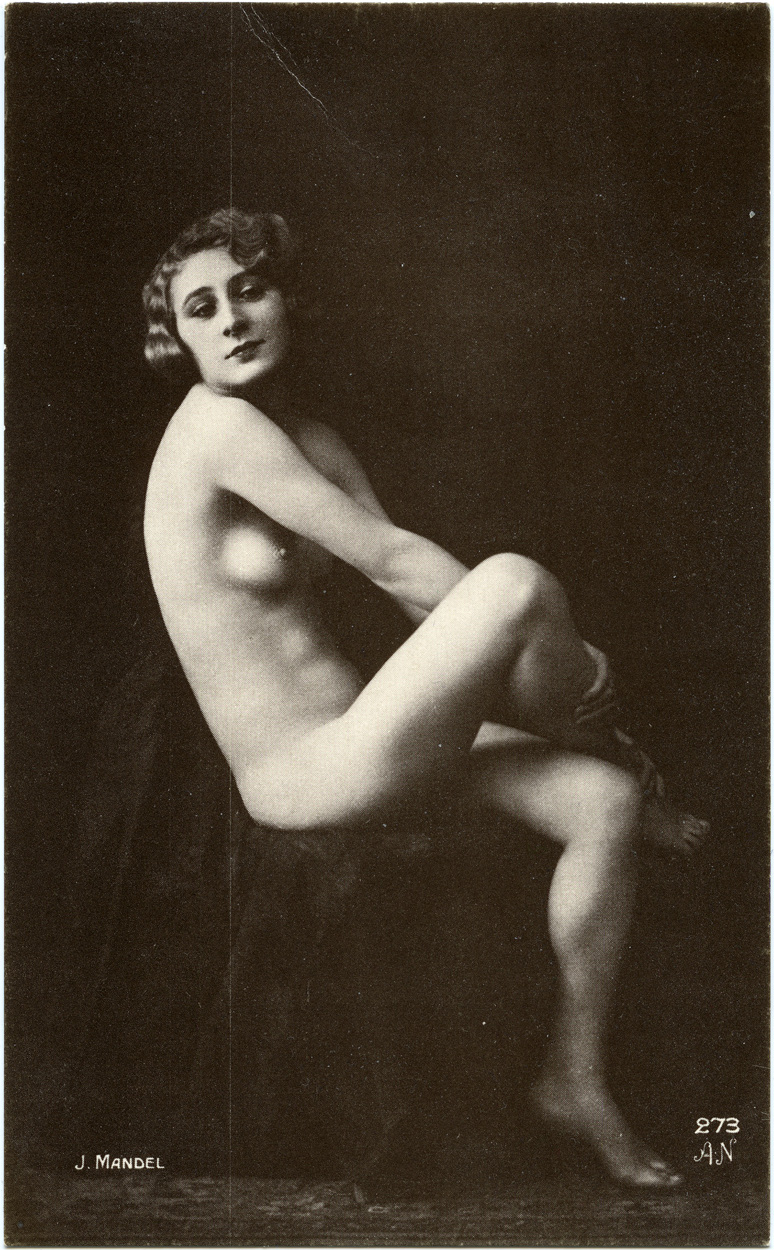
Here's a french postcard :
You can tell it is a French postcard because it stays "Carte Postale" on it which is French for "post card".
(for anyone searching for "french postcard" wanting to see erotic naked photographs of women then here is the front of the card).
labeled "J. Mandel 273 A-N"
(as a reminder of the inevitable human mortality I'll point out the model is probably dead. If she isn't then by now she is, to be kind, vintage – to be unkind she is ancient, decrepit, creased, wrinkled, robbed of many of her charms by age and gravity and probably looks like a she was made of wax and kept too close to a flame with her bounce and jiggle replaced with a sagging waddle.)
You can tell it is a French postcard because it stays "Carte Postale" on it which is French for "post card".
(for anyone searching for "french postcard" wanting to see erotic naked photographs of women then here is the front of the card).
labeled "J. Mandel 273 A-N"
(as a reminder of the inevitable human mortality I'll point out the model is probably dead. If she isn't then by now she is, to be kind, vintage – to be unkind she is ancient, decrepit, creased, wrinkled, robbed of many of her charms by age and gravity and probably looks like a she was made of wax and kept too close to a flame with her bounce and jiggle replaced with a sagging waddle.)
Saturday, July 21, 2012
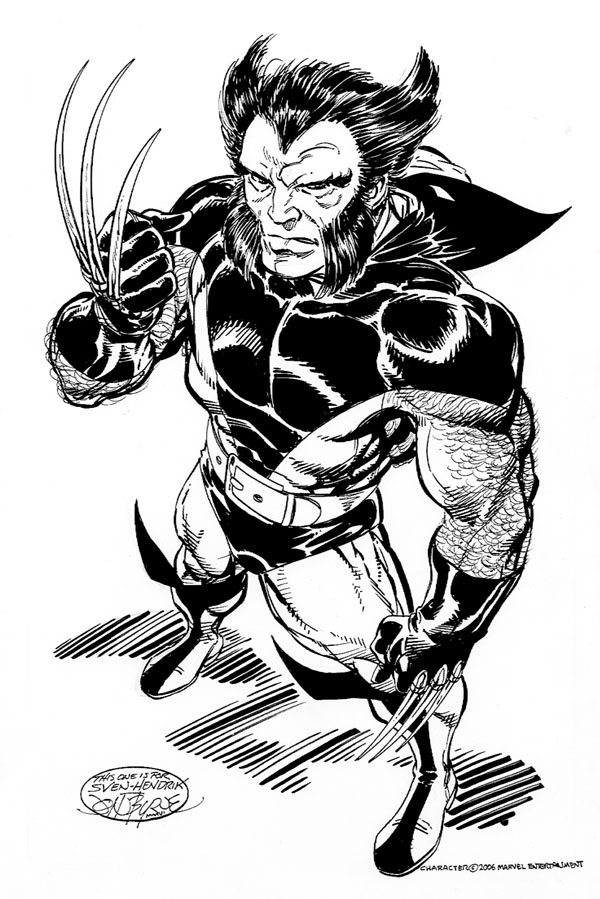
The Ibsen Look
Notice the similarity in extravagant facial hair?
X-Men's Wolverine as drawn by John Byrne c.2006
playwright Henrik Ibsen c.1870
From now on I'll refer to this as the "Ibsen Look"
Labels:
comics,
photo,
public service announcement
Sunday, May 8, 2011
Sunday, March 27, 2011
cartoonily accurate
still from the MGM Tex Avery cartoon One Cab's Family
it isn't cartoony exaggeration. It is an observation.
Photograph by Jacques Henri Lartigue of a car in motion. The camera shutter moved from bottom to top so as the shutter moved the car moved forward and a different part of the car was exposed.
Saturday, March 12, 2011
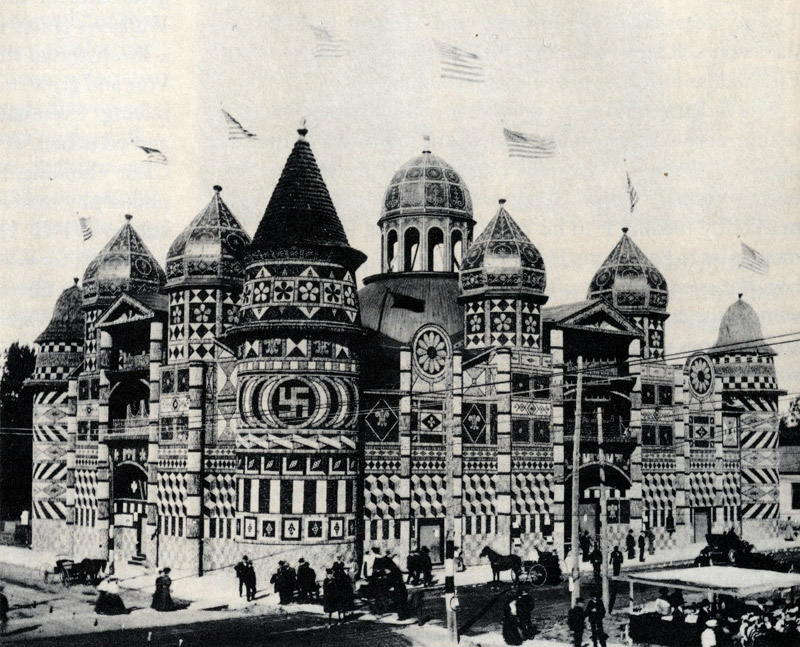
A Nazi Corn Palace?
click to embiggen
The Corn Palace of Mitchell, South Dakota in 1905 with a swastika on the front. A Nazi Corn Palace? It does have a swastika on the front but the photo is from 1905. So it is a non-nazi swastika.
The Corn Palace is a building decorated with ears of corn all over the exterior. "WTF" you say? I was there once as a kid and that was my thoughts exactly.
Friday, October 29, 2010
It is so big...
It seems like all nature shows that deal with any sort of geography at some point say "blah blah blah it is so big that it can be seen from space." Of course it can be seen from space. Basically everything can be seen from space unless it is underground.
Friday, August 27, 2010
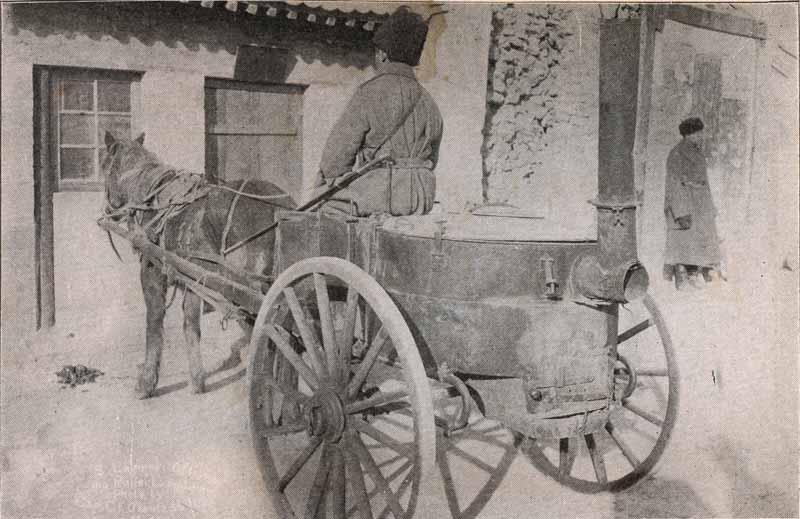
Russian Rocket Powered Horse
click to embiggen
The rocket powered horse was developed by Paco Industries for the Russian Imperial Army circa 1904. The exhaust force from the vertical nozzle pushed the rear of the cart down and raised the horse off the ground to prevent injury at high speeds. Steering was accomplished through a handle next to the driver controlling a differential mechanism affecting the comparative speed of the wheels. Pulling back turned left and pushing the lever forward turned right. The rear exhaust nozzle's thrust enabled unprecedented speeds which any army could appreciate.
The main problem with the Rocket Horse was inattentive conscripts being told to pour the volatile rocket fuel into the opening at the rear. This lack of clarity did not lead to good results for either the horse nor the conscript. Other minor problems included its tendency to flip, its poor steering capabilities, its lack of passenger or driver restraints and its occasionally becoming unintentional airborne.
or
A Russian Soup Wagon
The Czar takes good care of his soldiers. A notable feature of the equipment of the Russians in the traveling field kitchen, consisting of a boiler mounted in a special wagon, so arranged that it keeps the army soup hot while being served.
Thursday, November 5, 2009
because even babies like choice
Enfamil baby food/formula has "Two nipple options" to make it as similar to the real thing as possible. Because even babies like choice.
Monday, November 2, 2009
Sunday, March 15, 2009
Still Stripping After 25 Years
I admit I was a little concerned when I saw that my mom owns a book called "Still Stripping After 25 Years." My first thought was that a stripper who has been doing it for 25 years, although experienced, might be past her prime stripping years. Then I noted it was written by Eleanor Burns and I thought "Eleanor" is not a very sexy stripper name.
Apparently, stripping another meaning I'm not aware of.
Thursday, September 25, 2008
Wednesday, July 9, 2008
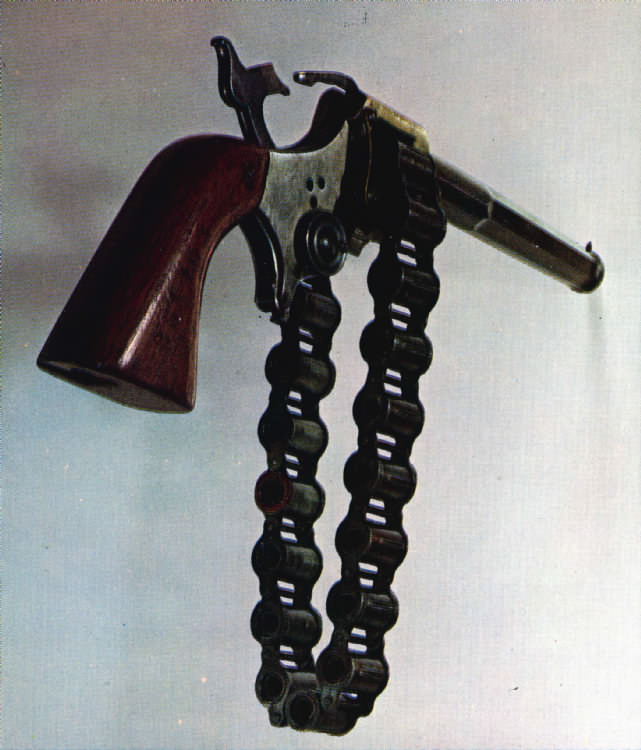
A cowboy's dream
scanned from an old Am Heritage.
A 20 shot revolver. I found Henry Josselyn's patent online issued Jan 1866.
Surprisingly, the patent doesn't mention that, once you ran out of ammo, you could swing it at someone like a chain.
There might be some issues fitting it in a holster.
It turns out not to be the only high capacity revolver. See here and here.
Subscribe to:
Posts (Atom)