Showing posts with label guns. Show all posts

Sunday, October 25, 2015

TV cop incompentence

Clip from Criminal Minds season 10 episode 18 "Rock Creek Park" :

(What's going on : The wife of an increasingly prominent Congressman is kidnapped and so the FBI team tries to figure out who would take her.)

(transcript of the episode clip)
FBI Agent Aaron Hotchner : Is there anyone who would want to hurt her?
Congressman Troy : No, no-no.  Sophie's a wonderful, sweet woman.  I, on the other hand, I'm not very well-liked in this town.
FBI Agent Aaron Hotchner : and who are your enemies?
Congressman Troy : Well, where do we begin? We have the oil lobbies.  Uh, we have the NRA and PETA. You have an equal opportunity offender.

(later)

FBI Agent Derek Morgan : So the gun lobbyists were dismissive of the congressman saying they don't waste their time with one-termers like Troy. But anyway, even if they were involved I highly doubt they would outsource the job to the Russian mob.
FBI Agent Aaron Hotchner : What about the oil companies
FBI Agent Kate Callahan : Pretty slimey, pun intended. But none of our sources say they were involved.
FBI Agent Derek Morgan : Well, considering how much oil comes out of Russia, they are the most likely candidates to have ties to the mob.
(later it is suggested that the Congressman supported fracking ban would drive Russian oil prices up so the oil companies aren't suspect.)


I've mentioned TV law enforcement incompetence before.

1) The congressman describes himself as "not very well-liked" and an "equal opportunity offender" but they only investigate groups he specifically named.
2) they forgot to look into PETA even though he mentioned them! They didn't even a "pretty slimey" or "pretty stinky", as the case may be,  comment.
3) With the NRA they don't ask "sources" they just asked one of their lobbyists if they did it.  On the bright side, the writers consider NRA lobbyists to be upright and honest citizens who the FBI can take at their word without needing to offer one whit of evidence. On the other hand, the writers really think that a NRA lobbyist would imply that kidnapping the wife of a 2 or more term congressman wouldn't be wasting their time.
4) There is the suggestion that, sure, the NRA might kidnap the wife of a longer serving politician but that they wouldn't outsource the work to the Russian mob. It's unclear if the writers feel the NRA would do it themselves with Wayne LaPierre in a ninja suit or if they would just employ Americans to do it.

-----------------

Bonus :
(transcript of the clip)
Penelope Garcia : I found the smoking gun or at least the stuff that goes in to the gun to make it smoke. Credit card receipts from the congressman show he purchased ammo for a handgun and then more smoke he sent that ammo to a PO Box registered in his name in Virginia.
FBI Agent Kate Callahan : And why would he do that?
FBI Agent Aaron Hotchner : Did you have your wife kidnapped?
Congressman Troy : What? No! What? Why are you saying this?
FBI Agent Jennifer Jareau : You purchased ammunition for a handgun last month and you had shipped to a mailbox in Virginia, which means you likely own a handgun although there isn't one registered to your name
Congressman Troy : Yes, I have a handgun.
FBI Agent Jennifer Jareau : That you bought illegally?
Congressman Troy : Uh, well I had to after having been so staunchly pro gun control.

Sunday, May 17, 2015

The War on Metaphor


A tweet from Richard Horton (‏@richardhorton1) who is the editor in chief of the UK medical journal the Lancet and totalitarian crankypants :
The NRA's use of the "war" metaphor is an illegal incitement to violence and should be prosecuted. bbc.co.uk/news/world-us…
 [link to a BBC story about an NRA official saying "This is not a battle about gun rights,'' Mr Porter told attendees on Friday, saying it was "a culture war".]

Classic war on metaphor… Oops, did I say war? He is campaigning against … oops a campaign is a war metaphor too. He's targeting …ah, no.  He's going to the barricades to … nevermind. 

He even recognizes and identifies it as a metaphor! Unlike some people who don't understand (or pretend not to understand) that a metaphor is not literal, he identifies that a figure of speech is being used but unfortunately that makes him sound like even more of a book burning totalitarian.

First metaphors are jailable, then similes, then allegories, then onomatopoeia and then, well, he'll just make up a reason after you're in jail.

Speaking of war, guess who wrote a book called Health Wars? The very same Richard Horton.


Wednesday, October 8, 2014

Mr. Jordan's Pants

Below is an excerpt from an old comment thread from Blair News which contains is a fine example of impenetrableness. Despite being repeatedly fact checked and counter arguments put forward Mr Jordan seems to emotionally know that he is right in some broad sense despite his problems with those little facts from the real world getting in the way.

Note how he starts by saying that the US Government is barred from collecting trace data and once that is pointed out as simply untrue he soon declares that they can't use computers while collecting trace data (the trace data he had earlier claimed was forbidden). He never acknowledged the link to either the ATF's state by state trace data or the ATF's computerized trace database (since he thinks the ATF can't use computers then he must imagine the servers are run by squirrels fulfilling http packet requests).

Is he really impenetrable or is he just throwing things at the wall in the hope that something will stick?

Mr Jordan's beclowning is below the fold.

Monday, March 10, 2014

explosion


Explosion of the Spanish flagship during the Battle of Gibraltar, 25 April 1607 by Cornelis Claesz van Wieringen, c1621


The explosion isn't in Industrial Light and Magic style but it is interesting that the flames are in Spanish red and yellow. Note the sails of each ship are blown to the left while the Spanish ship's sails are all blown away from the center of the explosion

detail #1 (from near the top of the painting)
a brush for cleaning a cannon bore and 2.5 people


detail #2
a drum, 2 men and, likely, the other half of the guy seen in detail #1 (that must be one tight fitting hat). The guy at the bottom left appears to wear a bandolier of cartridges for his rifle or arquebus


Saturday, January 18, 2014

Harvey Weinstein is PRO-gun he just hasn't realized it yet


Harvey Weinstein is PRO-gun he just hasn't realized it yet (audio)

Harvey Weinstein : [referencing the Warsaw Ghetto Uprising] This has been a project I've searched for ever since my aunt gave me the book when I was a boy. It's an important story to tell. 
Howard Stern : …holocaust story 
Harvey Weinstein : It's not a holocaust story as much as it's jews with guns. It's my whole philosophy, or anybody, it's the idea that when injustice is that great then you can't just march into the camps. This is the story that's the opposite. 
Howard Stern : Do you own a gun? 
Harvey Weinstein : No 
Howard Stern : You don't have any guns? 
Harvey Weinstein : I don't ever wanna have a gun 
Howard Stern : Well, why, if that story resonates with you, why not own a gun? 
Harvey Weinstein : No, this is, this is when you're marching a half a million people into Auschwitz. Howard Stern : Right 
Harvey Weinstein : I mean , whatever, I'd find a gun if that was happening to my people. I don't think we need guns in this country. … 


 And he'll get a fire extinguisher after the house is nearly burnt down. I don't think he's really given gun control much thought or he'd have realized that if those in the Warsaw Ghetto could have found 50,000+ guns to arm themselves then they probably would have. He needs to ask why they couldn't.


Update
confronted with the fact that he has produced a number of violent films, Harvey responds
"They have a point. You have to look in the mirror, too. I have to choose movies that aren’t violent or as violent as they used to be. I know for me personally, you know, I can’t continue to do that. The change starts here. It has already. For me, I can’t do it. I can’t make one movie and say this is what I want for my kids and then just go out and be a hypocrite."
Will his new Warsaw Ghetto Uprising movie eschew violence and have jews try to overcome Nazi genocide through coexist bumperstickers?

Monday, December 16, 2013

Phillip Adams : totalitarian crankypants


Phillip Adams is an old Australian lefty with a newspaper column, a radio show, and apparently a bit of a totalitarian streak.

The target of the US war on terror should be those NRMA nutters-who outgun and outmaneuver every challenger from POTUS down.And always have

NRMA is a typo for the NRA (National Rifle Association). (Or it isn't a typo and Adams has strong feelings about the National Roads and Motorists Association)

So, Phillip wants the US government to arrest and/or bomb people for engaging in free speech, questioning ideas, and peaceably petitioning the government. Who knew that merely advocating for one's explicit Constitutional rights would get you demonized as a terrorist. 

Notice it isn't the people actually committing the murders that he wants to targeted but the NRA.  Keep quiet about my support for the Third Amendment or he might call for my hands to be cut off.

Presumably, if the NRA were less successful then Phillip might tolerate their free speech and might not want them dead. Maybe. 

I'm sure all of those who fret over civility and campaign against eliminationist rhetoric will be up in arms and demand that he be denounced. Phillip Adams will be outraged when he hears what he's been saying. Here's Phillip Adams from Sept 10, 2011 : 


It was widely accepted that her [Gabrielle Giffords] attempted assassination was triggered, no pun intended, by the verbal violence of US politics – such as the “lock ’n’ load” rhetoric of gun-totin’ Sarah Palin, whose campaign literature literally targeted political opponents, depicting them in the crosshairs of telescopic sights. 


While sticks and stones break bones, words can never hurt? Manifestly untrue. Politics everywhere are holistic, interconnected, and the rhetoric of right or left can produce toxic atmospheres in which lunacy thrives.


It’s not enough for Abbott to tell us he “doesn’t entirely agree” with vile placards being waved at right-wing rallies. He must denounce them.


Today, words. Tomorrow, sticks and stones. And the day after that?


By the way, "It was widely accepted that her [Gabrielle Giffords] attempted assassination was triggered, no pun intended, by the verbal violence of US politics" was written a full 8 months after the shooting – that is, long after everyone but Phillip Adams realized Jared Loughner was motivated by being coo coo for cocoa puffs.

Update :  Here is some inflammatory demagoguery I've heard more than once.

To arms, citizens,
Form your battalions,
Let's march, let's march!
That impure blood
May water our furrows!
...
Tremble, tyrants and you traitors
The shame of all parties,
Tremble! Your parricidal schemes
Will finally receive their reward! 

Not only does it call for violence it also refers to the "enemy" tyrants and traitors as having "impure blood" which is a creepy bit of racial demogoguery. We can only hope Phillip Adams will do something about it before it kills us all.


Update II : On reflection, if Adams considers the NRA to be terrorists then perhaps his opinion about terrorists should be explored. 

In a column in the Australian July 12, 2005 titled "Britain had this coming" Adams explains :
And let's be clear about it: the people who died in the subway tunnels and on the bus were victims of the Iraq war. They died because of Blair's London Bridge, the one he built from the Thames to the Euphrates
.…
We say that what's happening in Baghdad and now London is inevitable, that the invasion has not liberated democratic forces but detonated more hatred, much of it directed against US hegemony and hubris.
Adams appears to think that terrorists lack an agency of their own and only react to outside stimulus.  I think this means Phillip wants to examine the NRA's root causes and conscientiously avoid doing anything that might provoke the NRA or its members into engaging in more of that free speech he finds so odious.


Update III : Phillip's twitter tirade includes "National Ratbags. National Racists. …The charnel house of Charlton Heston … those NRMA(sic) nutters" with all this incivility and "verbal violence" it raises the question : it seems Phillip is trying to provoke someone into murder, does he have a victim in mind? (assuming he believes his own writings)

Sunday, May 12, 2013

Rembrandt's Night Watch

Sections


Rembrandt's Night Watch, 1642 of the Rijksmuseum
click to embiggen

The Title
While the painting is known as Night Watch (Nachtwacht in Dutch) that is not the actual title. Thick layers of yellowing varnish, dirt the chiaroscuro led some to think is was a night scene. How much varnish? In 1911 an unemployed ship's cook slashed the painting with a cobbler's knife but he failed to penetrate past the thick layers of varnish and so his attack didn't affect the paint or the canvas (the plan, assuming it wasn't an expression of unthinking, impotent rage, was to get offered a job as painting slasher).
  • it was painted 1642 with no record of an official title
  • in 1653 it was simply described as painting in the great hall of Cloviersdoelen
  • in 1678 a Rembrandt pupil named Samuel van Hoogstraten referred to it as a "piece in the Doelen (militia guild)" 
  • in 1758 Jan van Dijk referred to it as "a company of militiamen starting on a march"
  • in 1797 an engraving by Lambert Antoine Claessens after Rembrandt's painting was titled "Armed Amsterdam Citizens"
  • in 1808 a letter to C.S. Roos of the Rijksmuseum it was referred to as "a painting by Rembrandt, being the Night Watch"
  • also in 1808 the receipt from the royal palace when the painting was received reads "a big painting showing a patrol of the Civic Guard, known as the Night Watch by Rembrandt"
  • in 1809 a catalogue of the Rijksmuseum described the painting (item #250) as "this piece is known all over Europe by the name of the Night Watch" but the catalogue author added "but which it is felt must really portray Captain F. B. Kok, Knight, lord of the manor of Purmerland and Ilpendam, with his subordinate officers and soldiers, marching out to practise target shooting"
  • In the book Het Rijksmuseum (1844) by E. J. Potgieter wrote "Rembrandt's Bird shooters… for Night Watch does not sound right here."
  •  In the book Guide to the National Museum at Amsterdam (1890) it is described as "Corporalship of Captn. Frans Banning Cocq and Lieut. Willem Van Ruytenburg van Vlaerdingen, Lord of Vlaerdingen"
  • in 1906 (?) Dr. F. Schmidt-Degener called it "March of the Soldiers of the Civic Guard"
  • in 1946 newspaper reporters were invited to view the painting during a restoration where dirt and varnish were removed and they described the now brighter painting as Day Watch.
  • the Rijksmuseum currently lists it as "Officieren en andere schutters van wijk II in Amsterdam onder leiding van kapitein Frans Banninck Cocq en luitenant Willem van Ruytenburch, bekend als de ‘Nachtwacht’" (Officers and other gunmen of district II in Amsterdam under the direction of Captain Frans Banninck Cocq and Lieutenant Willem van Ruytenburch, known as the "Night Watch"


The Genre
The group portraits of militia officers and men were often referred to as "corporalships." The specific ranks involved (Night Watch includes a Captain, Lieutenant, sergeants, etc) does not change that the genre is called corporalships. 

Below are a few examples of the corporalship genre listed in a rough chronological order. The progression from simple to more complex scenes can be seen.  Some are basically group portraits and are not obviously militia related. Some are static portraits while some show action. Some common elements, but not necessarily universal elements :  flags, uniforms, weapons, food. I think one can see the progression 
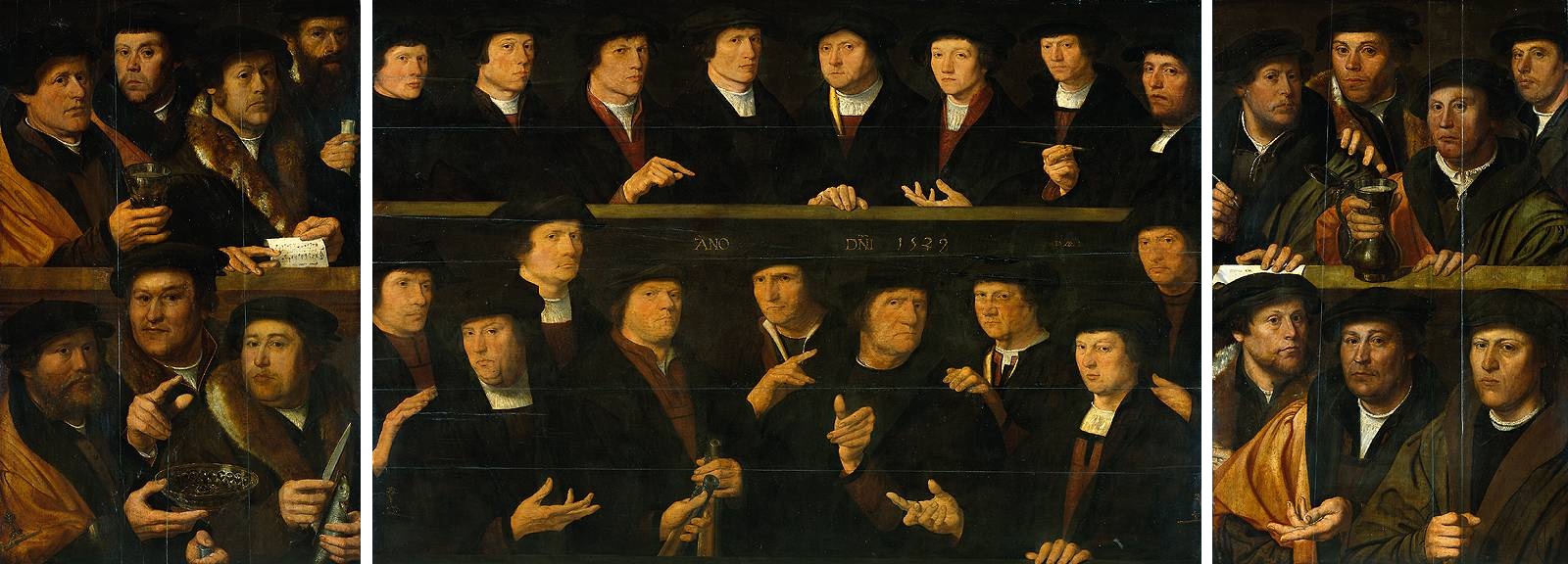
1
Militia painting in three parts by Dirck Jacobsz, 1529. commissioned by Kloveniersdoelen, Singel, Amsterdam
oil on oak panel, h 122cm × w 240cm.
link
2
Banquet of Members of Amsterdam's Crossbow Civic Guard by Cornelis Anthonisz, 1533
oil on panel, h 130cm × w 206.5cm.
link
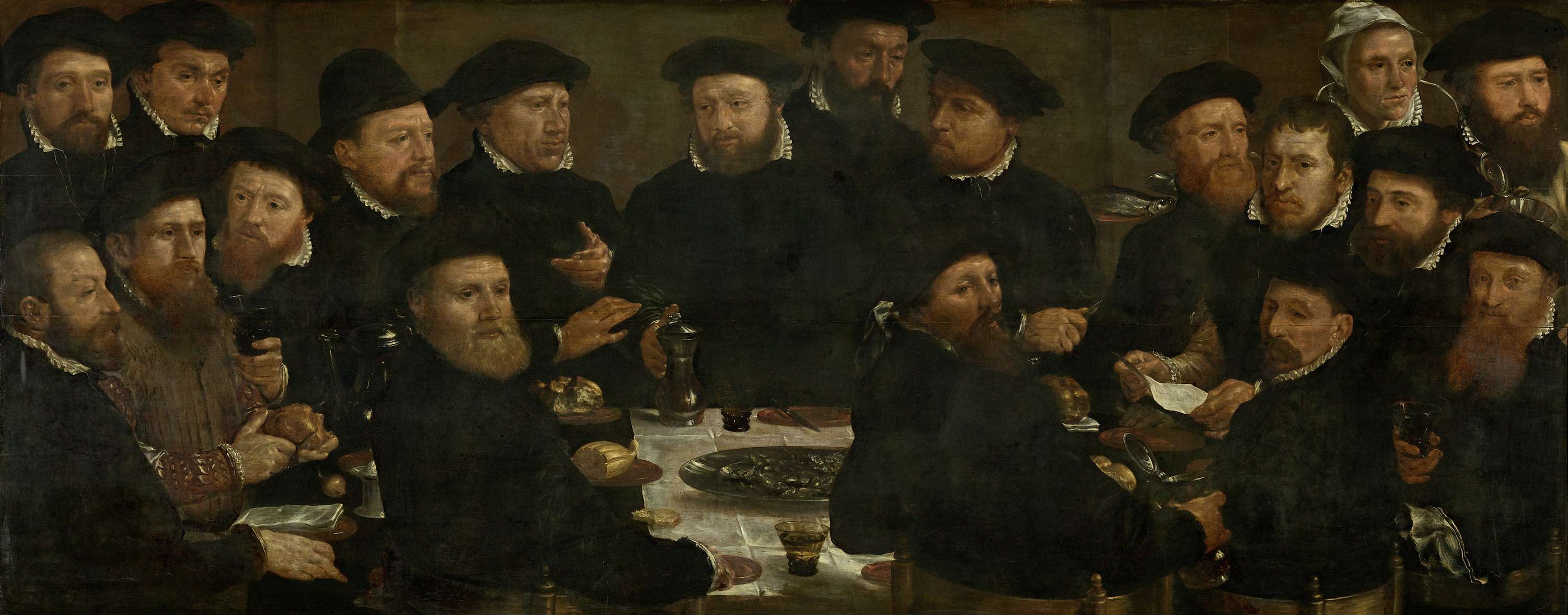
3
Maaltijd van achttien Amsterdamse schutters van Rot L, 1566, bekend als 'De poseters' (Meal of eighteen of Amsterdam archers Rot L) by Dirck Barendsz., 1566
oil on panel, h 120cm × w 295cm.
link
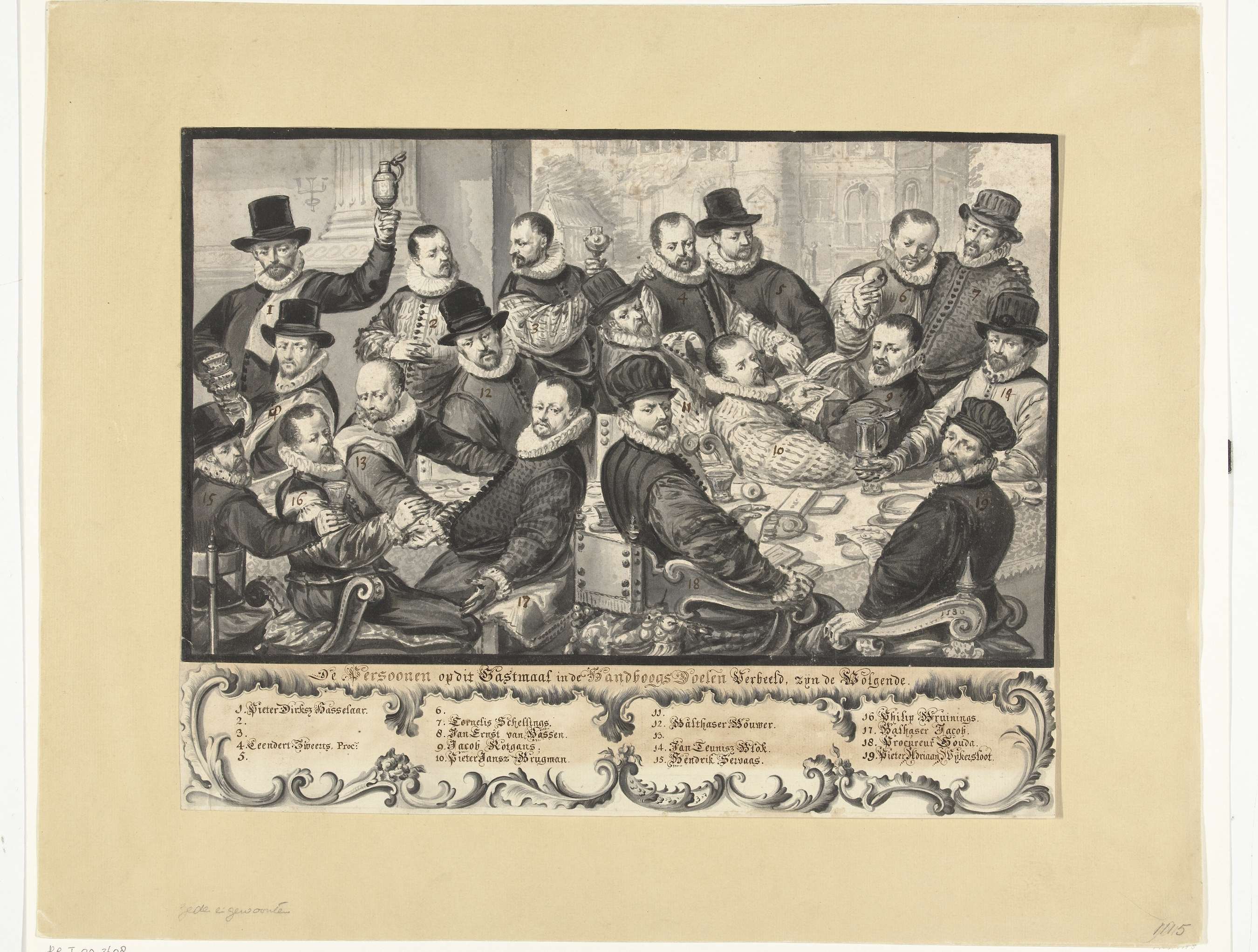
4
Maaltijd van officieren van de Handboogdoelen te Amsterdam (Meal of officers of the Longbow Archers in Amsterdam), 1586, anoniem, 1800 - 1899
in brown pen and brush in gray, white heightened here and there h 295mm × w 375mm
link
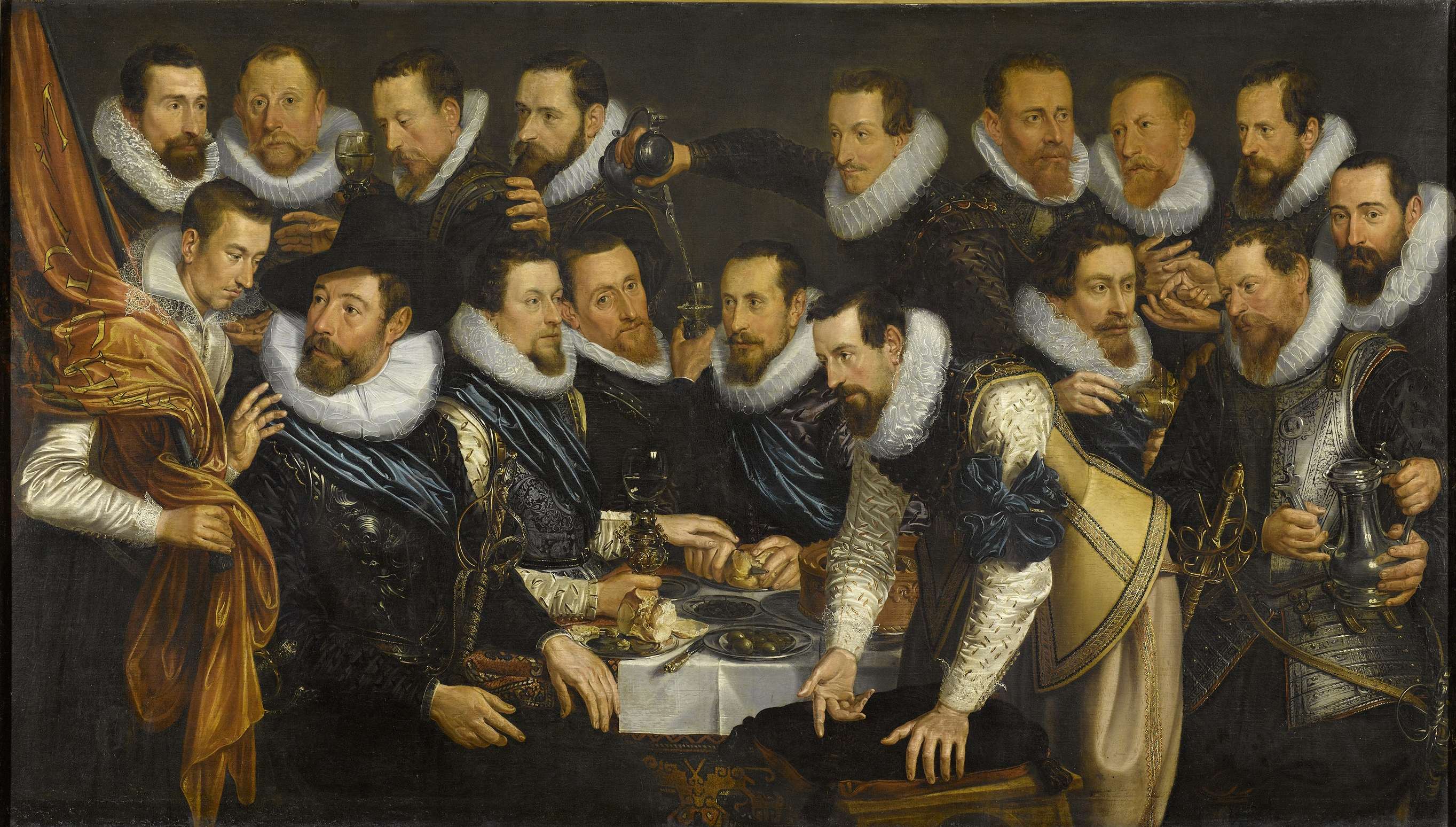
5
Het korporaalschap van kapitein Dirck Jacobsz Rosecrans en luitenant Pauw (Company of Captain Dirck Jacobsz. Rosecrans and Lieutenant Pauw, Amsterdam) by Cornelius Ketel, 1588
oil on canvas, h 208cm × w 410cm
link
6
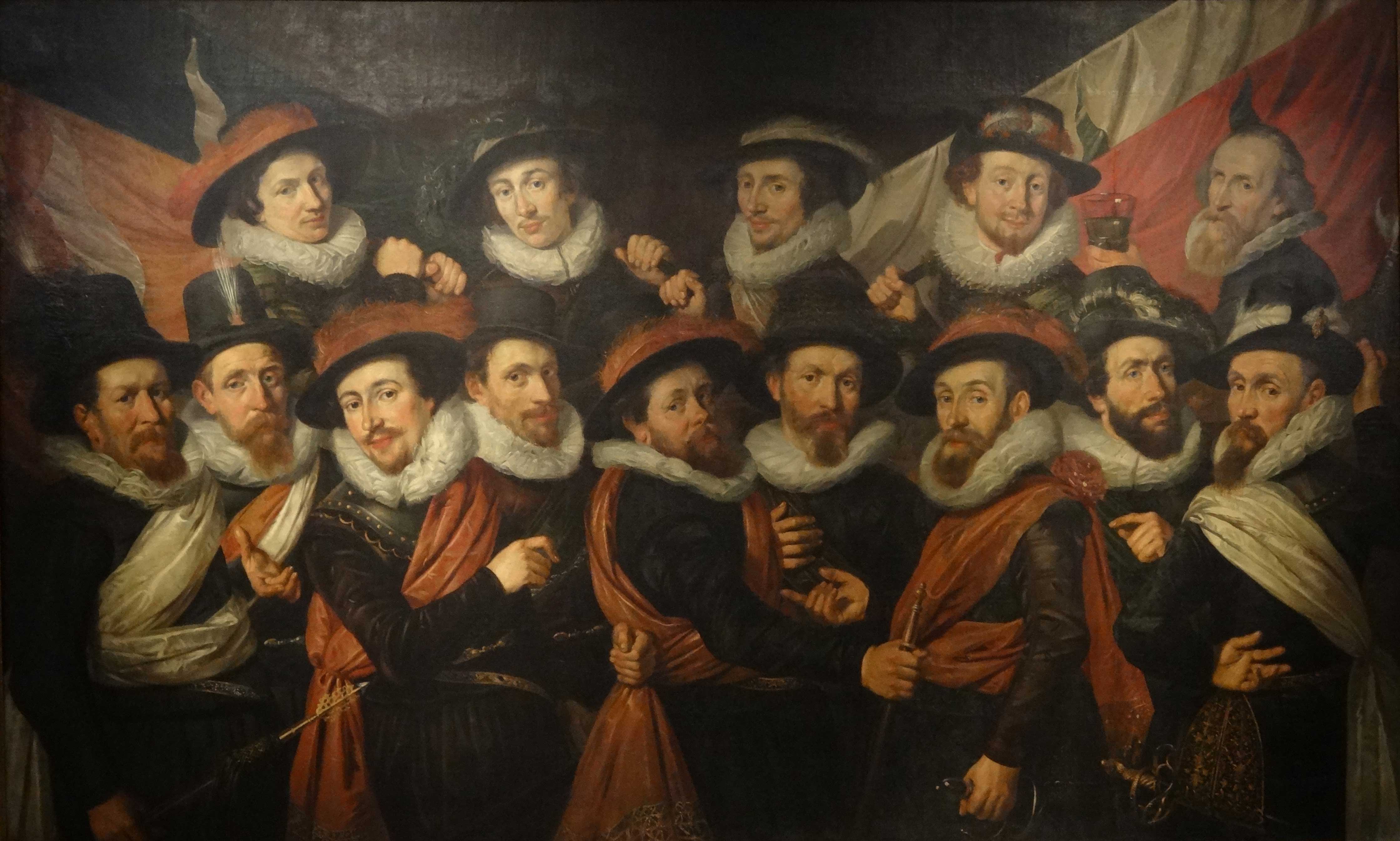
Schutters van de Haarlemse schutterij (Platoon of the Cluveniers Civic Guard, Haarlem) (Shooters Haarlem militia (Platoon of the Cluveniers Civic Guard, Haarlem)) by unknown, 1594
oil on canvas h 208cm x w 410cm
link
7
Banquet of the Officers of the Company of St. George by Cornelis van Haarlem, 1599
oil on canvas, h 169cm × w 223cm.
link
8
Officieren en vaandeldragers van de Jonge Schutterij, voor de Nieuwe of Sint Sebastiaansdoelen, Alkmaar (Officers and standard-bearers of the Young Shooting, for the new Saint Sebastian Doelen, Alkmaar) by Frans Menton, 1611
size unknown
link
9
Officieren en andere schutters van wijk XI in Amsterdam, onder leiding van kapitein Geurt Dircksz van Beuningen en luitenant Pieter Martensz Hoeffijser (Officers and other shooters XI district in Amsterdam, led by Captain Dircksz Geurt van Beuningen and Lieutenant Peter Martensz Hoeffijser) by Jan Tengnagel, 1613
oil on canvas, h 155cm × w 264cm
link
10
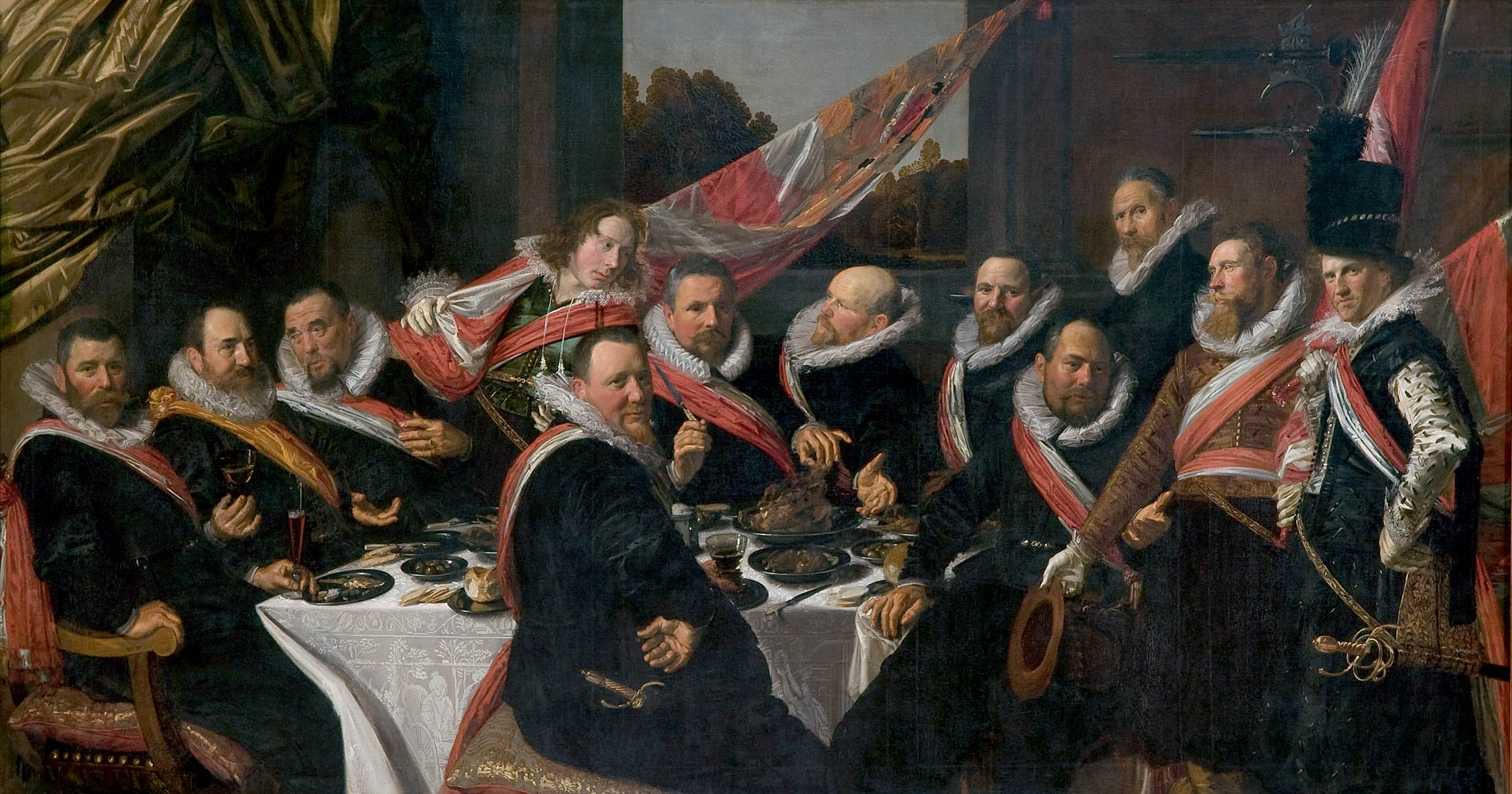
Banket van de officieren van de Sint-Joris-Doelen (Banquet of the Officers of the St George-Doelen) by Frans Hals, 1616
oil on canvas, h 175cm x w 324cm
link
11
Officieren en andere schutters van wijk III in Amsterdam onder leiding van kaptitein Jacob Gerritsz Hoyngh en luitenant Nanningh Florisz Cloeck (Officers and other shooters of district III in Amsterdam led by Captain Jacob Gerritsz Hoyngh and Lieutenant Nanningh Florisz Cloeck) by Paulus Moreelse, 1616
oil on canvas, h 169cm × w 333cm
link
12
Officieren van de schutterij o.l.v. kolonel Gijsbert Hendricksz. 't Hart (Officers of the militia led by Colonel Gijsbert Hendricksz. 't Hart) by Jan Daemesz de Veth, 1616
size unknown
link
13
Maaltijd van officieren van de St. Jorisdoelen (Meal of officers of the St. George Doelen) by Frans Pietersz de Grebber, 1618
oil on canvas, h 169cm × w 200cm
link
14
Officieren van de schutterij o.l.v. kolonel Gijsbert 't Hert (Officers of the militia led by Colonel Gijsbert 't Hart) by Jan Daemesz de Veth, 1619
size unknown
link
15
Officieren en vaandeldragers van de Oude Schutterij, voor de Oude of St. Jorisdoelen, Alkmaar (Officers and standard-bearers of the Old Militia, the Ancient of St. George Doelen, Alkmaar) by Zacharias Paulusz, 1621
size unknown
link
16
Officieren van de schutterij o.l.v. kolonel kolonel Andries Swaenswijck (Officers of the militia led by Colonel Colonel Andrew Swaeneven Wyck) by Jan Daemesz de Veth, 1622
size unknown
link
17
Schutters van het vendel van kapitein Abraham Boom en luitenant Oetgens van Waveren (Shooters of the vendel Captain Abraham Boom and Lieutenant Oetgens of Wavre) by Nicolaes Lastman and Adriaen van Nieuwlandt, 1623
size unknown
link
18
Banquet of the officers of the St George Civic Guard of Haarlem by Frans Hals, 1627
oil on canvas, h 179cm × w 257.5cm
link
19
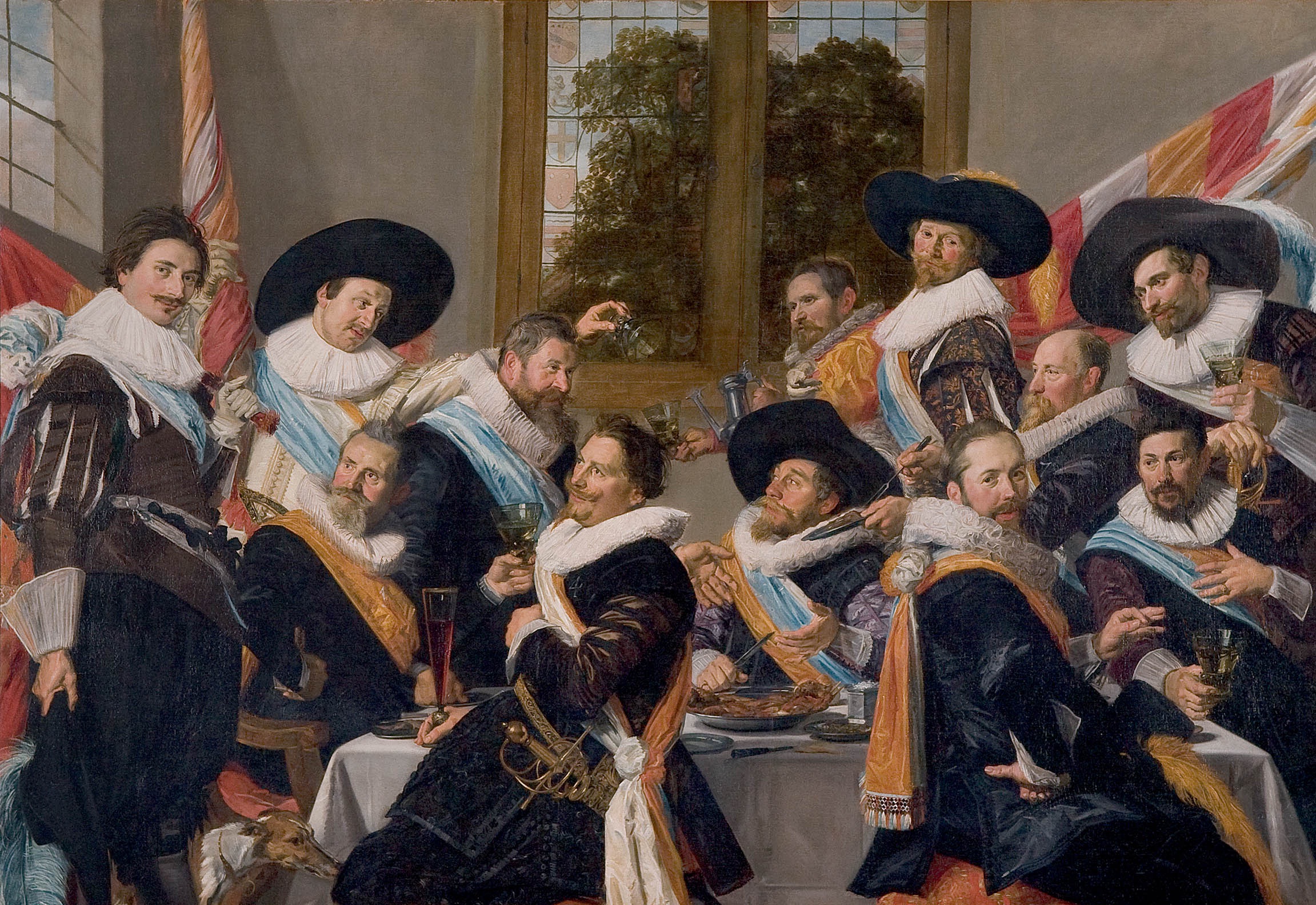
Banquet of the Officers of the St Hadrian Civic Guard Company by Frans Hals, c1627
oil on canvas, h 179cm × w 257.5cm
link
20
Officieren van de Haarlemse Kloveniersdoelen (Officers of the Haarlem Doelen) by Hendrik Gerritsz Pot, 1630
oil on canvas, h 214cm × w 276cm
link
21
Officieren en andere schutters van wijk III in Amsterdam onder leiding van kapitein Allaert Cloeck en luitenant Lucas Jacobsz Rotgans (Officers and other shooters of district III in Amsterdam, led by Captain Allaert Cloeck and Lieutenant Lucas Jacobsz Rotgans) by Thomas de Keyser, 1632
oil on canvas, h 220cm × w 351cm
link
22
Schutters van de compagnie van kapitein Jacob Symonsz de Vries en luitenant Dirck de Graeff (Shooters of the company of Captain Jacob Symonsz de Vries and Lieutenant Dirck de Graeff) by Thomas de Keyser, 1633
size unknown
link
23
Officers and Sergeants of the St Hadrian Civic Guard by Frans Hals, 1633
oil on canvas, h 207cm x w 337cm
link
24
The city council of The Hague deliberating the rebuilding of the Sebastiaansdoelen in 1636 with the officers of the St. Sebastian militia, 1636
size unknown
link
25
Officieren en andere schutters van wijk XI in Amsterdam onder leiding van kapitein Reijnier Reael en luitenant Cornelis Michielsz Blaeuw, bekend als 'De magere compagnie' (Officers and other shooters of district 11 in Amsterdam, led by Captain Reijnier Reael and Lieutenant Cornelis Michielsz Blaeuw, known as 'The meagre company') by Frans Hals, 1637
oil on canvas, h 209cm x w 429cm
link
26
Officieren en andere schutters van wijk VIII in Amsterdam onder leiding van kapitein Roelof Bicker en luitenant Jan Michielsz Blaeuw (Officers and other shooters district 8 in Amsterdam, led by Captain Roelof Bicker and Lieutenant Jan Michielsz Blaeuw) by Bartholomeus van der Helst, 1639
oil on canvas, h 235cm × w 750cm
link
27
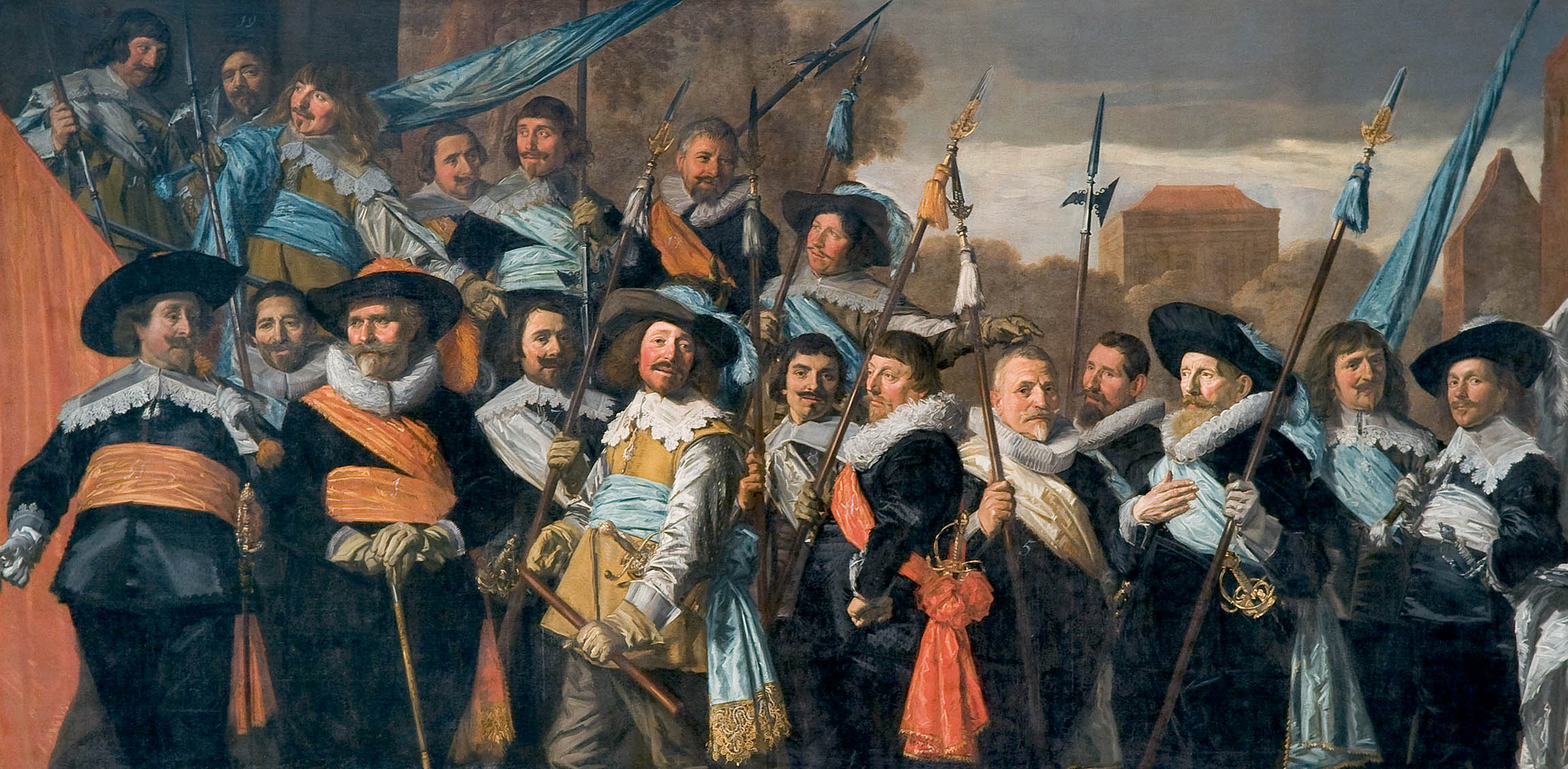
The officers and non-commissioned officers of the Saint George Civic guard in Haarlem by Frans Hals, 1639
oil on canvas, h 218cm × w 421cm
link
28 
Officieren en andere schutters van wijk XIX in Amsterdam onder leiding van kapitein Cornelis Bicker en luitenant Frederick van Banchem, gereed voor de ontvangst van Maria de’ Medici, koningin-weduwe van Frankrijk, in september 1638 (Officers and other shooters of district XIX in Amsterdam, led by Captain Cornelis Bicker and Lieutenant Frederick Banchem, ready to receive Marie de Medici, Queen Dowager of France, in September 1638) by Joachim von Sandrart, 1640
oil on canvas, h 343cm × w 258cm
link
29
Night Watch by Rembrandt, 1642
oil on canvas, h 379.5cm × w 453.5cm
link
30 
Officers of the Haarlem civic guard called the Cloveniers, or Musketeers, during the serving period 1639-1642 by Pieter Soutman, 1642
oil on canvas, h 203cm × w 344.5cm
link
31 
Officieren en andere schutters van wijk V in Amsterdam onder leiding van kaptein Cornelis de Graeff en luitenant Hendrick Lauwrensz (Officers and other shooters of district V in Amsterdam, led by captain Cornelis de Graeff and lieutenant Hendrick Lauwrensz) by Jacob Adriaensz. Backer, 1642
oil on canvas, h 367cm × w 511cm
link
32 
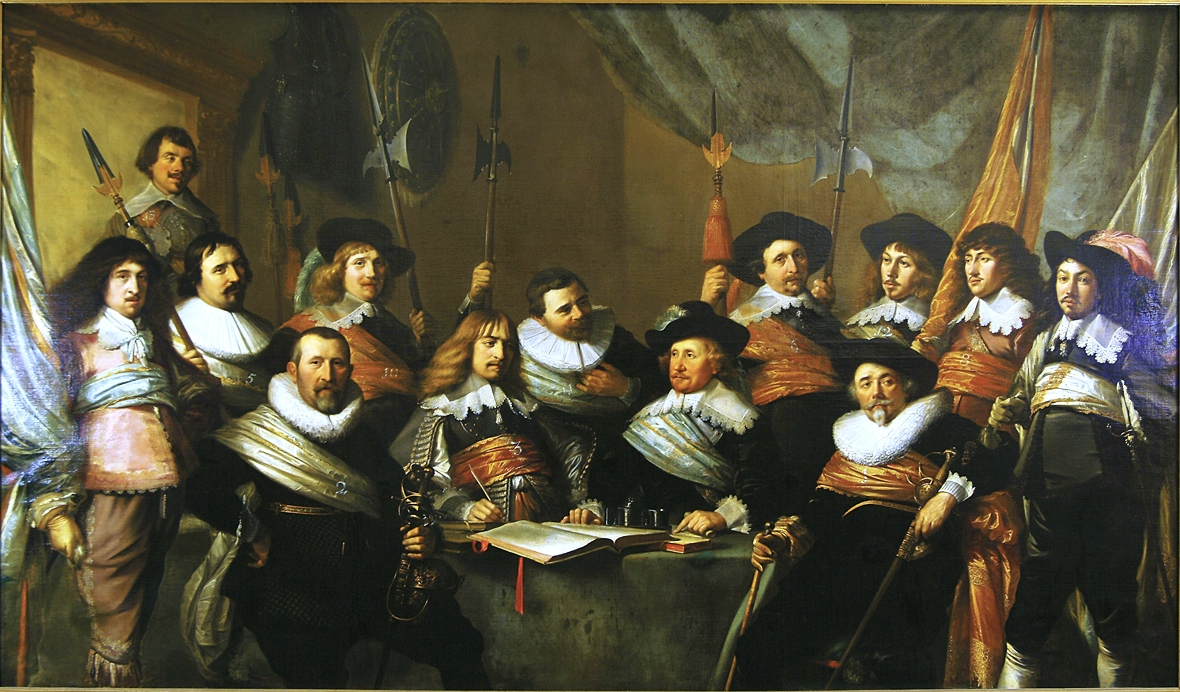
Four governors of the arquebusiers' civic guard, Amsterdam by Govert Flinck, 1642
oil on canvas, h 203cm × w 278cm.
link
33 
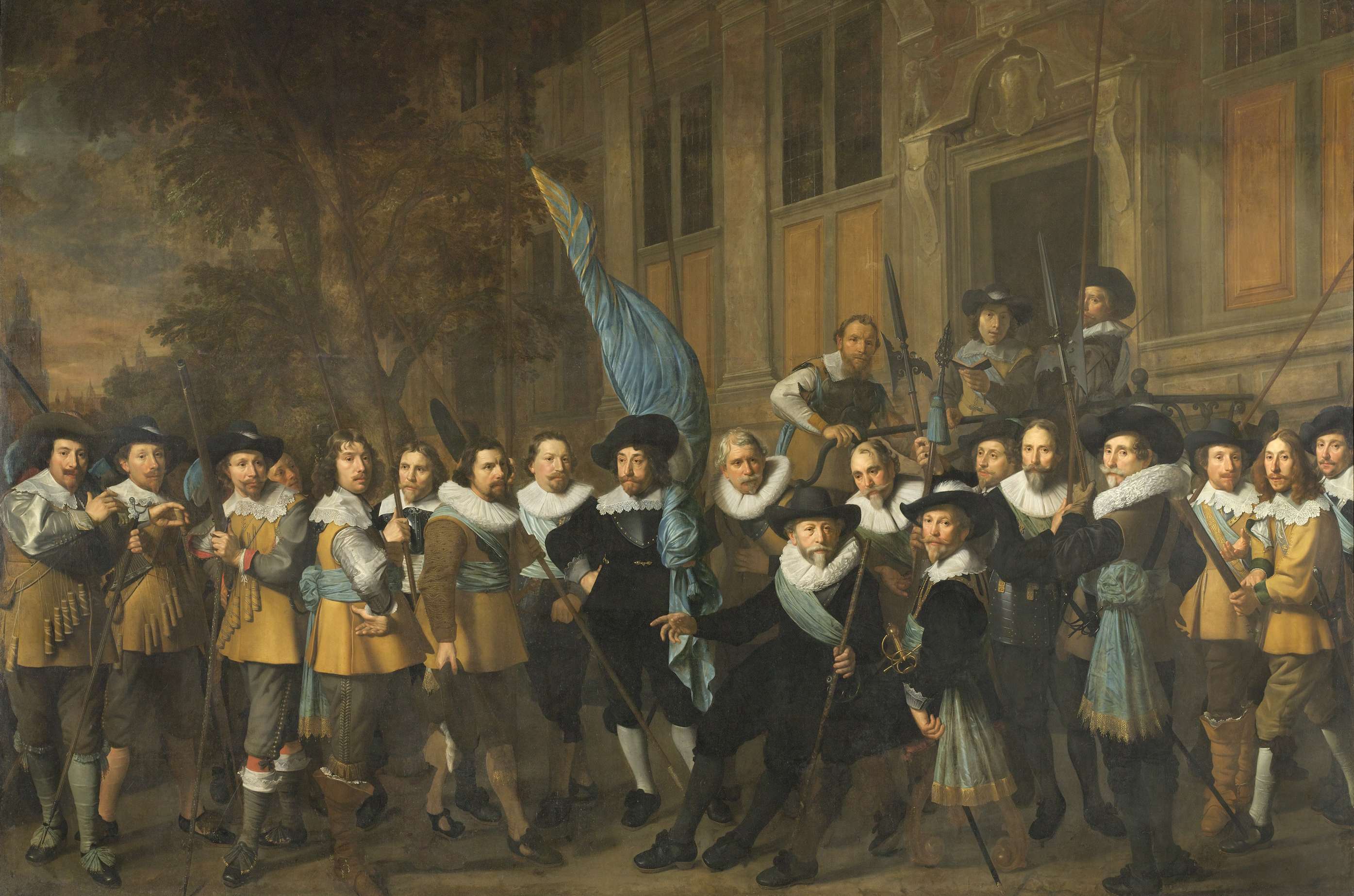
Officieren en andere schutters van wijk IV in Amsterdam onder leiding van kapitein Jan Claesz van Vlooswijck en luitenant Gerrit Hudde (Officers and other shooters IV district in Amsterdam, led by captain Jan Claesz of Vlooswijck and Lieutenant Gerrit Hudde) by Nicolaes Eliasz. Pickenoy, 1642
oil on canvas, h 340cm × w 527cm.
link
34 
Schuttersstuk, schutterij onder leiding van kolonel Herman Herbertsz (Archer Unit, militia led by Colonel Herman Herbertsz) by Wouter Pietersz Crabeth, 1644
size unknown
link
35 
Officieren en andere schutters van wijk XVIII in Amsterdam onder leiding van kapitein Albert Bas en luitenant Lucas Conijn (Officers and other shooters of district 18 in Amsterdam, led by Captain Albert Bas and Lieutenant Lucas Conijn) by Govert Flinck, 1645
oil on canvas, h 347cm × w 244cm.
link
36 
Schuttersmaaltijd ter viering van de Vrede van Munster (Militia Banquet to celebrate the Peace of Westphalia) by Bartholomeus van der Helst, 1648
oil on canvas, h 232cm × w 547cm
link
37 
Schutters van de compagnie van kapitein Joan Huydecoper en luitenant Frans van Waveren (Shooters of the company of Captain Joan Huydecoper and Lieutenant French of Wavren)  by Govert Flinck, 1648
oil on canvas, h 265cm × w 513cm
link
38 
De bestuursleden van de schutterscompagnie van St-Sebastiaan te Amsterdam (The committee members of the Shooter Company of St Sebastian in Amsterdam) by Bartholomeus van der Helst, 1653
oil on canvas mounted on panel, h 49.1cm x w 68.1cm
link
39 
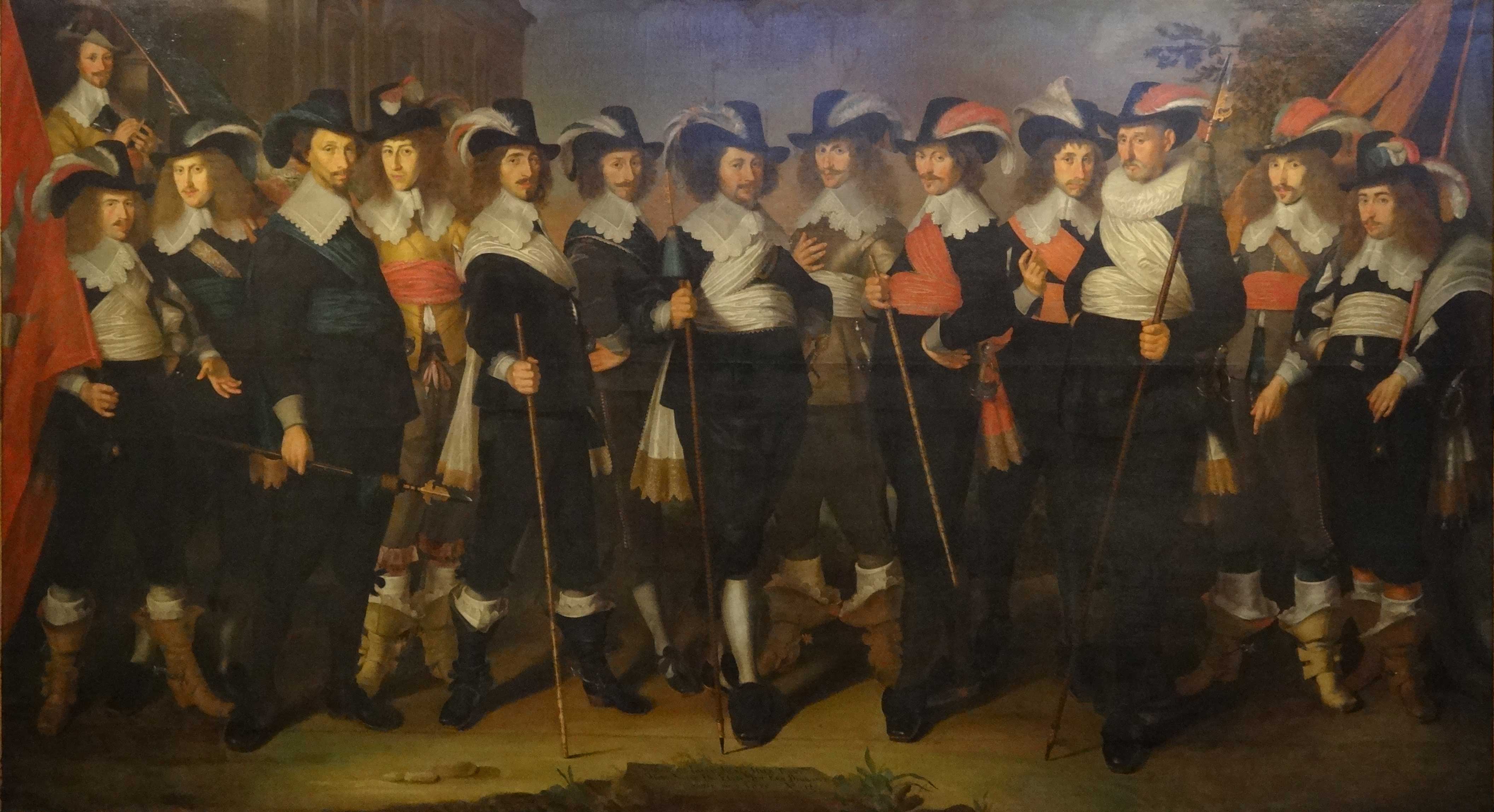
Schuttersstuk, schutterij onder leiding van kolonel Govert Suys (Archer Unit, militia led by Colonel Govert Suys) by Ferdinand Boel, 1653
size unknown
link
40 
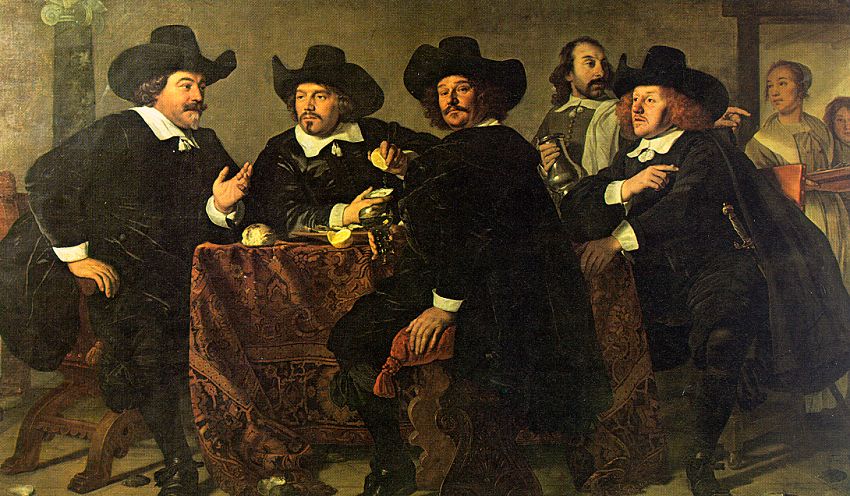
Four aldermen of the Kloveniersdoelen in Amsterdam by Bartholomeus van der Helst, 1655
oil on canvas, h 171cm x w 283cm
link
41 
Officers and Standard-Bearers of the Old Civic Guard by Caesar van Everdingen 1657
oil on canvas, h 212.2cm x w 350cm
link


Key to Rembrandt's Night Watch
The white rectangle denotes where the painting was trimmed in the 18th century probably from 152" x 188" (12 feet 8 inches x 15 feet 8 inches) to 143" x 172" (11 feet 11 inches x 14 feet 4 inches). The comparison was made superimposing the painting as it currently is to the copy by Lundens. It was trimmed after it was moved out of the militia guild.
The blue rectangle towards the bottom indicates where Rembrandt signed the painting.
The blue oval near the top indicates the escutcheon bearing the names of some of the
The green rectangle is approximately 72 inches high indicating that the Captain is either tall or he is painted larger than life.


Who's Who (from left to right)
Historian Bas Dudok van Heel not only determined the 18 names from the escutcheon but also identified many of those not mentioned on the escutcheon. Those mentioned on the escutcheon are marked with an asterisk (*).
(figures in the trimmed off section)
1. man in lace collar with long blond hair and his hat in hand. Identified as Jan Brughman (1614-1652), musketeer and the richest man in the company. *
2. man in lace collar and brimmed hat. Identified as Jacob Dircksen de Roy (1601-1659) *
3. Child. Unidentified.
(figures in the current state of the painting)
4. Man in winged helmet and halberd. Identified as Sergeant Reinier (Reijnier) Engelen. *
5. Man in background with musket raised in profile with one eye visible. Unidentified.
6. powder monkey - a boy in an oversized helmet and a carrying a powder horn. Unidentified.
7. Man in Spanish conquistador helmet. Identified as Jan Pietrsen Bronchorst (1587-1666). *
8. Man in hat.  Identified as Harman Jacobsen Wormskerck (1590-1653), buckler-man. *
9. Man with large feather on his helmet.  Identified as Elbert Willemszn Swedenrijck (1589-1644), musketeer. *
10. Man loading gun by pouring the charge down the barrel. Identified as Jan van der Heede (1610-1655), musketeer. *
11. Girl in green dress with only her eye and ear visible. Unidentified.
12. Girl in yellow dress carrying a chicken, dagger, pouch and a pistol on her belt while carrying a silver goblet in her hands.
13. Man standing akimbo holding flag. Identified as ensign Jan Visscher Corneliszoon (1610-1650) *
14. Man in beret with one eye visible. Unidentified but it has been suggested it is Rembrandt himself.
15. Man in helmet.  Identified as Claes van Cruijsbergen (1613-1663), buckler-man. *
16. Man in armor seen from side firing musket. Unidentified.
17. Man looking up. Unidentified.
18. Man walking while in red sash, black hat and white collar. Identified as Captain Frans Banning Cocq (1605-1655) *
19. Man in top hat holding pike.  Identified as Jan Ockersen (1599-1652), pikeman. *
20. Man in cloth hat with hand raised in response to #16 firing a musket.  Identified as Jan Adriaensen Keijser (1594-1664), captain at arms. *
21. Man in helmet with pike lowered. Identified as Walich Schellingwou (1613-1653), pikeman. *
22. Man in yellow holding a spontoon with blue & white fringe. Identified as Liutenant Willem van Ruytenburch (1600-1657). *
23. Man leaning over to blow out the pan of his matchlock.  Identified as Jan Claesen Leijdeckers (1597-1640), musketeer. *
24. Man in hat with feather at front holding pike nearly vertically.  Identified as Barent Harmansen Bolhamer (1589-1661), pikeman. *
25. Man in hat. Unidentified.
26. Man in black hat and white collar holding a halberd, talking to #27 and gesturing forward. Identified as Sergeant Rombout Kemp. His portrait can be compared to his portrait in the 1950 painting Regenten van het Nieuwezijds Huiszittenhuis (in English : Governors of the Nieuwezijds Huiszittenhuis) *
27. Man in helmet with red neckerchief.  Identified as Paulus Schoonhoven (1595-1679), pikeman. *
28. Bearded man with large drum. Identified as Jacob Joriszn (1591-after 1646), drummer.
29. dog barking at the drum

Some can be identified by what they carry : the sash identifies #18 as the leader, the spontoon identifies #22 as the Lieutenant, the flag identifies #15 as the ensign, and the halberds identify #5 and #26 as sergeants.


The Shield (the Escutcheon)
the shield of names from Rembrandt's Night Watch
above is a lightened version (click to embiggen) or embiggen the unlightened version
The escutcheon, the blue oval on the key, was added about 1715 (long after Rembrandt's death in 1669). above the figures is a shield inscribed with the following (the number in the parenthesizes identifies their location in the key):
Frans Banning Cocq, heer van Purmerlant en Ilpendam, Capiteijn (Lord of the Manor of Purmerlant and Ilpendam, Captain) (#18)
Willem van Ruytenbaurch van Vlaerdingen, heer van Vlaerdingen, Luitenant (Lord of the Manor of Purmerlant and Ilpendam, Lieutentant) (#22)
Jan Visscher Cornelisen, Vaendrich (ensign) (#13)
Rombout Kemp, Sergeant (#26)
Reiner Engelen, Sergeant (#4)
Barent Harmansen (#24)
Jan Adriaensen Keijser (#20)
Elbert Willemsen (#9)
Jan Clasen Leijdeckers (#23)
Jan Ockersen (#19)
Jan Pietersen Brochorst (#7)
Harman Iacobsen Womskerck (#8)
Jacob Dircksen de Roy (#2)
Jan van der Heede (#10)
Walich Schellingwou (#21)
Jan Brugman (#1)
Claes van Cruysbergen (#15)
Paulus Schoonhoven (#27)

Some Reproductions
Night Watch Copy by Gerrit Lundens (Dutch, 1622 - 1683?)
Note that it doesn't have the estucheon.
link


two pages from the family album of Captain Frans Baning Cocq showing a watercolor drawing by an unknown artist (attributed to Jacob Colijns) from before 1655. Probably drawn after Gerrit Lundens' copy. Note that it doesn't have the estucheon. The page on the left says "Schets van de schitbesüe op de groote eed van de Cloveniers doelen daesinuede singe foces van gusmeriande als caviteuve geeft Cade den simen lientenaunt  n silver van maerbingin om lon compaignie Burgers tr doen mascheren" (Sketch of schitbesüe on the great oath of the Cloveniers targets daesinuede singe foces of gusmeriande as caviteuve gives Cade the simen lientenaunt n silver of maerbingin to lon compaignie Citizens tr do mascheren)

1797 an engraving by Lambert Antoine Claessens (Flemish, 1764-1834) after Rembrandt's painting was titled "Armed Amsterdam Citizens"
At the lower right it says "Amsterdamsche Gewapende Burgery 1642. Gegraveerd naar de Origineele Schildery Berustende op het stadhuis van Amsterdam." (Amsterdamsche Armed Citizens 1642. Engraved to the Original Painting reliant on the city hall of Amsterdam.)
link


The Flag
lightened detail of the flag in Rembrandt's Night Watch
lightened detail of the flag in Night Watch
Blue, yellow, blue, yellow horizontal stripes with crest? Held by #13 ensign Jan Visscher Corneliszoon. The ensign's job was to be the flag bearer. The flag looks similar to the flag of the city of Leeuwarden, Netherlands. However, Leeuwarden is about 80 miles to the North East from Amsterdam.

 The Amsterdam flag is black, red and black horizontal stripes with a black "xxx" on the red stripe (much like the flag seen here).


The seal of Amsterdam is on the jacket worn by #22. Just to the right of the shadow hand is a rearing lion(?) and the vertical XXX.


Rembrandt's signature
Rembrandt's signature on Night Watch signed 'Rembrandt f 1642
Rembrandt's signature on Night Watch signed "Rembrandt f 1642"

Rembrandt's signature ("Rembrandt Æ’ 1642") is about 3 inches tall and 9 inches wide. The "Æ’" is an abbreviation of "fecit" which is latin for "made." "Rembrandt made [this] 1642." That is a BIG signature but in context of the massive scale of the painting it isn't that huge.


Rembrandt van Rijn's Guide to Guns
step one : carry it until ready to use
#25 with musket resting on his shoulder. He keeps it pointed in a safe direction. 
#25 carries a musket resting on his shoulder (the barrel disappears into the hat of #26 and probably coincidentally a barrel emerges from the left side of #25's hat.)
#12 carries a pistol tucked in her belt

step two : load the gun
#10 pouring a charge down the barrel
#10 loads a musket

step three : ready your fuse
#5 holding the fuse between his fingers. (see also between the fingers of #23 shown at step 5)
#5 & #23 has the fuse in hand

step four : aim and fire
The barrel and smoke of #16's musket as he fires
#16 fires (and appears to startle #20 who raises his hand)
(you should always keep in mind the 4 rules)

step five : ready the gun for reloading.
#23 blowing powder from the musket. (the fuse mentioned in step 3 is also visible between his fingers)
#23 clears the pan of the musket


other weapons
17 pikes? (#19, #21, many pikes leaning against the wall behind #26)
2 halberds (#4 & #26)
1 spontoon (#22)
6 guns (#5, #10, #12, #16, #23, #25)


The Militia


The Amsterdam Kloveniersdoelen as drawn by Reinier Vinkeles in 1789 (147 years after Night Watch was painted for it and 74 years after it had been moved out of the Kloveniersdoelen)


To compare to other militia paintings see the above Genre section.

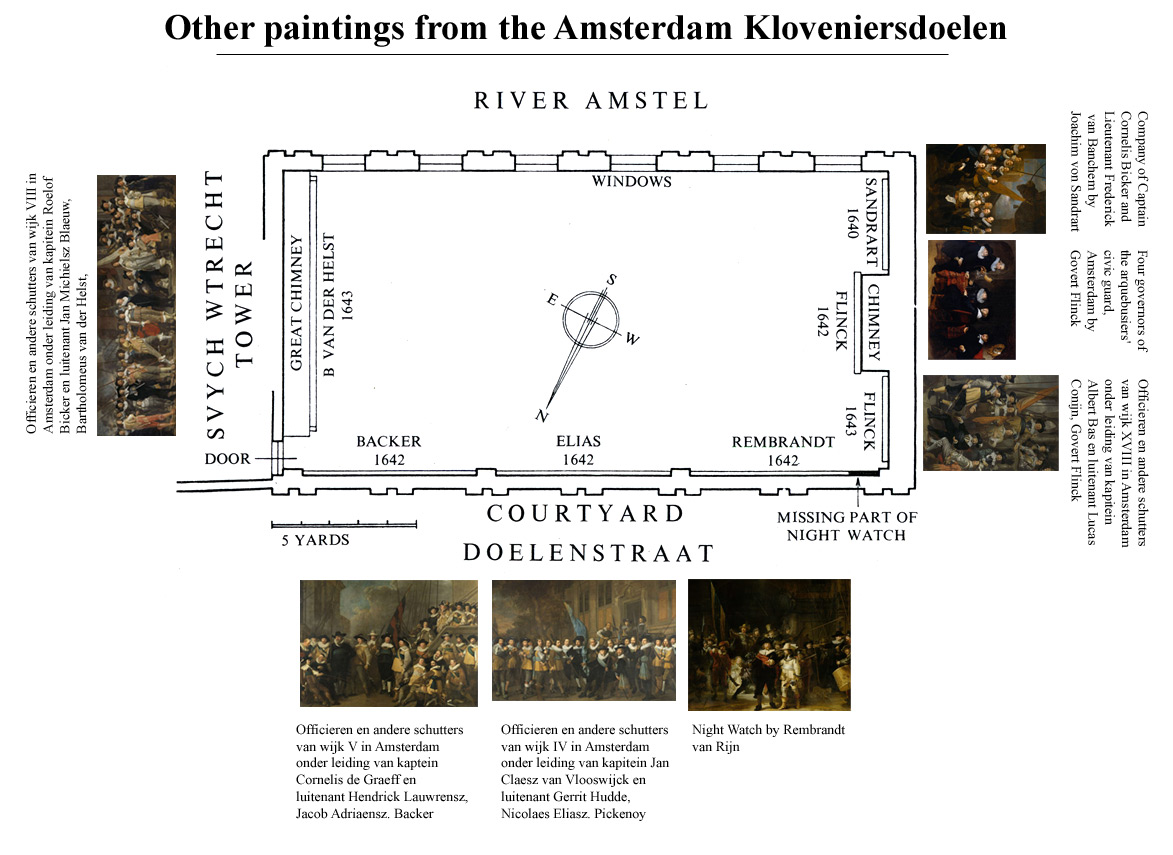
Other paintings from the Amsterdam Kloveniersdoelen

click to embiggen
Note : the date of the paintings on the above graphic and the list below differ somewhat. The dates on the list below are probably more recent than those listed on the graphic taken from a book with a copyright 1947.

Each painting is roughly life size but were uncoordinated so figures of the Backer painting are generally taller than those of the Elias painting. Neither were the paintings coordinated to be part of a single concept.

East Side
North Side


Night Watch by Rembrandt, 1642

West Side
Officieren en andere schutters van wijk XVIII in Amsterdam onder leiding van kapitein Albert Bas en luitenant Lucas Conijn by Govert Flinck, 1645

Four governors of the arquebusiers' civic guard, Amsterdam by Govert Flinck, 1642

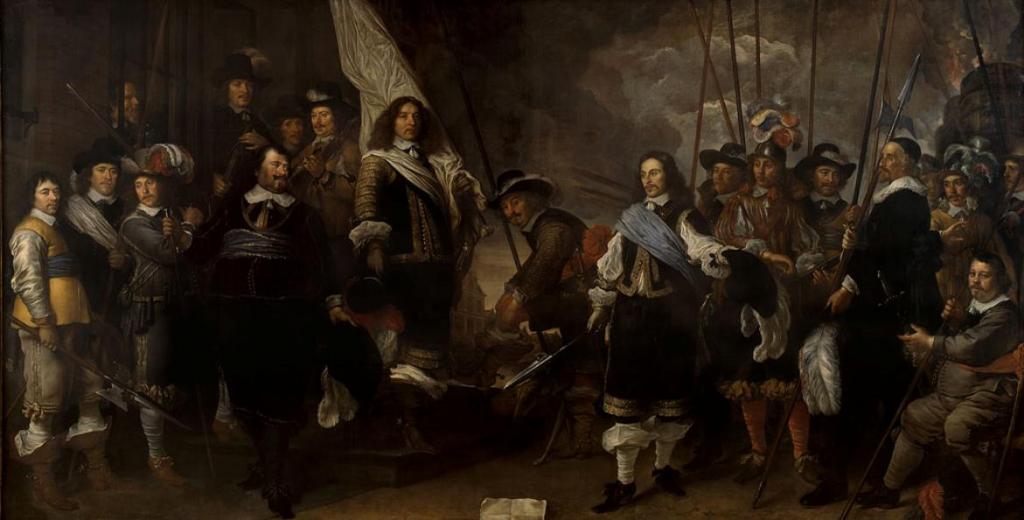
Company of Captain Cornelis Bicker and Lieutenant Frederick van Banchem by Joachim von Sandrart, 1638-40


The militia insignia on the arm of #23 (the only one wearing one)


Travel
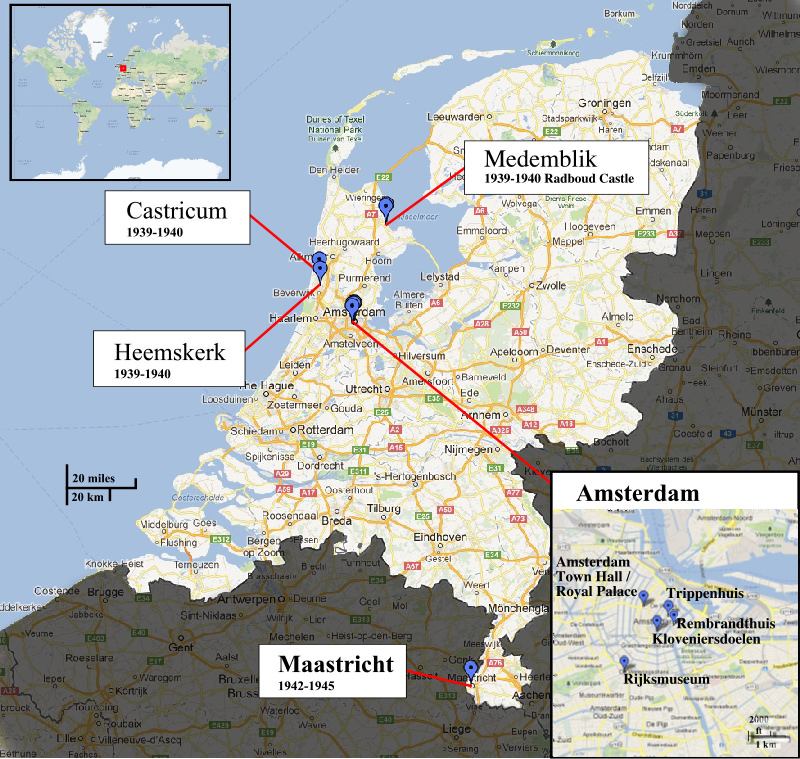
Rembrandt's Night Watch hasn't traveled far.
Map showing where the Rembrandt painting Night Watch has been.
  • 1642 - although I had previously speculated that his studio didn't appear to have high enough ceilings to accommodate the painting but I have since read that it was painted in his courtyard, removed from the stretcher, rolled and then taken to the Kloveniersdoelen.
  • 1642 to 1715 - militia house called the Kloveniersdoelen. (Considering the size of the painting it may have been painted at the doelen rather than at his studio as it doesn't appear to have high enough ceilings.)
  • 1715 to 1808 - Amsterdam Town Hall (later to known as the Royal Palace of Amsterdam)
  • 1808 - Trippenhuis : Napoleon declared his brother the King of Holland in 1806 and in 1808 his brother intended to turn the Amsterdam Town Hall into the royal palace. The Commissioners of the Town Hall decided which paintings belonged to the city and removed them to the Trippenhuis occupied by an art dealer, C. S. Roos.  July 8, 1808 Roos was ordered to return the paintings left in his safekeeping to the Town Hall.
  • on August 6, 1808 - the paintings were returned to the Town Hall.
  • 1815-1885 - The Town Hall become the provisional palace to the new Dutch King and Night Watch was again moved to the Trippenhuis.
  • 1885 - it was moved to the newly built Rijksmuseum
  • 1898 - it was moved for an exhibition at the Amsterdam municipal museum
  • WW2 travels
  •        Aug 1939 - Radboud Castle near Medemblik
  •        April 1940 - strong room in the dunes near Castricum
  •        March 21, 1941 - bunker near Heemskerk
  •        March 23, 1942 - bunker inside a hill called St Pietersberg near Maastricht
  • June 19, 1945 - back to the Rijksmuseum (Germany surrendered May 8, 1945)
  • 1948 - renovations at the Rijksmuseum required the painting to be moved to another room. Due to its size it was walked out of the Rijksmuseum and then brought back in a different way.
  • 2003 - refurbishment of the Rijksmuseum


Damage
  • Kloveniersdoelen : maneuvering 10-20 foot pikes they'll sometimes be moved carelessly
  • Kloveniersdoelen  market : the hall was converted into a market and no special protection was given to the paintings inside.
  • The move from the Kloveniersdoelen to the Amsterdam Town Hall involved the trimming of several feet of canvas and several figures off the painting.
  • 1911 : attack by an unemployed ship's cook who slashed the painting with a cobbler's knife
  • ww2 : removed from the stretcher and rolled to be removed to a bunker (near Heemskerk)
  • 1975 : Wilhelmus de Rijk, an unemployed schoolteacher slashed the painting several times with a kitchen knife. He was then committed to a mental hospital.
  • 1990 : acid attack
Special mention to the various attempts at restoration which one restorer commented on.  Between 1746 and 1766 Jan van Dijk to restore an assortment of Amsterdam municipal paintings and referred to his predecessors  as
"Bastards and scoundrels of the art who have spoilt the best works… nitwits… who… have made a pact with the Devil and conspired with him to kill these beloved pledges of Antiquity and Art. … How many of the most precious works of art have been spoilt by the hands of bunglers (one may even call them unskilled claws) of whom we still find signs in the Doelen, paintings that are so scoured that one sees the panels through the light as well as through the dark parts of the paintings.… One of those nitwits of Art had scrubbed in this way with water and Brussels sand, of which there are still witnesses alive who confirm this, indeed who even warned him."
Specifically referring to the Night Watch he noted :
"On account of  the many boiled oils and varnishes which from time to time have been brushed over it, it can no longer be distinguished what kind of company it is, let alone what the superior officers were called; for it was thought that it had been tarred over, but when it was cleaned by me I found that the names of both the superior officers and those of the private soldiers appeared in an escutcheon at the top of the painting…"


Thanks to the book Rembrandt's Night Watch by Ton Koot.