Showing posts with label nude. Show all posts

Sunday, February 18, 2018

Censorship : Al Hirschfeld

from The Line King : The Al Hirschfeld Story (1996) Al Hirschfeld tells the story of cartoon censorship :
I remember doing a drawing of Harry Kurnitz play and it was a nude. The Times wouldn't run it unless I put a brasserie on her. So I put a brassiere on it and it ran in the Times with a brassiere and it ran in the Tribune without it. ... I think Life Magazine picked it up 

And they show an article titled "All the Nude That's Fit to Print" by George Spelvin  (George Spelvin is a traditional pseudonym used in programs in the American theater.) The play, Reclining Figure by Harry Kurnitz, is a satire of art collectors and dealers revolves around a counterfeit painting of a reclining nude. The Hirschfeld illustration was commissioned by the producers to accompany an ad of reviewer comments. The date on the clippings appears to be Monday Oct 11, 1954.


the original ad of risque cartoon nudity

The ad modified for the New York Times to add a bra and remove her navel. But still no hint of pants. A simple nude can be seen as classical or a study of the human form. A woman wearing a bra, suggesting a modern woman, but no pants I'd suggest that makes it more lewd.
As a bonus : the Renoir-esque painting from the play as found on AbeBooks :


The director of the the film, Susan Dryfoos, deserves credit for the title The Line King. That's great.  The DVD also included a bonus video of Hirschfeld drawing taken 6 years after the feature was released. Both were a pleasure to watch.

Saturday, September 2, 2017

Ancient Sumerian

Never let it be said that this isn't a classy, high brow establishment interested in other cultures and languages.

The ancient Sumerian symbol for woman :

Sumerian pictogram for woman


Below is the Ancient Sumerian symbol for man. It seems more ambiguous. It could be a fist and forearm or a cartoon man standing in a helmet or a tailless seahorse.

spotty

Sunday, November 6, 2016

Art as a Creative Endeavor : Edward Burne-Jones

Phyllis and Demophoon by Edward Burne-Jones, 1870
watercolor on paper,  93.8 x 47.5 cm (36.9 x 18.7 in)

The Tree of Forgiveness by Edward Burne-Jones, 1882
oil on canvas, 190.5 × 106.7 cm (75 × 42 in)

In 1870, Edward Burne-Jones exhibited Phyllis and Demophoon
Phyllis, Queen of Thrace, falls in love with Demophoon, son of Theseus. He departs but promises to return in six months' time. When he fails to keep his promise, Phyllis hangs herself, and is turned by the gods into an almond tree. On his eventual return, Demophoon remorsefully embraces the tree, which blooms, as Phyllis emerges to forgive and reclaim her faithless lover.
Both Phyllis and Demophoon are modelled on Maria Zambaco, with whom Burne-Jones had been having an affair since June 1868 (a host of studies exist for both figures, in various locales). And for this reason, in conjunction with Demophoon's nudity, a controversy ensued when it was exhibited at the Old Watercolour Society for the Summer Exhibition of 1870. Within two weeks of the exhibition's opening, Burne-Jones withdrew the painting due to complaints, and two works by other artists were exhibited in its place. In August 1870, Burne-Jones resigned from the Society, over artistic integrity.
In the catalogue for the Summer Exhibition at the Old Watercolour Society, Burne-Jones included the following caption, a quote from Ovid: 'Dic mihi quid feci? Nisi non sapienter amavi' [Tell me what I have done? I loved unwisely.] Burne-Jones later reworked the painting entirely in oils, transforming the bodies of both Phyllis and Demophoon into an homage to Michelangelo, calling it 'The Tree of Forgiveness' (1882, Lady Lever Art Gallery, Port Sunlight), where Zambaco's face remains only on Phyllis.

The Tree of Forgiveness, 12 years later,  is about life sized. The figures are not identical to the previous version but they are remarkably similar and the concept is the identical. The colors are different. in the 1870 painting Demophoon looks slight and ashen.

The drapery in Phyllis and Demophoon covered Phyllis' body along with her arm covering her breast and the magical drapery wrapped itself around Demophoon's leg without providing him any modesty (modesty in the sense of avoiding impropriety or indecency but modest in the sense of "a small amount" could be used to describe him). In contrast, in The Tree of Forgiveness magical drapery covers his manhood and flowingly wraps around his leg and only his leg while she is exposed fully nude.

It is interesting that Michelangelo depicted women by drawing men and the "feminizing" them and Burne-Jones in Phyllis and Demophoon drew a woman and then "masculinized" the figure.


An attempt to show the scale of the pictures.

below the fold is an animated gif contrasting the two.

Wednesday, January 1, 2014

Happy Nude Year!


A Study in Curves (Reclining Nude) by William Merritt Chase, c1890
click to embiggen
A Study in Curves (Reclining Nude) by William Merritt Chase, c1890
Oil on Canvas
22" x 40" (55.9 x 101.6cm)


an attempt to show the scale of the painting

Saturday, August 17, 2013

word of the day : callipygian


The word of the day is callipygian : kallos means beauty, puge means buttocks. Aphrodite Kallipygos.

a Callipygian Venus (Naples)
1st or 2nd century BC

a Callipygian Venus (Naples)
1st or 2nd century BC
(second view)


Callipygian Venus by François Barois, 1683-1686 (2 views)


Friday, August 9, 2013

Book Notes : nasty, misogynistic, fearful contempt

photo of page 81 of the book the Essential Hieronymous Bosch
page from The Essential Hieronymus Bosch
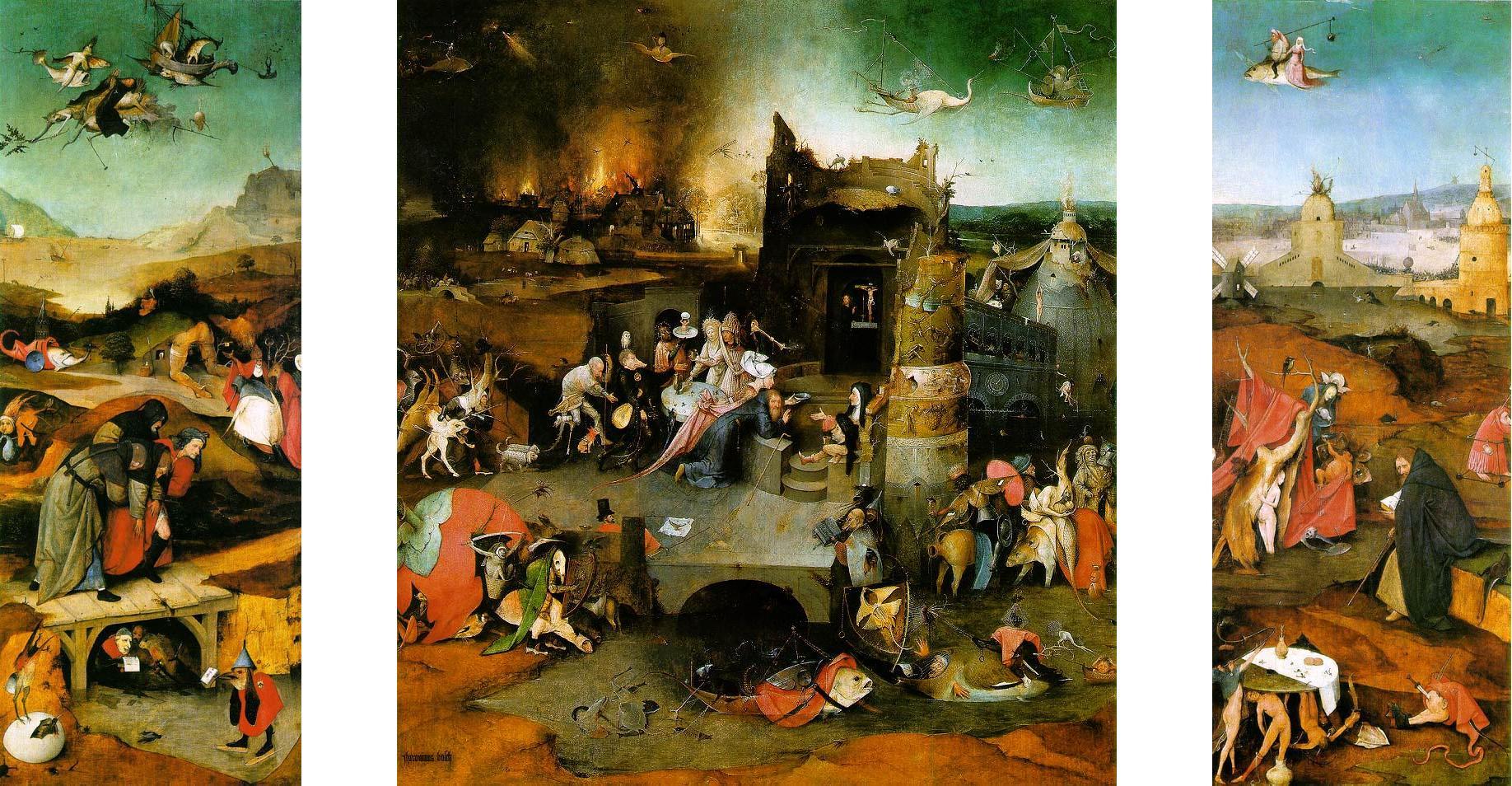
from the little book The Essential Hieronymus Bosch by W. John Campbell (2000) p81 about the painting the Temptations of Saint Anthony :

Unlike the abstract theme of salvation through prayer in the middle panel, the right wing – like the left – is a narrative, the temptation of the saint by a beautiful girl. This misogynist episode – a nasty medieval expression of fearful contempt of women – pits the saint and his Bible against the allure of a slender nude in the hollow of a dead tree.
photo of page 81 of the book the Essential Hieronymous Bosch
the Temptations of Saint Anthony triptych (right panel) by Hieronymus Bosch.  (A complaint about misogyny and no one mentioned the phallic shaped top of the building in the upper right?)  

Temptations of Saint Anthony (right panel) by Hieronymous Bosch
click to embiggen
detail of the Temptations of Saint Anthony (right panel) by Hieronymus Bosch

So, Saint Anthony being tempted by a plate full of gold coins is a gold-hating episode and a nasty medieval expression of fearful contempt of gold.

Is it misogynistic to suggest that many men can be tempted by a naked woman? Is it misogynistic to reject the advances of a naked woman? Or is it that she is naked? It must not be the temptation itself or it would be "biblical contempt" and not medieval contempt. Or is it misogynistic that she appears not to have feet (because she is standing in water)? Is the man and woman on a flying fish misogynistic too?

She appears to be covering herself with a crab. If she is infested with gigantic genital crabs then most men would be less tempted by her.

If the author intends "misogynist episode" to refer to Saint Anthony's rejection of the woman then the author has it wrong as I think she was actually the devil in disguise. A mis-diabolus-ist episode!


scale of Temptations of Saint Anthony by Hieronymous Bosch
an attempt to show the scale of the painting

Essential Hieronymus Bosch book review : As an aside, I bought the book on impulse and blindly online and it wasn't exactly what I was hoping for.  It is physically small (about 6" x 6") and parts of it are written in a style that, I think, is intended to sound like a high school girl. Oddly, this casual style isn't consistent. It is as if an editor circled a few paragraphs and said "Hey, punch this up a little and make it sound cool and youthful. Y'know, hep and groovy like the kids talk these days. And be sure to mention a popular TV show so the readers know that we know what's on TV. And call something misogynistic because the whippersnappers are always doing that."

It isn't a very deep book. Many of Bosch's paintings have a great many elements in them and while the book may take a stab at explaining a couple things it then moves on to the next painting. For example, the painting The Seven Deadly Sins illustrates the 7 deadly sins. There is an overview of the painting and about basically one line illuminating what is going on in most scenes. Like "Greed (Avaricia), as a judge taking a bribe (sitting on a bench, as in a modern court, he extends his palm behind him in a gesture called a 'porter's tip')" I would point out that the judge in the painting is literally sitting on a long bench with 2 other people while a modern judge sits on an elevated platform behind a large desk – which is called the bench for historical reasons. No mention of the other 2 men in the painting, the wood in the body of water or the peculiar tree behind the judge or if any of those elements are significant.

Some barely lend any insight at all to the painting like "Gluttony (Gula), a common problem in a world of feast or famine," or "Lust or Excess (Luxuria), as a party in a tent that recalls medieval book illustrations for romance of courtly love" while I think most people might want to know if that is a monk spanking a jester's bare bottom? The answer isn't found in this book.

Hieronymus Bosch's Seven Deadly Sins detail of Lust
"medieval book illustrations for romance of courtly love" =  a man in robes spanking a man dressed like a rabbit?

The blurb on the otherwise sparse back cover (there is only "bosch" in large letters, the UPC and the blurb) says "'Be an art expert in 5 minutes.' – The New York Times". The actual headline is "MAKING BOOKS; Be an Art Expert In Five Minutes!" and may involve sarcasm. The article itself says things like "At their worst (and perhaps at their best, too) the books provide art education through one-liners, sometimes with an attitude that, if not snide, is flip and condescending."  Also from the NYTimes article is this bit of snobbery "…the words may be embarrassingly rudimentary at times…" The problem is the lack of information not the lack of polysyllabic words.

Tuesday, January 1, 2013

Happy Nude Year!

Standing Bather by Edgar Degas, c1883-4, 12 1/8 x 9 3/8 in charcoal, pastel, watercolor
click to embiggen


Standing Bather by Edgar Degas, c1883-4,  charcoal, pastel and watercolor, 12.125" x 9.375"

Thursday, December 13, 2012

Goya's Maja

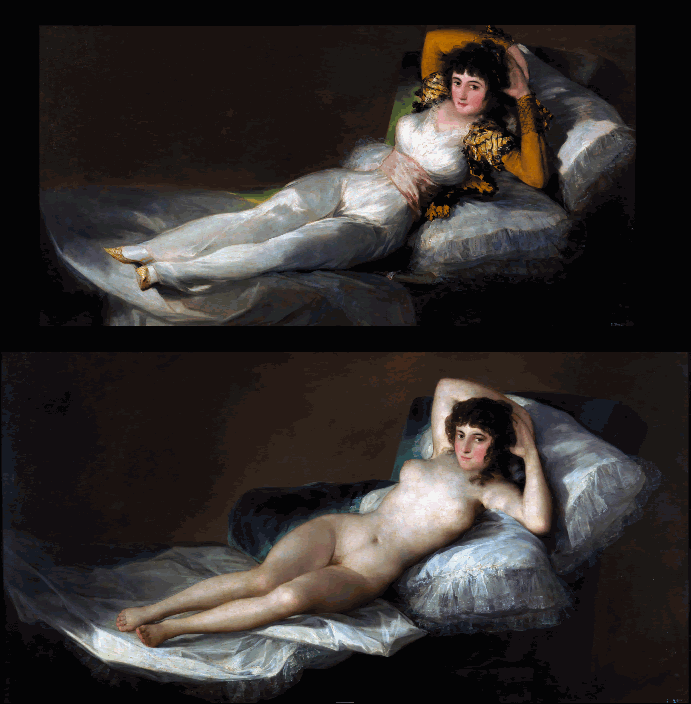
animated GIF alternating between Francisco Goya's Maja nude (La maja desnuda) and his Maja clothed (La maja vestida) making it look like the quickest striptease ever


A comparison of Francisco Goya's Maja nude (La maja desnuda) and his Maja clothed (La maja vestida). I had thought that they were the same figure with clothes painted on one but they are not an exact match.
And although the canvases are the same size (38 x 75 inches) the nude figure is smaller (the clothed figure had to be scaled down to make the comparison)

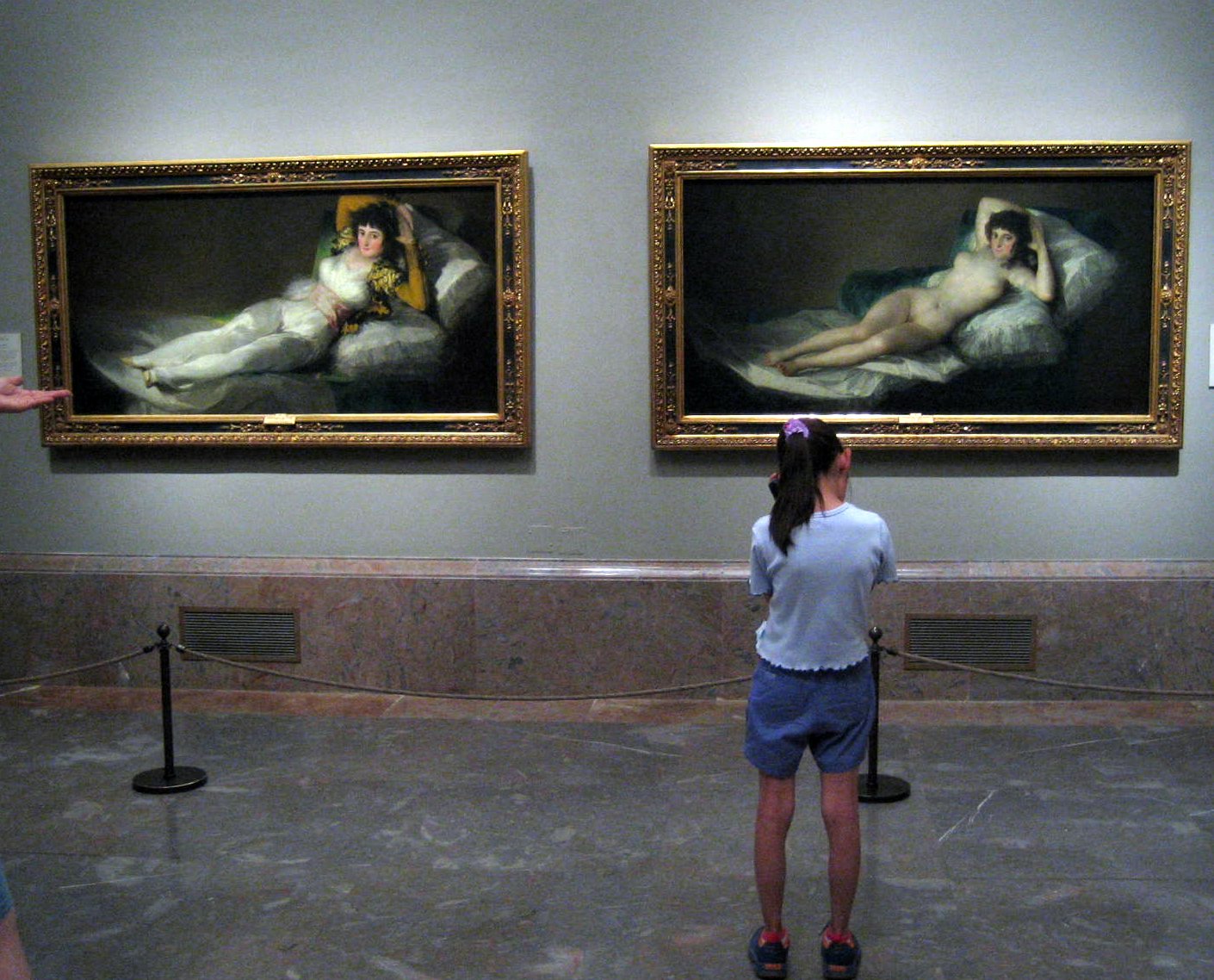
photo of Francisco Goya's Maja Nude and Maja Clothed side by side at the Prado
photo of Las Majas side by side at the Prado, Spain

Sunday, November 25, 2012

This is why modern men wear pants

Hercules And Diomedes sculpture by Vincenzo de Rossi, 1550 Diomedes grabs Herc's junk!
That's not what he meant when he asked "Give me a hand…"

Hercules And Diomedes by Vincenzo de Rossi, 1550.

They're wrestling! Hercules is trying to throw King Diomedes of Thrace to his own man-eating mares and Diomedes is using a below the belt move to try to prevent it.

This is why modern men wear pants or as some people refer to jeans : tactical anti-wang grabber defensive armor.

While other people are almost certainly checking out Hercules' junk or Diomedes' balls, I'm noticing that Herc has stubby little legs.

Saturday, November 24, 2012

Lesbian Symbol

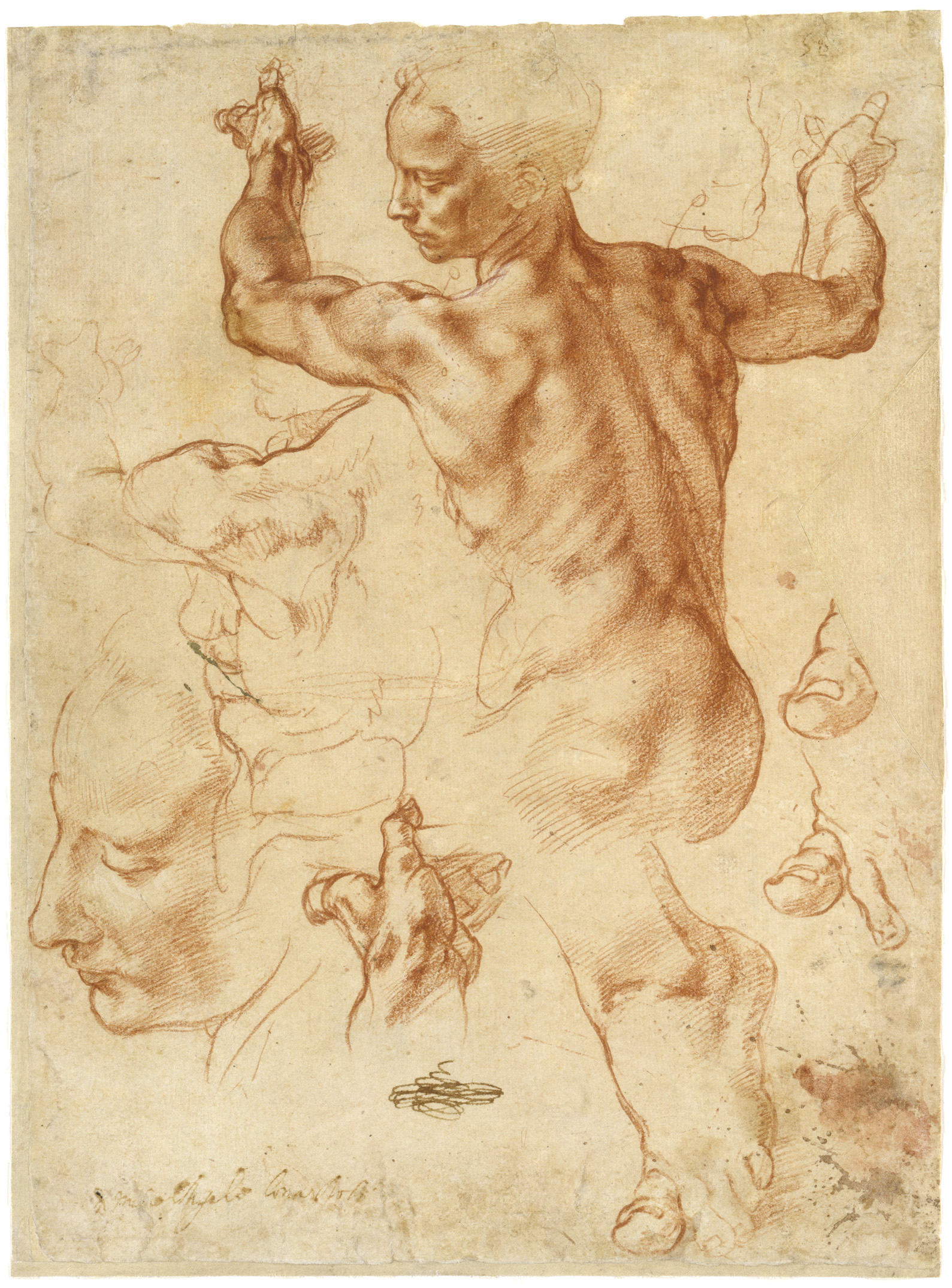
Studies For The Libyan Sibyl of the Sistine Chapel by Michelangelo

Did I write Lesbian Symbol? Sorry, I meant Libyan Sibyl.

Studies For The Libyan Sibyl of the Sistine Chapel by Michelangelo, circa 1510-11. It is only 11 3/8 x 8 7/16 inches and is simply marvelous. I'm not the only one as evidenced by the fact that people, generation after generation, have looked at it and decided to go to the trouble to keep a fragile sheet of paper safe and intact for over 500 years.

The use and the economy of line is extraordinary. Yet it was intended as a working drawing with scribbles and splatters of ink.  The varying states of completion of various elements makes it a lesson in drawing for those with the talent to learn from it.

I should mention that the back of the sheet, which is also a study for the Libyan Sibil, is much less impressive. The Libyan Sibil as painted on the Sistine Chapel lacks much of the charm of the drawing although who doesn't like a giant book. (here is a zoomable view of the Sistine Chapel)

A sibyl is any of certain women of antiquity reputed to possess powers of prophecy or divination. (The Libyan Sibyl is a woman but I think this drawing is clearly of a man.)

Wednesday, November 14, 2012

French postcard

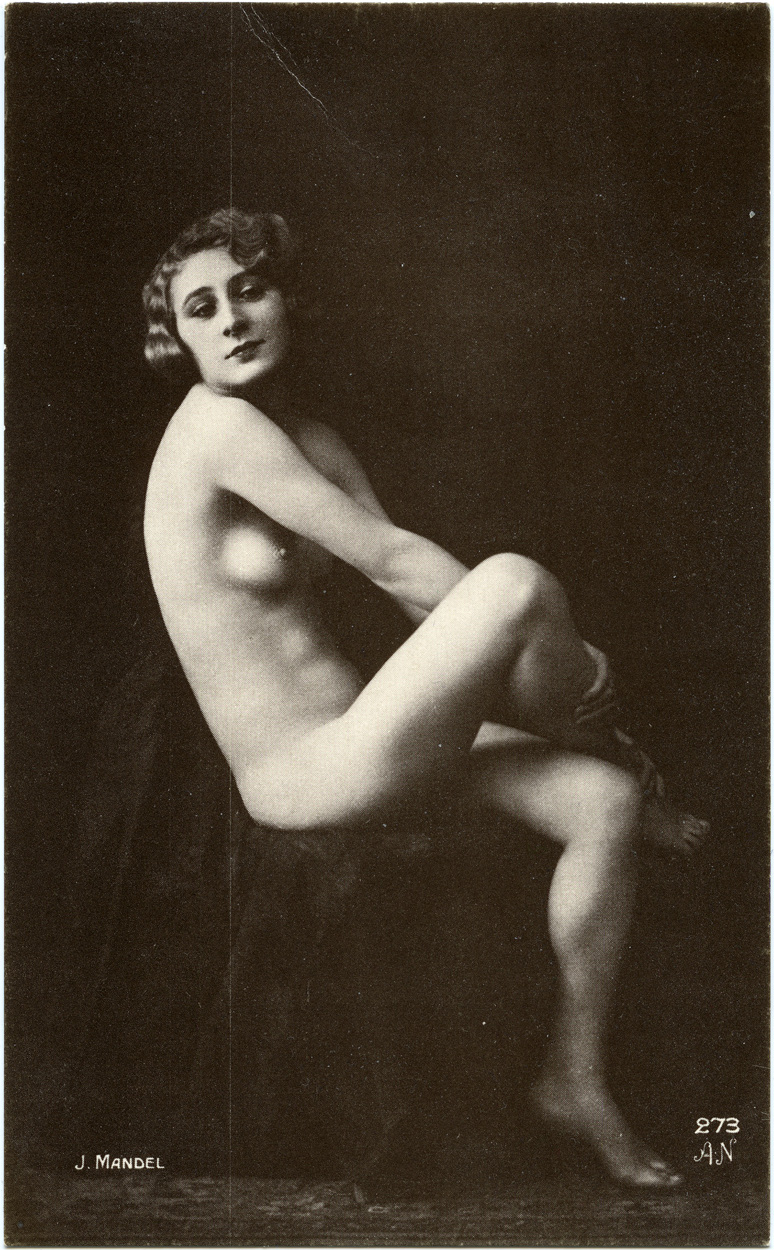
Here's a french postcard :


You can tell it is a French postcard because it stays "Carte Postale" on it which is French for "post card".

(for anyone searching for "french postcard" wanting to see erotic naked photographs of women then here is the front of the card).

labeled "J. Mandel 273 A-N"

(as a reminder of the inevitable human mortality I'll point out the model is probably dead. If she isn't then by now she is, to be kind, vintage – to be unkind she is ancient, decrepit, creased, wrinkled, robbed of many of her charms by age and gravity and probably looks like a she was made of wax and kept too close to a flame with her bounce and jiggle replaced with a sagging waddle.)


Thursday, April 12, 2012

the Pioneer Plaque

Pioneer spacecraft plaque


Since a simple star map would become distorted over time by gravity and expansion, the Pioneer plaque used distance from pulsars and the pulsars frequency to note its origin.

wiki notes that the arrow denoting the Pioneer spacecraft's origin received criticism because "arrows are an artifact of hunter-gatherer societies like those on Earth; finders with a different cultural heritage may find the arrow symbol meaningless"

Similarly , one could criticize the drawing of humans drawn in a simplified way that the vast majority of people can understand but may not translate to an alien that would have drawn in a topographic way or drawn heat or sees in another alien way.

But should aliens expect some other aliens' (Earthlings') spacecraft to not use their own language and their own symbols?

Morbo: Hmmm… judging by this the puny humans are nearly as tall as this spacecraft and the spacecraft is several times larger than their planet!
Kang : you have to admit that their planets are evenly spaced in a manner that is pleasing to the eye.
Morbo : The puny humans, don't realize that will only make it easier for Morbo's people to conquer their solar system!
Kang : It's a shame they haven't figured out a phonetic written language.
Morbo : Yes, for these puny humans to have spent so much effort to send a craft so far without asking how we are or describing how they taste is the height of rudeness!
Kang : Yes, yes, their message mostly seems to be about having us looking at them naked and they have drawn some disembodied boobs in the upper left...
Kang : I'm not sure if that is a frontal view or a top view or both.
Morbo : Puny humans only draw 2 bosoms! Pathetic!
Morbo : but these tasty circuits boards have all sorts of cryptic markings on them.
Kang : it must be a secret message. Perhaps it is a clue to a hidden treasure like in that Nicholas Cage movie.

Why not engrave a text explanation on the back or to the side? When dealing with aliens advanced enough for space travel, more information would be more useful. I think if we were to receive a message from aliens the more information received would be better.

(btw, I've always been annoyed at the fact that the 2 people are superimposed over the Pioneer craft – floating in front of it – instead of standing on the same plane as the spacecraft and standing in front of it.)

Friday, February 10, 2012

Thoughts from the Phallocracy

Mary Daly, feminist formerly of Boston College and currently dead, once said "If life is to survive on this planet, there must be a decontamination of the Earth. I think this will be accompanied by an evolutionary process that will result in a drastic reduction of the population of males."

So, like me – a member of the Phallocracy in good standing – Mary Daly envisioned and yearned for a future very much like a harem.

I suppose the only difference would be the eternal question of whether the dress code would be more like I Dream of Jeannie or more like J.A.D. Ingres' Turkish Baths.


p.s. "decontamination" is an interesting choice of words. I'm sure the problem of what would be the best and most proper term to use led her to consider her words carefully before she chose her final solution.

Saturday, August 6, 2011

puny

Roman statue of Pompey Magnus
click to embiggen


Some Romans wars :
the Germanic War was against Germans
the Mithridatic War was against Mithridates
the Punic War must have been against the Punies

Thursday, July 14, 2011

Simplification

Herma of Demosthenes
Herma of Demosthenes, c. 280 BC
click to embiggen


wiki describes a herma as "a sculpture with a head, and perhaps a torso, above a plain, usually squared lower section, on which male genitals may also be carved at the appropriate height... and were placed at crossings, country borders and boundaries as protection (against evil)"

 (note to self: evil is afraid of penises)

The article doesn't really answer why a herma consists of a rectangular block with such a limited set of sculptural elements.

Possible reasons :
  • Importance. Sculptors sought to simplify man to only the most important elements.
  • A solid rectangular block would be more resilient than a full figure but then the point of adding fragile genitals (see the broken bits in the photo above) brings that theory into question.
  • Identification. If someone doesn't recognize the face maybe they'd recognize another part.
  • Vandals. Who has never seen a dumpster or wall that a vandal has drawn a penis on to it? I imagine industrious sculpting vandals with chisel in hand sneaking out to the herma in the dark of night and chipping away until they've added a phallus.
  • the rectangular block below the head could serve a sign space – like a modern sandwich board.
  • many phalluses have, over the years, been broken. Perhaps they pointed a direction
  • for those hermas erected erect, they could serve as a way to protect Greek towns from roving bands of nymphomaniacs (this assumes there were actually roving bands of nymphos who could be distracted by the herma just outside of town)

Monday, June 27, 2011

An early vision of ancient man

And it looks like that ancient man is Homo Erectus.
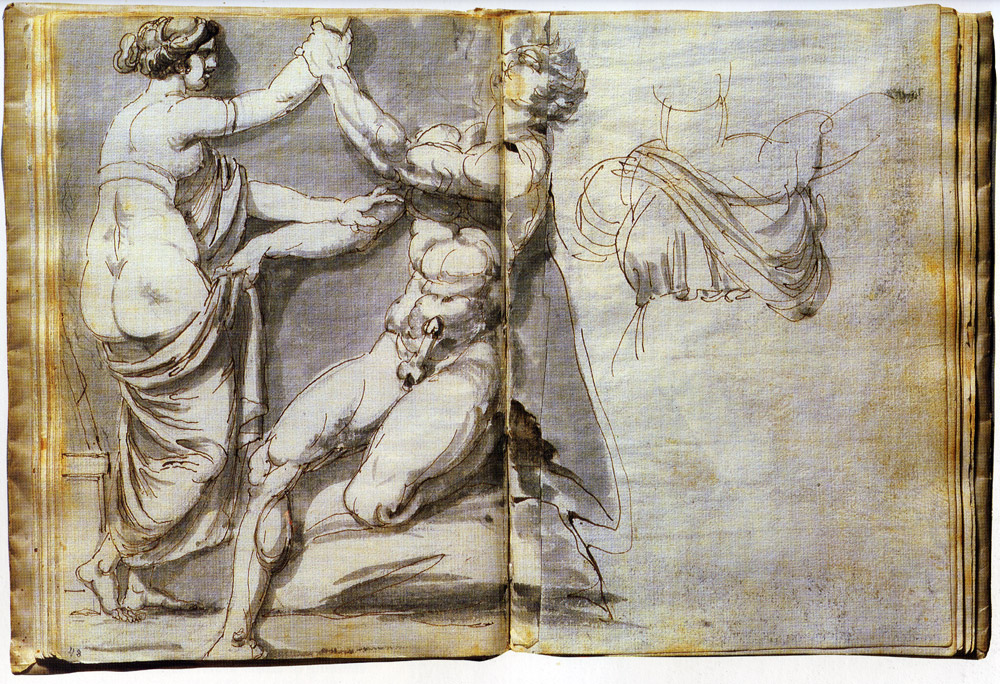
Study of an Antique Relief by Johan Tobias Sergel c.1769
click to embiggen


Study of an Antique Relief by Johan Tobias Sergel c.1769

Although it is identified as being part of the Pergamon Altar (circa 200 B.C.) I haven't seen this section in photos from the Pergamon Museum.

Sunday, November 28, 2010

ouch

engraving by Theodore De Bry after a painting by Jacques le Moyne (who accompanied a French expedition to Florida in 1564) showing how the Timucua treated the enemy dead. Including breaking bones, severing limbs, shooting arrows into the corpses, and scalping and drying the scalps over a fire.
click to embiggen


engraving by Theodore De Bry after a painting by Jacques le Moyne (who accompanied a French expedition to Florida in 1564) showing how the Timucua treated the enemy dead. Ouch.
Note the time lapse quality of the figure(s) running in the background.

Saturday, August 7, 2010

Peek a boo

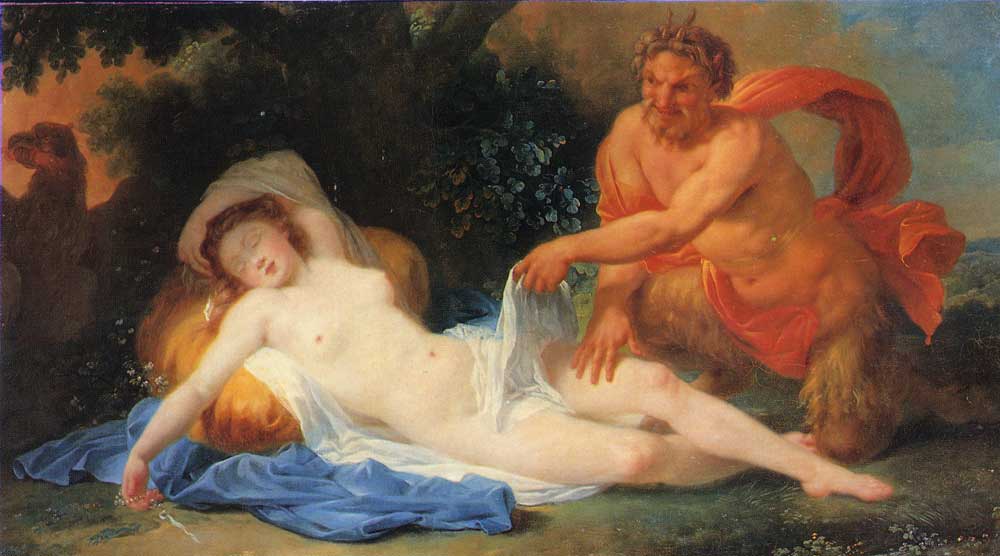
A Nymph and a Satyr  (attributed to Pierre-Charles Trémolières) oh no, nakedness!
click to embiggen


A Nymph and a Satyr attributed to Pierre-Charles Trémolières (1703-1739).

Note the difference between a Nymph and a nympho : a nympho would stay awake for the debauchery.

Unlike this painting by François Boucher, this just seems pervy. And not pervy in the good, just doing my part to continue the survival of the species way but the creepy kind of pervy. The voyeuristic eagle on the left doesn't help.

I imagine clothes that cling to you with no visible means of support like the satyr's outfit wouldn't be that comfortable.

Friday, February 13, 2009

Valentine's Day

Hercules and Omphale getting frisky by François Boucher circa 1724

Hercules and Omphale (getting frisky) by François Boucher circa 1724. How frisky? Two cupid frisky.


Here is a statue of Omphale dressed in a lion skin holding a club at her side and it is not Omphale sitting while standing erect and happy to see you.


I also learned from wiki that "Hercule et Omphale" is a short pornographic poem by Guillaume Apollinaire from a book called "Les onze mille verges" (The eleven thousand penises). That is one hell of a book title (assuming it isn't a sequel) but the poem doesn't impress me.