Showing posts with label Fine Art Porn. Show all posts

Monday, May 12, 2014

satyr tripod

"A tripod with ithyphallic Pans; the sinuous and virile Pans balance a basin upon their heads as they gesture caution. This object was very influential and was used as a model by many neoclassical designers." from the book The Lost World of Pompeii (2002)


ithyphallic : the prefix ithy- means straight or erect

Perhaps the designer wanted to give people who approach the basin plenty of hooks for them to hang their purses or whatever while they wash their hands.


The elongation of the satyr's legs is a distotrtion that seems to work probably because they aren't human.

Temptation of Saint Anthony by Salvador Dali (1946)


Thursday, February 27, 2014

recto

This might help those who can't remember the difference between verso and recto.

Kneeling Nun, verso, by Martin van Meytens, c1731
click to embiggen
Kneeling Nun, verso, by Martin van Meytens, c1731

a notable detail of the painting revealed below

Monday, July 29, 2013

Mutants need love too

Rembrandt's etching Ledikant
Rembrandt's Ledikant
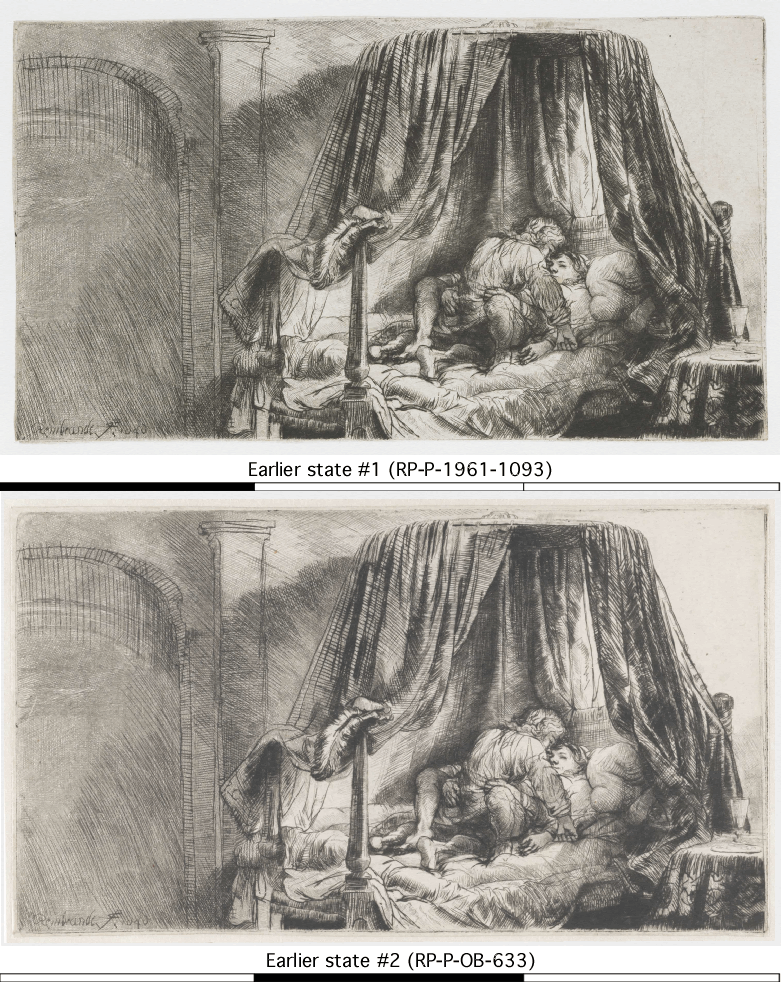
Het Ledikant (The Bedstead) also called Le Lit A La Française (the French Bed)  by Rembrandt van Rijn, 1646
etching, height 125mmx width 224 mm


The subject matter is pretty unambiguous to most people. The book Rembrandt and His Work (1899) describes it as "A very rare plate, which need not be described".  The dutch genre was apparently called "boelering" which is dutch for "cohabitation." Rembrandt was 40 years old at the time so I would suggest he qualifies as a dirty old man.

The alternate title, "French bed," is the name curtained beds were known by.  The open bed curtains add to the voyeurism. Hanging off the end of the bedpost is his hat with a large feather in it. On the left is an arched doorway and to the right is a table with a glass and plates on a bedside table.

Both sixes in the date are printed backwards. That is to say they were not etched onto the plate backwards.

There are several different states to the etching. With each revision was it unnoticed that she has 3 hands (one right and 2 left hands)? Assuming, she doesn't have 4 arms and that the second right hand simply isn't shown. Or maybe the intent was to imply a kind of motion.

From a Descriptive Catalogue of the Prints of Rembrandt (1836) :
First impression There is a margin at top and the plate measures 6 in by 8.9 in
At the bottom of the door leading from the recess is written Rembrandt f 1646
Second impression The margin is cut off it is extremely rare and measures 5 in by 8.9 in
There is much of the bur in this impression
Third impression It is very scarce the recess and door with the name are cut off it measures 5 in by 6.9 in

It has been suggested that the final state was trimmed out of shame to take off Rembrandt's name.

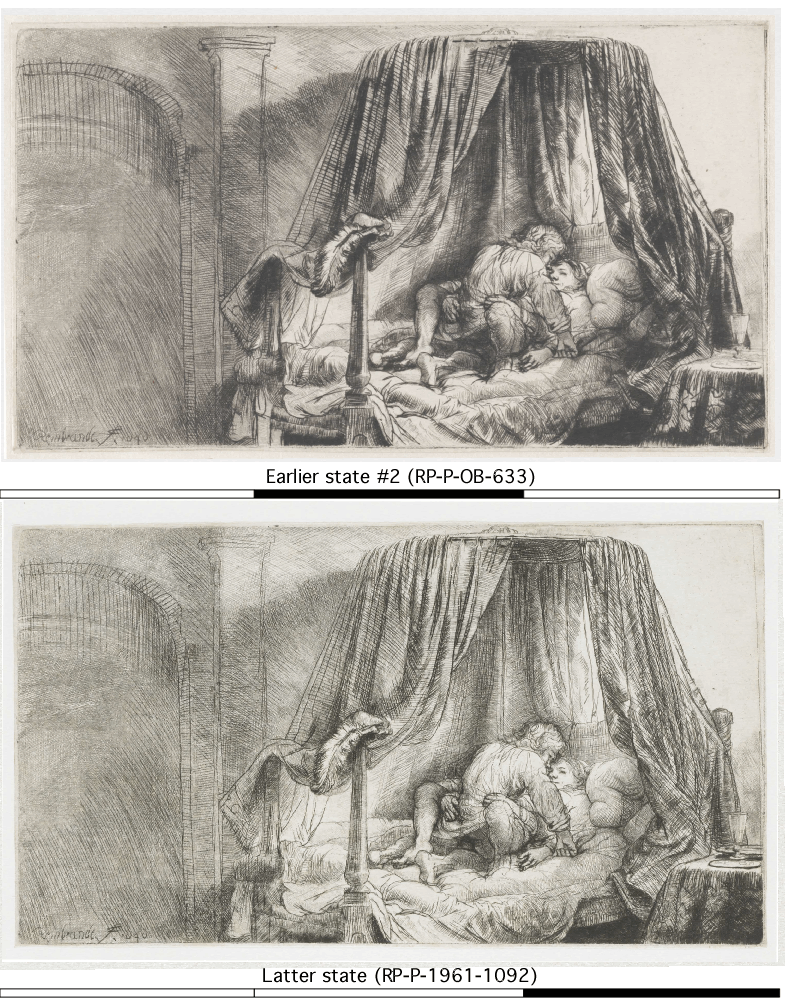
The British Museum says there are at least 4 states to the plate. The Rijksmusuem possesses at least 3 different states of the print :

  • RP-P-1961-1093 
  • RP-P-OB-633
    • man's arm burnished 
    • add a bit of smile to the woman's face 
    • (animation showing the differences between RP-P-1961-1093  and RP-P-OB-633)
  • RP-P-1961-1092 
    • darkened the leftmost bedpost
    • crosshatching on the side table
    • add shadow of the plate on table
    • altered the bedding hanging down
    • refined the curtain rod
    • (This is the image shown at the top of the post. Animation showing the differences between  RP-P-OB-633 and RP-P-1961-1092. Or an animation comparing all three).
an attempt to show the size and scale of Rembrandt's Ledikant
an attempt to show the size and scale of the etching

Monday, July 1, 2013

doing it like rabbits

Officieren van de Oude Schutterij in een landschap (Officers of the Old Militia in a landscape) by Claes Jacobsz. van der Heck, circa 1613
oil on panel, height 150cm x width 173cm
signed "C. Heck fecit" vertically on the end of a fallen log the militia men are sitting on in the lower right quadrant.


This is a unique among Dutch militia paintings. A few Dutch Militia Paintings are out of doors but this is the only one I'm aware of is set within a landscape (as opposed having a landscape as a background). Militias were formed to defend the towns and cities and the city of Alkmaar can be seen in the distant background.

Some militia's had their portraits painted in front of the Doelen (the militia headquarters). The reason for the setting could be that the militia went to the countryside to target shoot whereas other militias might target shoot to the city walls.

There is a house in the center of the picture and to its side is a cart/carriage. Another house is in the distance on the right. In the distance is the Sint-Laurenskerk (Saint Laurence) church.

The foreground has 17 men, the militia members. One of the foreground men gesturing to the left holds keys in his other hand.  A man pouring a drink on the right and several of the men in the foreground hold glasses. In front of the house appears to be dishes on the ground being licked clean by a dog. Many Dutch Militia Paintings were set during a meal with the members around a table. (like this one also from 1613 by Jan Tengnagel which also includes an ostentatious pouring of a drink.) The militia member sitting on the far left appears to have a dagger behind his back while, in contrast, the Tengnagel painting shows several men with swords.

The painter, Claes Jacobsz. van der Heck,  included a self-portrait of himself apparently as the man standing next to a woman in the midground in front of the house. In the background are many extraneous people (I count 15) which is uncommon for a militia painting. The painting has an assortment of sheep (11),  dogs (I count 8), and birds (including a peacock standing on the fence).


Also unique among Dutch militia paintings, in the upper left quadrant are 2 rabbits having sex :
Whoa! Those 2 bunnies are doing it like rabbits! detail of a Dutch Militia painting Officieren van de Oude Schutterij in een landschap (Officers of the Old Militia in a landscape) by Claes Jacobsz. van der Heck, circa 1613
detail of the center left section


an attempt to show the size and scale of the painting

Sunday, November 25, 2012

This is why modern men wear pants

Hercules And Diomedes sculpture by Vincenzo de Rossi, 1550 Diomedes grabs Herc's junk!
That's not what he meant when he asked "Give me a hand…"

Hercules And Diomedes by Vincenzo de Rossi, 1550.

They're wrestling! Hercules is trying to throw King Diomedes of Thrace to his own man-eating mares and Diomedes is using a below the belt move to try to prevent it.

This is why modern men wear pants or as some people refer to jeans : tactical anti-wang grabber defensive armor.

While other people are almost certainly checking out Hercules' junk or Diomedes' balls, I'm noticing that Herc has stubby little legs.

Monday, June 27, 2011

An early vision of ancient man

And it looks like that ancient man is Homo Erectus.
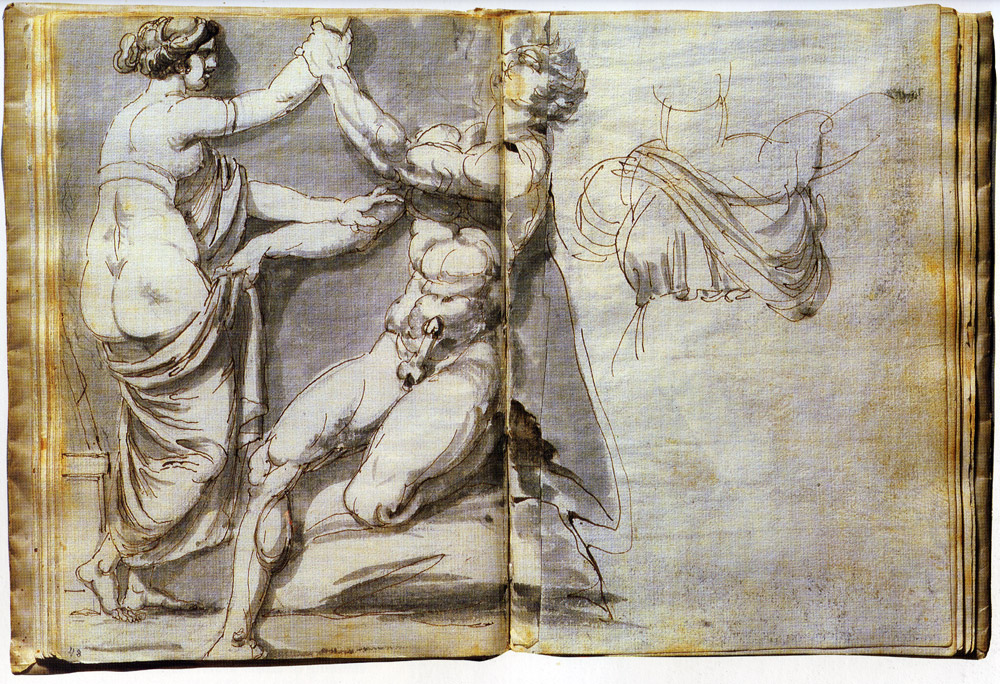
Study of an Antique Relief by Johan Tobias Sergel c.1769
click to embiggen


Study of an Antique Relief by Johan Tobias Sergel c.1769

Although it is identified as being part of the Pergamon Altar (circa 200 B.C.) I haven't seen this section in photos from the Pergamon Museum.

Friday, February 13, 2009

Valentine's Day

Hercules and Omphale getting frisky by François Boucher circa 1724

Hercules and Omphale (getting frisky) by François Boucher circa 1724. How frisky? Two cupid frisky.


Here is a statue of Omphale dressed in a lion skin holding a club at her side and it is not Omphale sitting while standing erect and happy to see you.


I also learned from wiki that "Hercule et Omphale" is a short pornographic poem by Guillaume Apollinaire from a book called "Les onze mille verges" (The eleven thousand penises). That is one hell of a book title (assuming it isn't a sequel) but the poem doesn't impress me.