Showing posts with label movie review. Show all posts

Saturday, August 6, 2022

Movie notes: Mary Queen of Scots (2018)

I was recently watching the movie “Mary Queen of Scots” from 2018.
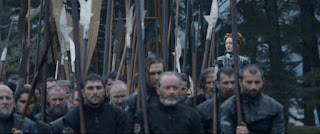
A Scottish army of nameless, non-diverse extras

It turns out that Tudor England & Scotland were racially diverse at the highest echelons of power although not so much when it comes to the rank & file soldiers. Apparently, painters at the time did a really poor job of capturing how black or Chinese they really were.
 
After Mary Queen of Scots (the Irish Saoirse Ronan) catches her husband naked and in bed with her prancing male aide David Rizzio (I didn’t recall that from the old history books), the aide begs forgiveness and the very Catholic Mary tells him to stand and that “you have not betrayed your nature” and he resumes his duties. Surely all Catholics in the 1500s were as tolerant, even Spanish ones.


Don’t think that this is a woke version of history : later she demands and tries to force sex from her drunken husband who repeatedly says no and he makes excuses while she turns violent and attacks him.
Later, a Scottish preacher calls her ”Queen Strumpet” and a crowd chants “death to the Whooooeeeerre” in a surprisingly charming Scottish accent.  I may have unintentionally laughed out loud.


Another line I that seemed questionable was her asking a Scots soldier if he was Catholic, him responding no and her telling him they all go to the same heaven.  


Visually it looks good but the script seems taken from a fairly boring soap opera with historical figures given roles and an extra dose of melodrama as opposed to a script telling what we know (or don't know) about consequential figures of history.  

Despite the drama that should be inherent in the story it was boring. It ends with a boring dialogue between Mary & Elizabeth that the filmmakers admitted was pure imagination and ahistorical. 

I doubt someone without prior knowledge of Mary Queen of Scots and Queen Elizabeth would come away with either a good understanding of the situation or a good understanding of history. 

Sunday, October 20, 2019

movie notes : Ad Astra


The main problem with the movie Ad Astra (Latin for "to the stars") can be summed up with the filmmakers neglecting the advice : Show, don't tell. This is especially necessary for characterization. Repeatedly, the movie has Brad Pitt & Tommy Lee Jones characters say a lot of things about themselves but doesn't show very much to establish what is said.

The movie was a big disappointment. Spoilers below.


Sunday, August 12, 2018

Movie Notes : Downsizing (2017)

Downsizing (2017) stars Matt Damon, Hong Chau and Christoph Waltz.

Hong Chau's character of annoying. She had an annoying voice and accent that sounded like a un-pc stereotype. I think the intent was for her to sound like a stereotype and then as her character develops the audience would see her differently. Worse, her character development was based on exposition.

Christoph Waltz played Christoph Waltz.

Matt Damon's character was an annoying idiot.  More than once I wished someone would slap him. Or that the movie be shown in Slap-O-Vision where anytime Matt Damon is speaking a guy in a mascot outfit with a gigantic Matt Damon foam head would walk down the theater aisles allowing viewers to slap him.

Who hasn't wanted to slap Matt Damon? Introducing Matt Damon Slap-O-Vision
mock up of Slap-O-Vision giant foam head of Matt Damon


At one point it is announced that Matt Damon's character is going to Norway. Why I wondered. Did I miss something? Ah, because the writer said "Lo, so it has been written, so it shall be done" Upon occasion it was preachy in a quite unsubtle way.  I did like his character being a goofy idiot when it comes to celebrities. The intended direction of his character arc was obvious but not convincing.

Generally, I don't like Matt Damon.  I'm not sure exactly why as I liked the Jason Bourne movies and some others but in others I simply find him grating – I'd suggest he has a powerful anti-charisma.  In the Martian (2015), I kept hoping he would run out of air but despite that it was still a good movie. I laughed when he appeared in Thor Ragnarok (2017) opposite Sam Neil and Liam Hemsworth. I think my antipathy started when he was promoting Good Will Hunting (1997, awful) he went on Charlie Rose along with Robin Williams and it turned out Robin Williams was the sophisticated intellectual and Matt Damon was a window licking moron who clearly had no idea that he was a window licking moron.

Keeping that dislike in mind I can confidently say that Downsizing would have been awful even if it had been Matt Damon-less. It started out ok. The first half hour introduced the characters and the shrinking premise and not long after the special effects gimmick was introduced they basically ignored it. 

The movie is described as :
"Feeling that their lives are out of control, a husband and wife decide to be reduced to tiny size to make life more affordable and leave a smaller carbon footprint. Unfortunately, after he undergoes the procedure, his spouse backs out."
It sounds interesting. It wasn't. The interaction between normal sized and tiny sized were few and after about a third of the movie there were only a few oversized props to remind you what the movie was supposed to be about. Once he is shrunk his wife makes a one minute 45 second appearance (by a phone call!) and then completely disappears from the movie. It was almost as if a different movie that had nothing to do with shrinking had been grafted onto the final 2/3 of the movie.

I suspect they didn't know what to do with the premise so they opted to make it an "issue" movie so they'll get plenty of good imdb reviews because the issue resonates with those reviewers and not because of the quality of the movie.

Saturday, August 11, 2018

Movie Notes : Father of the Year (2018)

Father of the Year (2018) : a mediocre movie where David Spade spends an entire movie doing an impersonation of Adam Sandler. That's about all worth saying about it.

Monday, March 5, 2018

Emma Watson's misspelled tattoo

Emma Watson's tattoo of the word "Times" and a cartoon worm watching television


Apparently, Emma Watson (who I saw in the pile of mediocrity that was The Circle. She somehow managed more anticharisma than I would expect but I'm not sure why.) got herself a misspelled tattoo on her arm for the Oscars.

First of all the font, at a distance, makes it look like the second word is a cartoon worm watching television.

That tattoo is an embarrassing series of mistakes : punctuation, capitalization, spelling and spacing. I'd like to think most people would proofread and notice is said "Times up" instead of "Tie me Up!"

Sunday, February 18, 2018

Censorship : Al Hirschfeld

from The Line King : The Al Hirschfeld Story (1996) Al Hirschfeld tells the story of cartoon censorship :
I remember doing a drawing of Harry Kurnitz play and it was a nude. The Times wouldn't run it unless I put a brasserie on her. So I put a brassiere on it and it ran in the Times with a brassiere and it ran in the Tribune without it. ... I think Life Magazine picked it up 

And they show an article titled "All the Nude That's Fit to Print" by George Spelvin  (George Spelvin is a traditional pseudonym used in programs in the American theater.) The play, Reclining Figure by Harry Kurnitz, is a satire of art collectors and dealers revolves around a counterfeit painting of a reclining nude. The Hirschfeld illustration was commissioned by the producers to accompany an ad of reviewer comments. The date on the clippings appears to be Monday Oct 11, 1954.


the original ad of risque cartoon nudity

The ad modified for the New York Times to add a bra and remove her navel. But still no hint of pants. A simple nude can be seen as classical or a study of the human form. A woman wearing a bra, suggesting a modern woman, but no pants I'd suggest that makes it more lewd.
As a bonus : the Renoir-esque painting from the play as found on AbeBooks :


The director of the the film, Susan Dryfoos, deserves credit for the title The Line King. That's great.  The DVD also included a bonus video of Hirschfeld drawing taken 6 years after the feature was released. Both were a pleasure to watch.

Saturday, February 3, 2018

movie notes : Creation (2009)


The blurb :
Paul Bettany stars as Charles Darwin in this BBC biographical drama that captures the legendary scientist in a period of intense mourning -- and expansive intellectual discovery -- following the untimely death of his young daughter, Annie. As Darwin dares to question the existence of God, he pens his groundbreaking tome, On the Origin of Species -- much to the chagrin of his religious wife, Emma (Jennifer Connelly).

On one hand, the movie has Jennifer Connelly but on the other hand it has so much melodrama. Sure Jennifer Connelly is nice to look at but that isn't enough to carry a movie. Frankly I thought it was boring. There were a few good scenes but also a fair amount of pretension. It seems they spent a surprising amount of money on special effects.

There is a character connection between Darwin and his daughter Annie but the 3 other children are props. Darwin and Emma (Jennifer Connelly) are basically strangers sharing the screen. In one of the bonus features it is noted that Paul Bettany and Jennifer Connelly are actually married.  The science and the religious consequences were simple backgrounds for the personal drama. I think it was a terrible movie mostly because my expectations of what it would be were so far off from what was delivered.

--------------

There seems to be a specific genre of film where they take science and scientist and essentially ignore the science except for some jargon to set a scene and instead focus on a personal melodrama of the scientist.  I think this misses the point. The science should be the focus and the argument and discovery and the ramifications should be the drama. A partial list :

Creation (2009)
The Imitation Game (2014) with Keira Knightley & Benedict Cumberbatch
Man Who Knew Infinity (2016) with Dev Patel & Jeremy Irons

"Based on a true story" but often instead of the hard science parts that can be verified and discoveries charted the "based on a true story" veneer gets stuck on the human drama where almost all of the dialog is lost to history and a writer has to make it all up.

Tuesday, November 14, 2017

How Orwellian : Africa's Great Civilizations on art and civilization


mask of the Ooni note the holes around the mouth and hairline to attach a beard and wig. Also note the odd crease lines on the neck.

PBS's Africa's Great Civilizations clip from episode 3 (about minute 43) :


Henry Louis Gates (host) : This astonishing sculpture is the mask of the Ooni. Obalufon the Second, monarch of one of the most important kingdoms in all of west Africa in the middle ages, the Kingdom of Ife. This is one of 40 or so brass copper sculptures executed with dazzling naturalism under the king's patronage. 
woman : They are technically among the most truly remarkable works of art created anyplace in the world. These are striking heads that are quite naturalistic but they're also this idealized naturalism so that none of the warts and wrinkles of the face is shown. If you look at them there is almost this serenity and calmness in them and give a sense of timelessness which are really, really beautiful.

Henry Louis Gates (host) : While European artists were still grappling with perspective and often struggling with the human form these African artists were making magnificent lifelike sculptures. It's not just the technical achievement of the sculptures its also their sheer artistry...


What he says in bold, taken separately, are true. But when put together he is drawing a comparison between the two and making an equivocation of 2 different things. Drawing and sculpture are 2 distinct mediums.  Being in the round, an object in 3d can be measured from any direction and compared to the model. They can even be put side by side and compare the profiles. Or a pantograph could be used. Or molds taken.

In contrast with drawing a slight shift in position changes the perspective. Even with a camera obscura or a grid window while they could help even a small change in the position of the artist would distort the image.  Even with photography it can take some skill to copy an image well and make an image that doesn't look copied from a photograph.

Let us compare a sculpture from a European artist of the same time period and see how it compares to the Ife artist:
Head of an Angel circa 1250, Paris, France

The sculpture above was carved from a piece of limestone.  I wouldn't call this "struggling with the human form" (assuming the nose was broken off and not forgotten by the sculptor). It is remarkably lifelike and quite subtle. I'm not going to try to puff this up by disparaging the African artist because I think the Ife head is well done.

St Donatus, Meissen Cathedral south wall of choir, Meissen, Saxony, Germany circa 1255-1260
Above is another example, this time a full figure, that I don't think is struggling with the human form (this one has a nose).

Would he have described African drawing as "grappling with perspective and often struggling with the human form while these European artists were making magnificent lifelike sculptures"? The series had several cringeworthy moments where the host takes on the role of cheerleader.


--------------------------

The Great Zimbabwe, mortarless stone walls as high as 36 feet (11m), seen from above


PBS's Africa's Great Civilizations clip from episode 4 (about minute 25) :


Associate ProfessorEdmund Akaba, University of Miami : It tells us that Africans were building cities in the 13th century and 14th century and 15th century contrary to this notion that Africa is, to some people, it's a place where there are animals and you have a couple of villages. But it shows that there was substantial technological and architectural development and that all these exploits were the work of Africans. 
Matenga : There is the debate about what is a civilization. Civilization has been rather sort of wrongly defined as the ability to write, leave text. I believe, in its own way, this place is a text.
Henry Louis Gates (host) : It is a text. (his voice rising)
Matenga : It is a text because a text is about communicating messages.
Henry Louis Gates (host) : mm-hmm
Matenga : So, this is a medium through which you can communicate messages.
Henry Louis Gates (host) : This is a sublime manifestation of the human spirit.
Matenga : Absolutely.

I agree that defining civilization as the ability to write is a wrong definition. Although I am unclear as to why he calls it a wrong definition and then wants to use that definition.

I always thought Civilization is the ability to build a city - to be able to sustain a place with a general civilness beyond kith & kin and beyond a population size where people can all know each other.

Congratulations! Africans built cities. He mentions other African cities and one had 15,000 people and another 20,000. For some reason, unlike the comparison with European artists above, he didn't draw a comparison to the progress of other places at the same time : Paris, France had a population of over 200,000 in 1300. Venice over 100,000, Beijing, China 400,000

"I believe, in its own way, this place is a text."

WTF. and then the host responds "It is a text." WTF.  Just WTF.  So a dog peeing on a tree is sending a message. In it's own way, urine is a text. I look forward to his next documentary series : "Great Civilizations of Dogs"

Writing is about knowledge. Being able to pass on the knowledge of thousands and thousands of people over thousands of years helps to build and keep a civilization.  A written language is not a prerequisite to civilization but I would suggest it is close. I would even suggest that it probably is a prerequisite for a modern civilization. Did a lack of written language prevent societies from expanding and sustaining? I suspect so.

movie notes : Queen Margot (1994)

Queen Margot American movie poster
I don't think a scene of these two wrapped in a red blanket was actually in the theatrical release of the movie

Queen Margot (1994) is a French historical movie and I highly recommend it.

It is a 1994 movie based on the 1845 Alexander Dumas novel which in turn is based on French history from 1572. I don't particularly trust anything that is "based on a true story" so I'm a little uneasy about the historical veracity of a movie based on the novelization of history written 273 years after the events took place and the movie is close to half a millennium (422 years) away from the actual events

For much of the movie I had no idea what was going on in context of French history. Fortunately, it's characters follow human impulses and it wasn't hard to understand what was going on. I'm pretty sure the movie covered all 7 deadly sins (gluttony, lust, greed, hubris, despair, wrath, vainglory, and sloth).

La Reine Margot - Queen Margot french movie poster
the French movie poster


Isabelle Adjani is a fragile beauty but none the less a beauty and I couldn't keep my eyes off of her. In contrast, Henry III of Navarre is played by Daniel Auteuil an ugly frenchman (not to be cruel but he doesn't have conventional movie star good looks. He did a good job though). In the poster at the top of the post, they focus on Adjani and her other costar Vincent Perez.  Adjani is full of emotion but unlike her contemporary Juliette Binoche doesn't spend all her time crying (Binoche seemed to have a talent for beautifully weeping).

Margot and Catherine de Medici (Adjani and Virna Lisi who at times is a little scary looking and seems to age 20 years in the movie) 
The costumes and sets are wonderful. The violence in the movie starts slow but builds and then peaks with the St Barthelomew's Day Massacre. It is often a beautiful movie. At times this movie is like a French painting of Gericault or Delacroix come to life.

I didn't keep a death count during the movie because I usually only do that with action movies but I should have. It was a lot.

I actually sat in the theater during the entire end credits listening to the music. In particular, I found one song compelling; what I assumed at the time was a late medieval French folk song isn't. Obviously I don't speak French, the song "Elo Hi" is in Hebrew.


Elo Hi by Ofra Haza


La reine Margot – Soundtrack is an album by Goran Bregović, with the music that he composed for the 1994 film La Reine Margot, by Patrice Chéreau. Like most of Bregović's work, the melodies in this soundtrack are heavily influenced by Balkanfolk music tradition, but he also refurbished and recycled some of his previous work while he was the frontman of Bijelo dugme, one of the most influential Yugoslav rock bands of the 1970s and 1980s
An unexpected source of music for a French film.

Friday, October 27, 2017

movie notes : Breaking the Waves (1996)


Cinéma vérité : in this case, pointlessly lingering shots to pad the running time and flaunt self-indulgent pretentiousness.

I saw Breaking the Waves (1996) in the theater. It is about a simple minded woman who might be crazy and thinks she talks to god. She marries an oil rig worker (I can't recall if there was a connection between the 2 or if it was just physical or if it was just convenient to the plot). She misses him while he is gone and prays for him to come back to her and then he is permanently paralyzed in an accident (a well done scene as I recall). Hopeless, he tells her to move on. Trying to convince her to move on he tells her to sleep with other men then he'll get better.

Between the trite plot, an ending that I predicted halfway through (but I thought it was too lame and hackneyed to make it into a movie), the so-called characters and the feeling that its 4 and a half hour running time could have been edited down to 30 minutes I felt absolute rage at this movie, for while having potential, turning out to be a waste of time. If I hadn't been the only person in the theater I would have tried to start a riot to tear down the screen and hang the director (Lars von Trier) in effigy.

I've never walked out of a movie but this is one that I wish I had.

People would explain to me that it is an artistic triumph, that it is well respected, that it is the darling of critics all over the world, that it is important and that it is an award winning movie but absolutely none of them had seen the movie.

I thought about rewatching it before writing this review but the intensity of my dislike for it remains. (I should also note that while I wrote above that it had a 4 and a half hour running time according to dvd.com its running time was only 2hrs 39min – it only felt twice as long.)

Monday, September 4, 2017

movie notes : Valdemar Legacy (2010)


The Valdemar Legacy (2010) is Lovecraftian horror movie. It was pretty good. It had some tension and it maintained my interest.

The main problem with the movie is the structure. It begins with one set of characters but then has a long flashback with a different set of characters and ends with the first set of characters ready for Valdemar Legacy II. Now, if I had part II queued up after finishing part I then that might be ok; but I didn't.

Spanish language with subtitles and if you watch it with the Amazon Video subtitles turned on then it provides subtitles for the sound effects.

The character Jervás was played by Paul Naschy who I would swear I've seen in more than one movie but I can't figure out which.

----------------

from imdb's trivia section :
The first movie in all Spanish's cinema history made without Spanish government subsidies.

That seems both impossible and yet somehow plausible.

Saturday, August 19, 2017

movie notes : Atomic Blonde (2017)


This gets the "She's a Ninja!" tag.  Mostly it was plausible but there were 2 occasions where she grabbed a fully grown professional spy goon and she flipped him aside like he didn't weigh twice as much as her. There were also the occasional choreographed fight scene when she fights multiple opponents where it seemed like everyone paused while she hits the first guy and then the first guy pauses while she hits the second guy etc... But that seems to be in most action movies these days.

It stars an aging Charlize Theron whose British accent didn't seem quite right. But my critical response to her performance could be due to her anti-charisma.  Her power of anti-charisma is probably equal to Matt Damon. Just like Matt Damon in the movie The Martian during the movie I hoped that Charlize Theron's character would get transported to another planet and run out of air. With both I am find myself distracted during their movies with the hope that their characters will die. It is potent anti-charisma indeed when I find myself hoping against hope that an East German Stasi goon will win the fight.

Unlike Matt Damon, I wonder if she is actually a robot. There was a moment, that due to the lighting, her pupil appeared to be square and my first thought was "I knew it she's an android!" (I thought for sure her character was an android in Prometheus). She isn't an unattractive woman but besides her appearance she generally seems like a complete bore and unconvincing.

At one point she takes a bath in a tub full of ice and then gets out, drops a couple ice cubes into a glass and pours herself a vodka. The ice cubes obviously came from the disgusting bath water.

Thursday, August 10, 2017

movie notes : Crumb (1994)

from the commentary track of the documentary movie Crumb (1994) (around the 24 minute mark)

Terry Zwigoff, director :  This guy Skutch he's talking about [a high school bully from the Crumb childhood] is another guy I tried to track down and interview in the film and I actually found him. He was living outside Milford, Delaware; close to where he'd gone to high school. I got him on the phone and I said to him I'd doing a documentary about this guy Robert Crumb and his brother Charles and Max and do you remember him from high school. He said "yeah vaguely" I said what do you do for a living? I may come out there and interview you if; we're trying to raise more money at the time... He said he ran some sort of salvage operation; I couldn't tell from that whether it was some sort of like a  progressive recycling situation or just a city dump. I couldn't tell. We were so short on money I just sort of let that go. It could have been good, I don't know.

it is an interesting distinction to draw into importance. Now, I may be being uncharitable but it seems like he sees a "progressive recycling situation" as something wonderful while a city dump/scrap yard/salvage operation is simply and distinctly déclassé. But is there a difference?

There is to some. Not a practical difference; both are recycling. Both are about reuse. Both are about not being wasteful. The difference is an arbitrary one of social standing.

This is much like those who are fascinated by "tiny houses," even those with wheels so they are mobile but somehow the phrases "mobile home" or "trailer home" are studiously omitted.  The difference between a tiny house and a mobile home is often defined as being able to afford minimalism vs not being able to afford something other than a mobile home.

Again,  I may be being uncharitable (and a little unfair as I am not a mind reader) but he did feel it necessary to interrupt his fellow commentarian to put this little bit of information out there (and the above transcript is the full statement he made about the man).  I sense he was thinking of the meme of the bully in high school who peaks in those years and then declines into obscurity while the victims of the bully have a documentary film made about them.

Monday, January 23, 2017

Bad graph : Requiem for the American Dream (2015)

A Bad Graph from the movie Requiem for the American Dream (2016) at about 42 minutes in

the graph is labeled at left  "% of total tax revenue"


Noam Chomsky : During the period of great growth of the economy the 50s and the 60s, but in fact earlier, taxes on the wealthy were far higher. Corporate taxes were much higher, taxes on dividends were much higher, simply taxes on wealth were much higher. The tax system has been redesigned , so that the taxes that are paid by the very wealthy are reduced and correspondingly, the tax burden on the rest of the population is increased.

My first thought was that "% of total tax revenue" meant the percentage of all Federal tax revenue – which seemed like an odd measure. My second thought was that graph sure doesn't show much in way of business cycles. That would be because they labeled it "% of total tax revenue" instead of the less ambiguous "tax rate." It turns out that the tax rate on "dividends were much higher" but the "taxes that are paid by the very wealthy are" increased and, contrary to Chomsky, not "reduced."

graph showing capital gains tax rate and the inflation adjusted revenue


------------------
towards the end

The tendencies we've been describing within American society; unless they are reversed, it's going to be an extremely ugly society. It's a society based on Adam Smith's vile maxim: all for myself, nothing for anyone else. A society in which normal human instincts and emotions of sympathy and solidarity and mutual support are driven out. That's a society so ugly I don't know who would want to live in it. I wouldn't want my children to. 
If only Adam Smith had some sort of Theory of Moral Sentiments. Of course, "all for myself, nothing for anyone else," was described by Adam Smith as a "vile maxim" and was not his vile maxim.


Wednesday, November 30, 2016

She's a ninja! : Riddick (2013)

"She's a ninja!" is what a want to exclaim when I see a TV show or a movie where, usually, a beautiful, small framed woman beats up some guy who is bigger than her. 

At around 1:03 in the movie Riddick (2013), the sequel to Pitch Black (2000) and The Chronicles of Riddick (2004), is an especially egregious example of this. The girl, Dahl played by Katee Sackhoff, after hitting the character Santana (Jordi Mollà) several times faces retaliation. He hits her, throws her on the floor and gets on top of her and she struggles futilely.


When they reappear in the next scene she is fine while Santana, a fully grown man who probably outweighs her by quite a bit, is bloodied, disheveled and has left a pool of his blood on the floor. How exactly she managed this is unclear.

Wednesday, September 28, 2016

Movie Notes : Magritte : An attempt at the Impossible

from the movie Magritte : An attempt at the Impossible (2007)

E.L.T. Mesens on left and Louis Scutenaire on the right

Narrator : "Louis Scutenaire (known as Scoot) …"the enemy of poetry is work." He was employed in the Ministry of the Interior."

Sunday, June 5, 2016

movie notes / Bad statistics : Philomena (2013)

Philomena (2013) starring Steve Coogan and Judi Dench.


The son's sister : "He wasn't too happy the last years of his life, working for Reagan. He was pretty messed up about it."
Steve Coogan's character : "The Republicans withdrew funding for AIDS research because they blamed the epidemic on the gay lifestyle."
And yet the budget went up every single year throughout Reagan's term (table below from linked pdf).


Update (Nov 12, 2017; nearly a year and a half later LOL) : It dawned on me that Congress appropriates funding. Hmmm, who was in charge of Congress?
When Reagan took office House 244 (D) to 191 (R), Senate 46 (D) to 53 (R) and one independent
1983-85  House 272 (D) to 163 (R), Senate 45 (D) to 55 (R)
1985-87 House 253 (D) to 182 (R), Senate 47 (D) to 53 (R)
1987-89 House 258 (D) to 177 (R), Senate 47 (D) to 53 (R)
The final weeks of the Reagan administration : House 251 (D) to 183 (R), Senate 55 (D) to 45 (R)

So throughout Reagan's term, the Republicans never were even close to a majority in the House and except for the very end where they became a minority they had a slight majority in the Senate but at no point had a filibuster proof majority.

Sunday, January 10, 2016

Erasing the Past : North Korean TV News

From the documentary movie "The Propaganda Game"

Narrator : "When we went to the North Korean  TV to get  archive footage, they told us they needed to erase the traitor Jang Song-thaek first."


Saturday, June 27, 2015

Erasing the Past : Who murdered the monks of Monasterio Montserrat

from the documentary Sagrada : Mystery of Creation (2012)

It isn't a terrible movie but it has some intrusive artistic pretensions and it uses the church as a background to tell the history of the church when I would have preferred the church and its idiosyncrasies be the subject with the history as a background.

But one thing struck me as eliding reality.


partial transcript (clip starts at about 32:30 into the film) :
Daughter of Antonio Gaudi's assistant : He [Antonio Gaudi's assistant] went there every day until July 18, 1936. Then the chaos of the civil war arrived. All the churches in Barcelona were burnt. [including the incomplete Sagrada Familia]
…
Narrator : The construction work on Sagrada Familia was abandoned. The Civil War raged on until, in the beginning of 1939, Barcelona fell, followed by Madrid shortly after.  General Franco subsequently ruled Spain with an iron hand. Speaking Catalan was prohibited. In the Monastery of Montserrat, where sermons were still held in Catalan, 21 monks were murdered. 

This suggests that Spain fell to Generalissimo Franco (true), he ruled with an iron hand (true), speaking Catalan was prohibited (sort of true) and then the monks were murdered; perhaps because they held sermons in Catalan. The problem I have is that the monks were murdered not by Franco's Nationalists but by the Republican side (more specifically, I'd guess POUM or the CNT) and they were murdered before the end of the War. Barcelona wasn't even controlled by Franco until the surrender in 1939.

Additionally, "All the churches in Barcelona were burnt." is, I think, incorrect. I could be wrong but I believe in was an anti-catholic pogrom and other churches were not targeted (as Barcelona was overwhelmingly Catholic then Protestant churches were less significant). Again, this was done not by Franco's Nationalists but by the Republican side in territory not controlled by Franco.

Anti-clerical violence started before the Spanish Civil War.  On May 10, 1931 (5 years before the start of the Spanish Civil War and less than a month after King Alfonso XIII fled) Spain saw convents set alight in Madrid, Málaga, Seville, Cádiz and Alicante and 2 dozen churches attacked.

As an aside,  I've been told that the ban on Catalan was done with typical Spanish efficiency. Schools were ordered to teach in Castilian Spanish and so they "officially" complied. The school inspector would call ahead and let them know when an inspection was coming and on that day the students would put away their Catalan books and get out their Castilian books and class would be in Castilian as required. After the inspector left the Castilian books would go back in the closet and they continued in Catalan while the inspector could file a report that he is doing a great job and everything is how it is supposed to be.

Monday, January 26, 2015

movie notes : Interstellar


The future has incredible disappointing robots. Metal cereal boxes that wobble
Cap'n Crunch box has very similar proportions to the robots in Interstellar

Star Wars WobbleBot
spoilers below