Sunday, November 9, 2014

Chuck Close at work part 2


(see also the post Chuck Close at work part 1 that showed the process of his post-photorealistic, prismatic grid work)


 Painting of John 1971-72 progression of various sections of the painting. The painting's size is 100 x 90 inches (8' 6" x 7' 6")
from Chuck Close Work page 78


 Chuck Close painting Mark 1978-79 (108 x 84 inches or 9 x 7 feet)
from Chuck Close Work page 86


Notice the 5 reference photos : magenta color separation, cyan color separation, then magenta+cyan color separation so he can check his progress, yellow color separations and magenta+cyan+yellow (the full color photo).

Chuck Close's approach to photorealistic painting is not what I expected. To achieve a slick photorealistic you pretty much have to approach it from a strict mechanical process but this wasn't what I expected. But it seems like a sensible approach : simplification and the use of technology.

He appears to begin, from top to bottom dividing the image into sections. A section is then painted from the magenta separation and once that is done that section is painted from the cyan separation with the magenta+cyan proof as an added reference. Then the section is painted guided by yellow separation. Only once the section is completed does he move on to another section

By painting one color at a time he is essentially doing 3 monochrome paintings albeit the second and third are atop a previous painting. Copying each color separation and using the magenta+cyan reference photos he reduces the problems of mixing colors correctly and consistently. Instead, he only has to do faithfully copy each color separation using a selection of values from light to dark of only a single color and the final color should come out correct.

Personally, I prefer his later "prismatic grid" works. Once you've seen a couple giant portraits they lose their uniqueness. They become enlarged photos. Photos enlarged by a very time consuming mechanical process like Chuck Close is an Epson printer. That is the point some might say but …


Pictures from the book Chuck Close Work by Christopher Finch (2010).

Saturday, November 1, 2014

Preserve history! No, not that history.


Clip from Secrets of Althorp - The Spencers (2013) :
Narrator : What you see now is an illusion designed to look like grey brick. The exterior is made up of 106,000 thin clay tiles, called mathematical tiles. But centuries of wet English weather wreaked havoc with this outer shell
…
Jan Bialek (Althorp Building Manager) : Originally, the mathematical tiles were fixed on a quite think lime mortar bed. And then iron nails would be fixed through the holes that are in there and the nails went through the lime mortar and into the red brick. The problem with the nails is that they are iron nails and they rust. And there's no secure fixing to the tiles. So the tiles are gradually coming loose and moving away
Narrator : The Earl embarked on a massive renovation project . A new lead roof and secure fixings for every tile on the walls.
Jan Bialek (Althorp Building Manager) : one or two people have asked "well, why didn't you restore it back to its original red brick?" Physically, it couldn't be done because the red brick was damaged behind.
Narrator : And there was another problem. Althorp's historical importance means that the house is protected by England's strict national heritage rules and regulations. The Earl would not have been allowed to strip the unique façade away from the building. …
"We must preserve history! But no, not that history." I suspect it is less about an interest in history and more about a dislike of change or a need for someone to boss people around.

(to whoever might be interested , the clip continues and explains how they fixed the mathematical tiles in place)


Wednesday, October 22, 2014

Out of context fun : Duck breasts


"But you know what? So are my duck breasts."
– Courtney Lapresi on Masterchef Season 5, Episode 19, September 15, 2014

Tuesday, October 14, 2014

Olve Oyl and all her curves

Olve Oyl and all her curves. Risque animation below the fold

Wednesday, October 8, 2014

Mr. Jordan's Pants

Below is an excerpt from an old comment thread from Blair News which contains is a fine example of impenetrableness. Despite being repeatedly fact checked and counter arguments put forward Mr Jordan seems to emotionally know that he is right in some broad sense despite his problems with those little facts from the real world getting in the way.

Note how he starts by saying that the US Government is barred from collecting trace data and once that is pointed out as simply untrue he soon declares that they can't use computers while collecting trace data (the trace data he had earlier claimed was forbidden). He never acknowledged the link to either the ATF's state by state trace data or the ATF's computerized trace database (since he thinks the ATF can't use computers then he must imagine the servers are run by squirrels fulfilling http packet requests).

Is he really impenetrable or is he just throwing things at the wall in the hope that something will stick?

Mr Jordan's beclowning is below the fold.

Saturday, October 4, 2014

movie notes : Wagner & Me


The original music of Richard Wagner's Götterdämmerung bound into book form.
Wagner and Me (2010) is a little movie about Stephen Fry's mixed feelings about the music of Richard Wagner and his distaste for things associated with the music (including the composer). Fry is a professional raconteur so despite the movie at times being centered more on Fry and what he might be thinking at that particular moment than Wagnerian history (to be fair, the title is Wagner & Me as opposed to All About Wagner) it is interesting and entertaining throughout.


Stephen Fry says :
Wagner's Russian adventure was a triumph. He was even sounded out about taking over as artistic director of the Mariinsky. Had he accepted there might never have been a Bayreuth Festival House [The theater designed to Wagner's vision of his ideal theater]. He might never have completed the Ring Cycle.
His story would have had a different and probably less controversial ending.

Hmmm, if his music had become more influential in Russia than Germany… I guess Russian Czars and Russian Communists must have ruled in a boring and completely uncontroversial way.  Interesting isn't it that some mass murdering political leaders are controversial and some aren't.  Note that the controversy is not due to Richard Wagner's antisemitism which was known before his trip to Russia but because several decades after Wagner's death (Feb 13, 1883) someone bad liked his music. 

I confess that despite the movie's attempt at explaining why some people balk at Wagner because Hitler (born 6 years after Wagner's death) liked his music and the Nazi's played it, I do not understand it. I think I'll watch the movie again later to try to determine if it is a lack of understanding on my part or if I don't understand because it isn't rational.

I've heard the dislike of Wagner and of "his relationship with the Nazis" before and for a while I was under the impression that he was, if not a Nazi, then a Nazi sympathizer which must have meant that he lived to be well over 100. What is really meant is the Nazi's relationship to Wagner not Wagner's 
relationship with the Nazis as he was long, long dead. (I can't help but wonder if some people confuse Richard Wagner with another German composer, Richard Strauss, who was alive during the Nazi regime and did deal with the Nazis.)

There is a transgenerational corruption of blood mentioned in the movie, but with a twist. Normally the corruption of blood stains the descendants but Fry has the stain run from descendants' spouses to taint the ancestor and his musical compositions. The movie informs that Wagner's son-in-law Houston Stewart Chamberlain was a racist and early supporter of Hitler and his daughter-in-law Winifred is said "to revere Hitler." The beliefs of the spouse of Wagner's third child is left unmentioned. 

Other than Wagner, would Fry accept someone else claiming music or a bloodline or a family is tainted by the words and actions of ancestors or descendants? 

Hypothetically, if Johann Sebastian Bach's great-great-great-great granddaughter is a inveterate shoplifter will some people chose not to listen to a Bach piece or perhaps with the distance of time they'll simply refuse to listen to it in stereo.

At one interesting point Fry is discussing Wagner with a musician who survived the Auschwitz as to whether his music is tainted and she starts asking him questions : "What happens to you when you sit there for five hours?" "Why do you have to listen to Wagner in Bayreuth?"

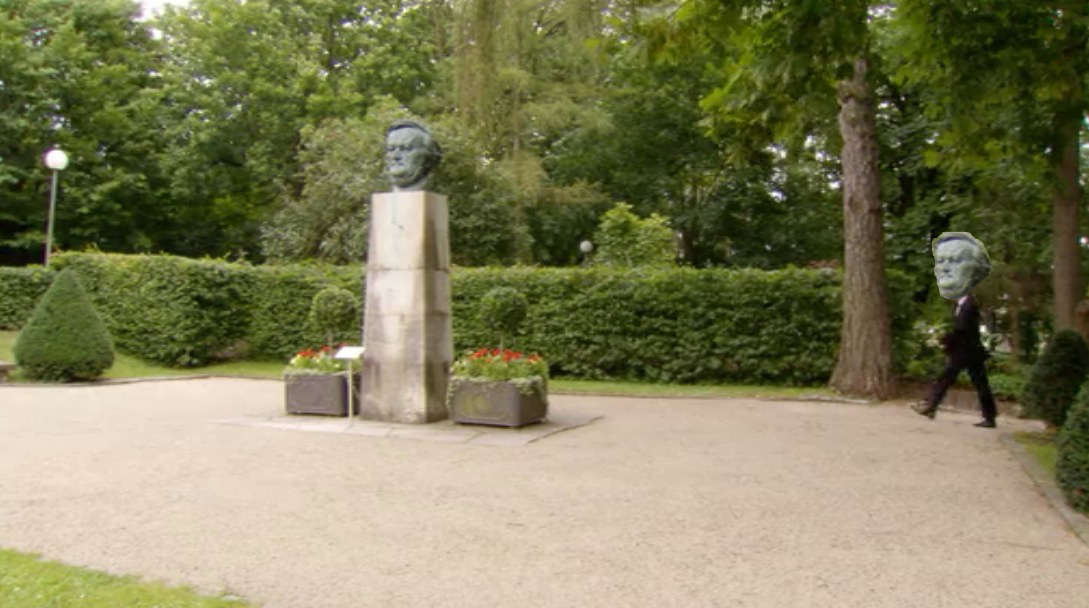
Oversized bust of Richard Wagner by Arno Breker at Bayreuth Festspielhaus (note the monumental scale)

Stephen Fry says :
"even this memorial bust was created by Hitler's favorite sculptor"

Considering that the bust was done by Arno Breker in 1939 (Breker was born 27 years after Wagner's death and the work done 56 years after) is it really surprising that it was done by a Nazi approved artist at a time when so-called degenerate art was being discouraged (as in censored). 

I'm not sure what to call this. Instead of sins of the father perhaps call it Sins of the Muse. The implication is that Hitler liked a sculptor and decades after the composer's death that sculptor used Wagner as a subject and therefore through no action by Wagner his music is tainted. 


Additionally, I'll note that Stephen Fry wore pants throughout the entire movie! Just like Hitler!