Showing posts with label Different standards for different totalitarians. Show all posts

Sunday, October 8, 2017

Propaganda posters from the Spanish Civil War #2 : Franco

(this is the second installment; the first group of propaganda posters from the Spanish Civil War is here)


Franco found here 
by J. Davó (signed at lower left) and printed by the Romero Lithograph (Tenerife, Canary Islands). Excellent use of a limited number of colors.

A smiling Franco, atop a white horse leads 2 columns of supporters. Those on the left carry the red and yellow pre-republic, red and yellow civil ensign Spanish flag (or the royalist flag if a crest is hidden in the fold). The column on the right carries the red and black flag of the Falange. Franco and his horse complete the cross.  "Julio 18, 1936" refers to the date of the beginning of the Spanish Civil War. The rays behind the cross evoke a dawn.

Franco's horse steps on a red snake, a traditional symbol of evil, holding a hammer and sickle in its mouth. The symbols of the hammer and sickle were used by some political parties of the Republican Left.

Not to be cruel, but Franco was not a particularly handsome man and yet here he is drawn in a remarkably flattering way while retaining his likeness. Contrast it to the painting below by Paco Ibera. Franco is as reality would have him : balding, bags under his eyes and a rounded chin (disguising a double chin that can be seen in the photo of Franco later in the page.

----------------
Dictator in Furs by Paco Ibera
This was previously mentioned here. Go to that link for more commentary on this.

----------------

"Franco cut off at the knees" may not have been the creator's intent

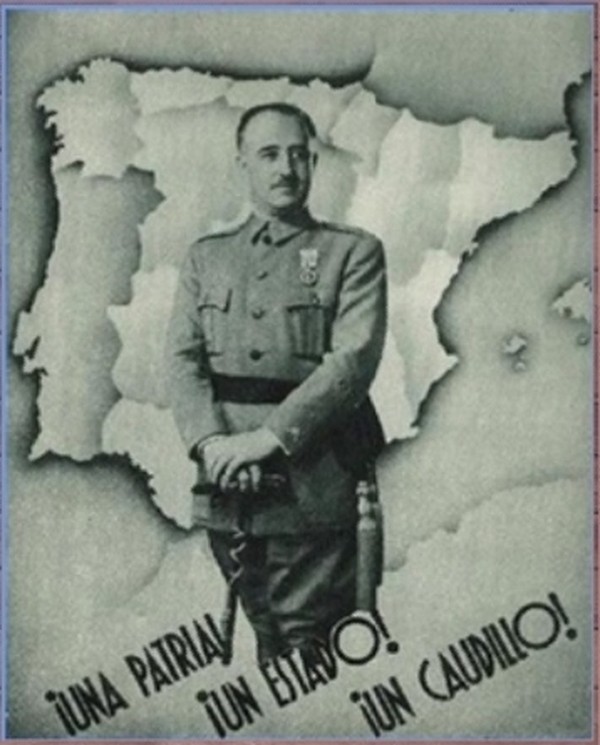
Una Patria! Un Estado! Un Caudillo! (One fatherland! One state! One strongman!)

I suspect this is not from the Spanish Civil War but afterwards.  Cropping Franco off at the knees making him look like Dorf the Dictator. I find it interesting that while there is a relatively bright contrast between the Spanish-French border there is less contrast between the Portugese-Spanish border – it is only slightly more pronounced than the internal borders. Franco presents him self simply : a lack of epaulets or furs or rows of medals.

The font seems very 1930s.

----------------

The next portray Franco is a less flattering way.

 Izquierda Republicana En Vanguardia Contra El Fascismo Internacional (Left Republican in vanguard against international fascism) by Petit Guillén Carteles  de la Republica y de la Guerra Civil #180
Left Republican in vanguard against international fascism! (Seriously, you would think they would have included an exclamation point or 2)

Izquierda Republicana En Vanguardia Contra El Fascismo Internacional (Left Republican in vanguard against international fascism) by Petit Guillén (signed at lower left)

from the upper left is Jose Maria Gil Robles (with a pear for a head and bald except for a stem on top) he wears a Sacred Heart necklace to note his Catholicism. Next to him is Benito Mussolini wearing a tiny hat. Below Gil Robles is Adolph Hitler looking sad with his head cocked horizontal.
from left to right : Gil Robles (no stem on top), Francisco Franco and unknown.

Below Hitler is a short, cartoony, Chaplinesque Francisco Franco with a swastika and a death's head on his hat and a sword in his raised hand.

They are all wrapped in the Spanish Republican flag (red, yellow and purple) being pulled by a Republican soldier. While Mussolini, Hitler and Gil Robles are bound together, Franco only has the flag wrapped on one side and he holds a sword that can probably cut fabric.

To the right, behind the soldier, and at the far right is Manual Azaña and his awkward, wrongly drawn hand and pointy finger gesturing upwards. Unlike Franco in the first image, I think here Azana looks little better than reality.

photograph of Manual Azaña (note that the artist wasn't exceptionally unflattering it is just that Manual Azaña looked like a muppet in real life.)

Surrounding Azaña is a crosshatch of white.  Part of the problem likely being those on the left (of the poster) were drawn by a skillful cartoonist while Azaña was likely drawn by the cartoonist copying a photograph and trying to draw realistically while his real talents line in his skill as a cartoonist.

At lower right is a logo "Junta Municipal Delegation de Propaganda Valencia" (Municipal Board Delegation of Propaganda Valencia) (as an aside it is a nice font)

A striking contrast in styles; cartoony for the villains and realistic for the politician and idealized for the Republican soldier.

----------------

el generalisimo by Pedero Carteles de la Republica y la Guerra Civil #551
el generalisimo by Pedrero (signed at lower left)

#551 in Carteles de la Republica Y la Guerra Civil
Junta Delegada de Defensa de Madrid

I imagine that  the title "el generalisimo" in all lower case was intended to be diminishing towards someone grandiose enough to call himself "el generalisimo."

Francisco Franco as death himself dressed in a long grey coat, a black and red cape, white gloves, and spurs. His hand on his sword and his cape carried by an obese army general, an obese capitalist and an obese friar toting a rifle. Again, Franco is shown wearing a swastika.

The helmet is more like a Prussian/German pickelhaube than a contemporary Spanish army helmet (at least as far as i've seen. In fact, while I've browsed through many photos from the Spanish Civil War the only helmets I've seen are on the Republican side. The overseas cap seems to have been worn on the Nationalist side.) Franco's white gloves remind me of the white gloves a plethora of animated cartoon characters like Mickey Mouse wear.

----------------

el generalisimo by Antonio Cañavate Carteles de la Republica Y la Guerra Civil #552
el generalisimo by Antonio Cañavate (signed)
I.E. el generalisimo
Junta Delegada de defensa de Madrid
Rivadeneyra, UGT  Madrid

I think this is the most effective. It is fun, interesting and harshly mocking. Francisco Franco on his My Little Pony (with a swastika brand). The chubby horse smiles at a butterfly as it rears up while striking a coy David-esque pose.
Napoleon Crossing the Alps by Jacques Louis David, 1801

Franco's chest is puffed out and he holds a wooden club (one of the knots is heart shaped). He wears an extravagant uniform complete with epaulets, a sash, side stripe pants, a hat with different colored feathers,He has a colorful horse blanket and a blunderbuss (outdated for a 100 years). I'm not sure why his skin is orange, perhaps to comment on his tan from his years in Morocco and the Canaries.

From the swirling clouds drop 2 bombs. The cactus in the background is made up of faces.

It is interesting that the swastika is attached to Franco by his opponents but Franco did not use it as a symbol used to represent the Nationalists. The symbol used by Franco is the old national flag - horizontal red, yellow, red stripes or the red and black Falange symbol and, of course, he used himself as a symbol.

In contrast, elements of the Spanish left also freely adopted the hammer & sickle for themselves (in particular : the PCE, Partido Comunista de Espana aka the Spanish Communist Party and PSU the Partido Socialista Unificado aka Unified Socialst Party and POUM Partido Obrero de Unificación Marxista aka the Worker's Party of Unified Marxists).

Keep in mind that at the time of the Spanish Civil War the Nazis were thugs and totalitarians but not yet genocidal mass murderers while the Soviet Union were also totalitarians and thugs but had also been responsible for the death of thousands of forced laborers constructing the White Sea Canal,  the Holodomor, a man-made famine killed millions, and Stalin's Great Purge had started. Different standards for different totalitarians I suppose.

Note the stark contrast in the message being sent : This poster and the "Izquerida Republicana" present Franco as a joke. A puffed up cartoon dandy. But the one between them shows Franco as a gigantic walking death.

Sunday, August 20, 2017

Genius of the Modern World s1e1 Marx

Genius of the Modern World, season 1, episode 1, titled "Marx" clip from about the 41 minute mark.


Bettany Hughes : And then we're told Marx made things worse. Living with the family was a feisty woman called Helene. She helped around the house, she was a fellow radical and friend but, Marx slept with her and fathered an illegitimate son at the same time that Jenny was pregnant again. This was not Marx's finest hour.

Rachel Holmes (Marx Family Biographer) : Jenny was furious. They'd all known each other for a long time. So, clearly, there is some drama and upset that goes on. and it is really heavy going. Marx is sending notes to Engels saying I can't go home because it's an absolute storm and everyone is really upset and Jenny was furious please come have a drink with me at the pub at Russell street.

Bettany Hughes  : You know he has slept with somebody who's not his wife; she's pregnant. This is a terrible stigma at the time. It's tough now it was really really tough in the nineteenth century.

Rachel Holmes (Marx Family Biographer) : Hmmmm...Well, is it? Because they are quite conventionally unconventional. And at that time, illegitimacy, particularly in the circles that they were moving in, politically and socially, isn't such a stigma. But at the same time quite a lot of the evidence points towards the fact that Jenny wanted it covered up.

Bettany Hughes  : so who takes responsibility for all this?

Rachel Holmes (Marx Family Biographer) : Who makes it ok is Engels. He makes it understood that he is the father. And Engels, he takes the rap for his best friend.

Bettany Hughes  : Wow. What do you think this incident tells us about Marx?

Rachel Holmes (Marx Family Biographer) : Marx is a man! And ultimately, also a Victorian Patriarch. A man like any other that needs to be understood in context and all heroes have their flaws.

----------------
The interview with Rachel Holmes ends on that note.

Ah, the familiar Marxist argumentation style of tossing up a variety of arguments up to see what sticks (I call it the Socialist Harangue) :
Oh, poor Marx! He was a victim in this and people were mad at him; he was suffering! Didn't fall for that? OK, then ...An illegitimate kid is no big deal! It was accepted in their social circle. Was his wife part of his social circle? OK, then ... in that case it's no big deal because Engels makes it understood that he is the father. He takes the rap and by rap I mean the thing I just claimed wasn't a big deal a moment ago. Oh, you still think it reflects poorly on Marx? OK, then ... it's because he's just a man! All men have illegitimate kids! We should really blame the Victorians as they controlled the penis of all German emigres! Blame the Patriarchy! It was taken out of context! Don't forget he's a hero! C'mon! You're holding him to too high of a standard! Other than that he's a hero! Nobody's perfect!

I'll note that the subjects of the series "Genius of the Modern World" are Karl Marx, Friedrich Nietzsche and Sigmund Freud.

from episode 2 of the series on Nietzsche :

The host, Bettany Hughes, declares that :
"The Nietzsche of the Nazis was a hideous parody... And yet perhaps the blame for his misuse is not entirely Elizabeth's. Nietzsche would never have advocated Hitler's final solution but, he was naive if he thought his work would not be misunderstood. Evil loves nothing better than a void, and the philosopher's clever, ambiguous aphorisms could easily be put to the service of evil. Even when he was entirely sane, Nietzsche  said that bad would be done in his name. The sister and the brother must share responsibility for the life that his work took on after his death."

It is worth noting that Nietzsche died in 1900 when Hitler was 11 years old and Nietzsche's Will to Power was published posthumously in 1911. Both Marx and Nietzsche wrote about the restructuring of morality and society. Despite Marx's positive view of revolutionary terror (which I don't recall the episode mentioning) there wasn't a comparable measuring of responsibility in the Marx episode.

n.b. I had previously mentioned Stephen Fry's Wagner and Me which had a similar corruption of reputation not through Wagner's own actions but but by other people's behavior.

Saturday, October 4, 2014

movie notes : Wagner & Me


The original music of Richard Wagner's Götterdämmerung bound into book form.
Wagner and Me (2010) is a little movie about Stephen Fry's mixed feelings about the music of Richard Wagner and his distaste for things associated with the music (including the composer). Fry is a professional raconteur so despite the movie at times being centered more on Fry and what he might be thinking at that particular moment than Wagnerian history (to be fair, the title is Wagner & Me as opposed to All About Wagner) it is interesting and entertaining throughout.


Stephen Fry says :
Wagner's Russian adventure was a triumph. He was even sounded out about taking over as artistic director of the Mariinsky. Had he accepted there might never have been a Bayreuth Festival House [The theater designed to Wagner's vision of his ideal theater]. He might never have completed the Ring Cycle.
His story would have had a different and probably less controversial ending.

Hmmm, if his music had become more influential in Russia than Germany… I guess Russian Czars and Russian Communists must have ruled in a boring and completely uncontroversial way.  Interesting isn't it that some mass murdering political leaders are controversial and some aren't.  Note that the controversy is not due to Richard Wagner's antisemitism which was known before his trip to Russia but because several decades after Wagner's death (Feb 13, 1883) someone bad liked his music. 

I confess that despite the movie's attempt at explaining why some people balk at Wagner because Hitler (born 6 years after Wagner's death) liked his music and the Nazi's played it, I do not understand it. I think I'll watch the movie again later to try to determine if it is a lack of understanding on my part or if I don't understand because it isn't rational.

I've heard the dislike of Wagner and of "his relationship with the Nazis" before and for a while I was under the impression that he was, if not a Nazi, then a Nazi sympathizer which must have meant that he lived to be well over 100. What is really meant is the Nazi's relationship to Wagner not Wagner's 
relationship with the Nazis as he was long, long dead. (I can't help but wonder if some people confuse Richard Wagner with another German composer, Richard Strauss, who was alive during the Nazi regime and did deal with the Nazis.)

There is a transgenerational corruption of blood mentioned in the movie, but with a twist. Normally the corruption of blood stains the descendants but Fry has the stain run from descendants' spouses to taint the ancestor and his musical compositions. The movie informs that Wagner's son-in-law Houston Stewart Chamberlain was a racist and early supporter of Hitler and his daughter-in-law Winifred is said "to revere Hitler." The beliefs of the spouse of Wagner's third child is left unmentioned. 

Other than Wagner, would Fry accept someone else claiming music or a bloodline or a family is tainted by the words and actions of ancestors or descendants? 

Hypothetically, if Johann Sebastian Bach's great-great-great-great granddaughter is a inveterate shoplifter will some people chose not to listen to a Bach piece or perhaps with the distance of time they'll simply refuse to listen to it in stereo.

At one interesting point Fry is discussing Wagner with a musician who survived the Auschwitz as to whether his music is tainted and she starts asking him questions : "What happens to you when you sit there for five hours?" "Why do you have to listen to Wagner in Bayreuth?"

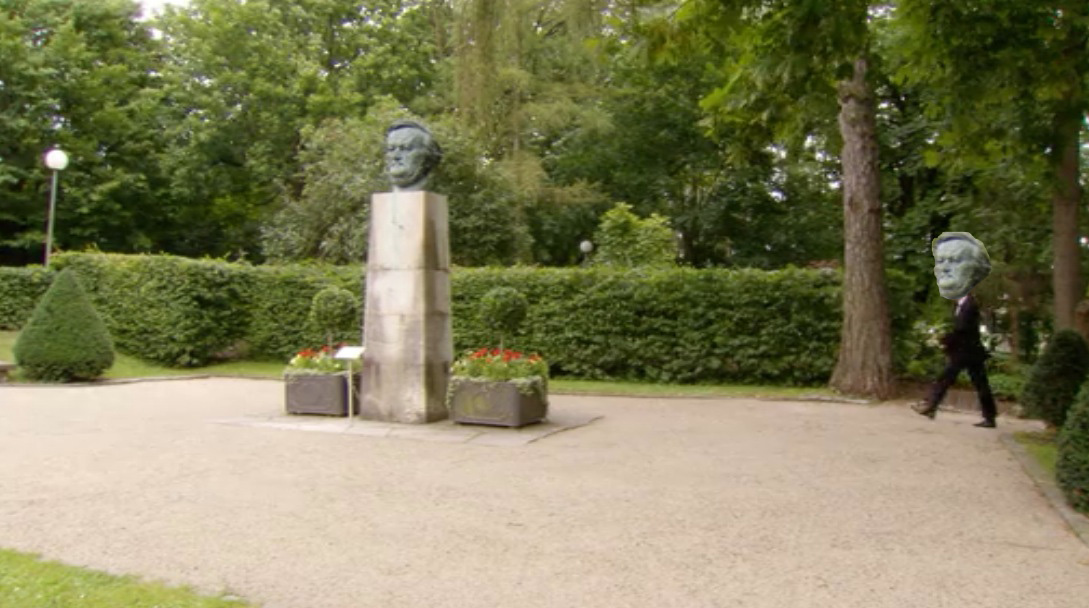
Oversized bust of Richard Wagner by Arno Breker at Bayreuth Festspielhaus (note the monumental scale)

Stephen Fry says :
"even this memorial bust was created by Hitler's favorite sculptor"

Considering that the bust was done by Arno Breker in 1939 (Breker was born 27 years after Wagner's death and the work done 56 years after) is it really surprising that it was done by a Nazi approved artist at a time when so-called degenerate art was being discouraged (as in censored). 

I'm not sure what to call this. Instead of sins of the father perhaps call it Sins of the Muse. The implication is that Hitler liked a sculptor and decades after the composer's death that sculptor used Wagner as a subject and therefore through no action by Wagner his music is tainted. 


Additionally, I'll note that Stephen Fry wore pants throughout the entire movie! Just like Hitler!