Showing posts with label Spanish Civil War. Show all posts

Sunday, February 25, 2018

Propaganda posters from the Spanish Civil War #3 : a contrast or a consensus?

(this is the third installment; the first group of propaganda posters from the Spanish Civil War is here and the second, focusing on depictions of Franco, is here)


the Government's leash hand
Izquierda Republicana Junta Municipal Valencia
Gobierno. 
Obediencia ciega hasta ganar la guerra.
Orden Publico
Agricultura
Transporte
Industrias de Guerra
Ejercito
El que trate de mermar dicha autoridad es un traidor y a estos hay que exterminarlos.

Left Republican Municipal Council Valencia.
Government. Obedience blind until winning the war.
Public Order
Agriculture
Transport
War Industries
Army
The one who tries to reduce that authority is a traitor and these must be exterminated.


-----------------

It is surprising how much the Republican side and the Nationalist side agree. The above poster calls for the extermination for those who are not blindly obedient to the government and the poster below agrees : communism leads to extermination


communism leads to extermination : for some it is a bug for some it is a feature
"Lo Que Hay... ...Detrás del comunismo"
What there is ... ....behind Communism


-----------------

(scene : interior of a Valencian poster design office)
Valencian #1 : "Let's portray the government as a giant who can guide people into working together."
Valencian #2 : "Well, we should also stress the consequences of not working together."
Valencian #1 : "Let's portray the government as a giant who is psychopathically violent at anything less than cooperation." 
Valencian #2 : "but what about disagreement or questioning or people making suggestions?"
Valencian #1 : "Okay....Let's make it a giant who is psychopathically violent at anything less than blind obedience."
Valencian #2 : "*sigh* Cold blooded murder is awesome! I want to marry that giant! But shouldn't we portray the purpose of the government?"
Valencian #1 :  "Good thinking! We'll portray the government as a giant who is psychopathically violent at anything less than blind obedience and he keeps people on leashes." 
Valencian #2 : "Who wouldn't admire a government like that"


Sunday, October 8, 2017

Propaganda posters from the Spanish Civil War #2 : Franco

(this is the second installment; the first group of propaganda posters from the Spanish Civil War is here)


Franco found here 
by J. Davó (signed at lower left) and printed by the Romero Lithograph (Tenerife, Canary Islands). Excellent use of a limited number of colors.

A smiling Franco, atop a white horse leads 2 columns of supporters. Those on the left carry the red and yellow pre-republic, red and yellow civil ensign Spanish flag (or the royalist flag if a crest is hidden in the fold). The column on the right carries the red and black flag of the Falange. Franco and his horse complete the cross.  "Julio 18, 1936" refers to the date of the beginning of the Spanish Civil War. The rays behind the cross evoke a dawn.

Franco's horse steps on a red snake, a traditional symbol of evil, holding a hammer and sickle in its mouth. The symbols of the hammer and sickle were used by some political parties of the Republican Left.

Not to be cruel, but Franco was not a particularly handsome man and yet here he is drawn in a remarkably flattering way while retaining his likeness. Contrast it to the painting below by Paco Ibera. Franco is as reality would have him : balding, bags under his eyes and a rounded chin (disguising a double chin that can be seen in the photo of Franco later in the page.

----------------
Dictator in Furs by Paco Ibera
This was previously mentioned here. Go to that link for more commentary on this.

----------------

"Franco cut off at the knees" may not have been the creator's intent

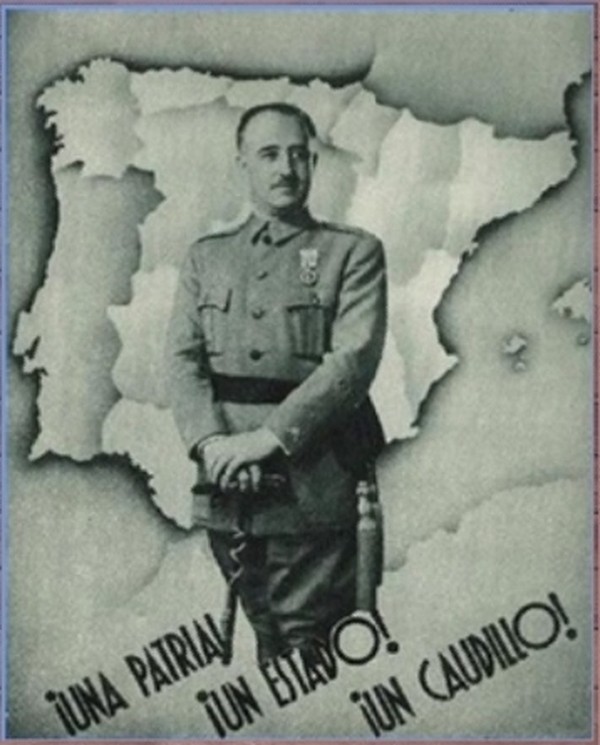
Una Patria! Un Estado! Un Caudillo! (One fatherland! One state! One strongman!)

I suspect this is not from the Spanish Civil War but afterwards.  Cropping Franco off at the knees making him look like Dorf the Dictator. I find it interesting that while there is a relatively bright contrast between the Spanish-French border there is less contrast between the Portugese-Spanish border – it is only slightly more pronounced than the internal borders. Franco presents him self simply : a lack of epaulets or furs or rows of medals.

The font seems very 1930s.

----------------

The next portray Franco is a less flattering way.
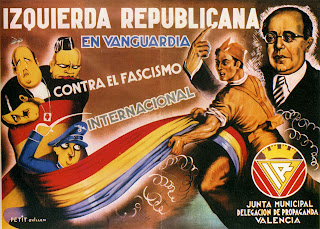
 Izquierda Republicana En Vanguardia Contra El Fascismo Internacional (Left Republican in vanguard against international fascism) by Petit Guillén Carteles  de la Republica y de la Guerra Civil #180
Left Republican in vanguard against international fascism! (Seriously, you would think they would have included an exclamation point or 2)

Izquierda Republicana En Vanguardia Contra El Fascismo Internacional (Left Republican in vanguard against international fascism) by Petit Guillén (signed at lower left)

from the upper left is Jose Maria Gil Robles (with a pear for a head and bald except for a stem on top) he wears a Sacred Heart necklace to note his Catholicism. Next to him is Benito Mussolini wearing a tiny hat. Below Gil Robles is Adolph Hitler looking sad with his head cocked horizontal.
from left to right : Gil Robles (no stem on top), Francisco Franco and unknown.

Below Hitler is a short, cartoony, Chaplinesque Francisco Franco with a swastika and a death's head on his hat and a sword in his raised hand.

They are all wrapped in the Spanish Republican flag (red, yellow and purple) being pulled by a Republican soldier. While Mussolini, Hitler and Gil Robles are bound together, Franco only has the flag wrapped on one side and he holds a sword that can probably cut fabric.

To the right, behind the soldier, and at the far right is Manual Azaña and his awkward, wrongly drawn hand and pointy finger gesturing upwards. Unlike Franco in the first image, I think here Azana looks little better than reality.

photograph of Manual Azaña (note that the artist wasn't exceptionally unflattering it is just that Manual Azaña looked like a muppet in real life.)

Surrounding Azaña is a crosshatch of white.  Part of the problem likely being those on the left (of the poster) were drawn by a skillful cartoonist while Azaña was likely drawn by the cartoonist copying a photograph and trying to draw realistically while his real talents line in his skill as a cartoonist.

At lower right is a logo "Junta Municipal Delegation de Propaganda Valencia" (Municipal Board Delegation of Propaganda Valencia) (as an aside it is a nice font)

A striking contrast in styles; cartoony for the villains and realistic for the politician and idealized for the Republican soldier.

----------------

el generalisimo by Pedero Carteles de la Republica y la Guerra Civil #551
el generalisimo by Pedrero (signed at lower left)

#551 in Carteles de la Republica Y la Guerra Civil
Junta Delegada de Defensa de Madrid

I imagine that  the title "el generalisimo" in all lower case was intended to be diminishing towards someone grandiose enough to call himself "el generalisimo."

Francisco Franco as death himself dressed in a long grey coat, a black and red cape, white gloves, and spurs. His hand on his sword and his cape carried by an obese army general, an obese capitalist and an obese friar toting a rifle. Again, Franco is shown wearing a swastika.

The helmet is more like a Prussian/German pickelhaube than a contemporary Spanish army helmet (at least as far as i've seen. In fact, while I've browsed through many photos from the Spanish Civil War the only helmets I've seen are on the Republican side. The overseas cap seems to have been worn on the Nationalist side.) Franco's white gloves remind me of the white gloves a plethora of animated cartoon characters like Mickey Mouse wear.

----------------

el generalisimo by Antonio Cañavate Carteles de la Republica Y la Guerra Civil #552
el generalisimo by Antonio Cañavate (signed)
I.E. el generalisimo
Junta Delegada de defensa de Madrid
Rivadeneyra, UGT  Madrid

I think this is the most effective. It is fun, interesting and harshly mocking. Francisco Franco on his My Little Pony (with a swastika brand). The chubby horse smiles at a butterfly as it rears up while striking a coy David-esque pose.
Napoleon Crossing the Alps by Jacques Louis David, 1801

Franco's chest is puffed out and he holds a wooden club (one of the knots is heart shaped). He wears an extravagant uniform complete with epaulets, a sash, side stripe pants, a hat with different colored feathers,He has a colorful horse blanket and a blunderbuss (outdated for a 100 years). I'm not sure why his skin is orange, perhaps to comment on his tan from his years in Morocco and the Canaries.

From the swirling clouds drop 2 bombs. The cactus in the background is made up of faces.

It is interesting that the swastika is attached to Franco by his opponents but Franco did not use it as a symbol used to represent the Nationalists. The symbol used by Franco is the old national flag - horizontal red, yellow, red stripes or the red and black Falange symbol and, of course, he used himself as a symbol.

In contrast, elements of the Spanish left also freely adopted the hammer & sickle for themselves (in particular : the PCE, Partido Comunista de Espana aka the Spanish Communist Party and PSU the Partido Socialista Unificado aka Unified Socialst Party and POUM Partido Obrero de Unificación Marxista aka the Worker's Party of Unified Marxists).

Keep in mind that at the time of the Spanish Civil War the Nazis were thugs and totalitarians but not yet genocidal mass murderers while the Soviet Union were also totalitarians and thugs but had also been responsible for the death of thousands of forced laborers constructing the White Sea Canal,  the Holodomor, a man-made famine killed millions, and Stalin's Great Purge had started. Different standards for different totalitarians I suppose.

Note the stark contrast in the message being sent : This poster and the "Izquerida Republicana" present Franco as a joke. A puffed up cartoon dandy. But the one between them shows Franco as a gigantic walking death.

Saturday, June 27, 2015

Erasing the Past : Who murdered the monks of Monasterio Montserrat

from the documentary Sagrada : Mystery of Creation (2012)

It isn't a terrible movie but it has some intrusive artistic pretensions and it uses the church as a background to tell the history of the church when I would have preferred the church and its idiosyncrasies be the subject with the history as a background.

But one thing struck me as eliding reality.


partial transcript (clip starts at about 32:30 into the film) :
Daughter of Antonio Gaudi's assistant : He [Antonio Gaudi's assistant] went there every day until July 18, 1936. Then the chaos of the civil war arrived. All the churches in Barcelona were burnt. [including the incomplete Sagrada Familia]
…
Narrator : The construction work on Sagrada Familia was abandoned. The Civil War raged on until, in the beginning of 1939, Barcelona fell, followed by Madrid shortly after.  General Franco subsequently ruled Spain with an iron hand. Speaking Catalan was prohibited. In the Monastery of Montserrat, where sermons were still held in Catalan, 21 monks were murdered. 

This suggests that Spain fell to Generalissimo Franco (true), he ruled with an iron hand (true), speaking Catalan was prohibited (sort of true) and then the monks were murdered; perhaps because they held sermons in Catalan. The problem I have is that the monks were murdered not by Franco's Nationalists but by the Republican side (more specifically, I'd guess POUM or the CNT) and they were murdered before the end of the War. Barcelona wasn't even controlled by Franco until the surrender in 1939.

Additionally, "All the churches in Barcelona were burnt." is, I think, incorrect. I could be wrong but I believe in was an anti-catholic pogrom and other churches were not targeted (as Barcelona was overwhelmingly Catholic then Protestant churches were less significant). Again, this was done not by Franco's Nationalists but by the Republican side in territory not controlled by Franco.

Anti-clerical violence started before the Spanish Civil War.  On May 10, 1931 (5 years before the start of the Spanish Civil War and less than a month after King Alfonso XIII fled) Spain saw convents set alight in Madrid, Málaga, Seville, Cádiz and Alicante and 2 dozen churches attacked.

As an aside,  I've been told that the ban on Catalan was done with typical Spanish efficiency. Schools were ordered to teach in Castilian Spanish and so they "officially" complied. The school inspector would call ahead and let them know when an inspection was coming and on that day the students would put away their Catalan books and get out their Castilian books and class would be in Castilian as required. After the inspector left the Castilian books would go back in the closet and they continued in Catalan while the inspector could file a report that he is doing a great job and everything is how it is supposed to be.

Wednesday, March 25, 2015

Civility! Calle Mateu Morral


Matteo Morral assassination attempt on the King of Spain Alfonso XIII in 1906


In 1906 Mateu Morral threw a bomb concealed as a bouquet from his hotel window at the King of Spain, Alfonso XIII, and his bride Victoria Eugenie as the wedding procession moved along the Calle Mayor in Madrid, Spain.

While his bomb left the king and queen unharmed, 25 bystanders were killed and over a hundred injured. After he was captured he killed his guard and then killed himself. 

Fast forward about 30 years :
During the Spanish Civil War, Calle Mayor (Main Street) was renamed Calle Mateo Morral by the Republican Madrid council.

Sunday, May 19, 2013

Propaganda posters from the Spanish Civil War

Propaganda poster from PSUC during the Spanish Civil War. Mes Homes! Mes Armes! Mes Municions! (translated into english is More men! More arms! More ammunition!) Signed Olé?
click to embiggen

Mes Homes!
Mes Armes!
Mes Municions!
(translated from Catalan : More men! More arms! More ammunition!)

The UGT on the armband refers to the Unión General de Trabajadores (General Union of Workers) which was usually associated with Partit Socialista Obrer Espanyol (PSOE - Spanish Socialist Workers Party) and the PSU in the corner is Partit Socialista Unificat aka the political party PSUC (Partit Socialista Unificat de Catalunya) which was part of the Comintern and Stalinist (in the sense that they supported and were supported by Stalin but also in the sense that they killed people who disagreed with them). This mainly Catalan political party didn't put the Spanish flag or the Catalan flag on their poster but the hammer and sickle (it is the same as the USSR flag except for lacking the star) :

Propaganda poster from PSUC : Ingresseu al partit socialista unificat - The Clenched Fist Salute : the Nazis weren't the only ones convincing people to publicly make silly hand gestures in unison.
PSO PCC USC PCP Ingresseu al Partit Socilista Unificat (Enters the Unified Socialist Party)
PSUC (Partit Socialista Unificat de Catalunya) was formed in 1936 by the merger of :
  1. the PSO was the Partit Socialista Obrer (Party of Socialist Workers)
  2. the PCC was the Partit Comunista de Catalunya (Communist Party of Catalonia)
  3. the USC was the Unió Socialista de Catalunya (Socialist Union of Catalonia) and
  4. the PCP was the Partit Català Proletari (Proletarian Catalan Party).
The bottom left reads "editat del sindicat de dibuixants professionals UGT" (published UGT union of professional illustrators). The bottom right is something indistinct and "…Barcelona." Signed "Rafel Tona del S.D.P." (SDP = Sindicat de Dibuixants Professionals).

The Clenched Fist Salute : the Nazis weren't the only ones convincing people to make silly hand gestures in public.


Boles, La Cinquena Columna Spanish Civil War poster by Lorenzo Goñi
boles, la cinquena columna (Bowls, the fifth column)

I don't understand this one. "Boles" is Catalan for "balls." (and it is Spanish for "bowls", the noun not the verb, which would make even less sense.) Are balls reactionary?  Bocce ball is considered fascist? Is it that the 5th column is snowballing? The first guy with a crown represents royalists, the second person has a rosary to represent Catholics and the rest I'm not sure. Are the towers supposed to be radio towers, telephone lines, a goal, or what?

Note the red seal at the lower left that says "department d'agit propaganda del…" (Department of Agitation Propaganda of [PSUC]…). At some point, propagandists continually debased facts so badly and so often that the term "propaganda" became derogatory and so people stopped labeling propaganda as propaganda.

Of the Nationalists factions, the Carlists used a Cross of Burgundy flag and Franco adopted the Falangists' symbol of a group of arrows with a yoke. The Nazi swastika doesn't seem to have been used extensively by the Nationalists. From what I've seen even the planes of the German Condor Legion were not marked with the swastika. I have seen a photo of Franco's car and it did have a swastika on it on at least one occasion and more importantly Franco and the Nationalists received support from both Nazi Germany and Fascist Italy including German airplanes and thousands of Italian soldiers. The swastika was not the symbol the Nationalists most associated with themselves but their opponents certainly associated them with it.

Venus Dictator in Furs. Painting by Paco Ibera

Franco in furs like Bette Davis.  He wears his Miss España sash in the traditional Spanish colors (as opposed to the red, yellow & purple of the Republican flag) and on his chest is a maltese cross (an order of knighthood perhaps? – this forum leads me to the Grand Cross of the Order of San Fernando). Below the cross is a pin of the symbol of the Falangists. His hand rests on a cane while his other hand holds his hat; a garrison cap with a gold tassel. He tries to strike a regal pose. Franco alone takes up nearly half of the image.

On the lower left is a cartouche with Franco's well known and brief declaration of the end of the Spanish Civil War. In a Roman font it declares in large type "La Guerra ha terminado" (The war is over).  There is probably no connection between this and John Lennon's song "War is Over."

The cartouche also says "Parte oficial de guerra. Correspondiente al dia 1º de Abril de 1939 - III Año Triunfal." (Official report of the war. Corresponding to 1st day of April 1939 - Triumphal Year III.) "Triumphal Year III" is itself propaganda, imitating Mussolini's declaration of 1922 (the year Mussolini came to power) as Year One. Declaring a Triumphal Year and Triumphal Year II without being completely triumphant doesn't seem ideal.

"En el día de hoy cautivo y desarmado el ejército rojo, han alcanzado las tropas nacionales sus últimos objectivos militares. Burgos, 1 de abril de 1939 Ano de la Victoria" (On this day, with a captive and disarmed Red Army, the national troops have reached their final military objectives. Burgos – a city in Northern Spain, 1 April 1939 Year of the Victory.)

At the top of the cartouche is a new Spanish coat of arms that harkens back to the royal coat of arms used from 1469 to 1516. Behind the black bird (eagle of Saint John) is a ribbon reading "Una, Grande, Libre" (one, great, free). Declaring Spain to be united was a fiction and free is not what one most associates with a dictator.

At the bottom left of the cartouche is the seal of Franco reading "cuartel general del Generalisimo, estado mayor" (General barracks of the Generalisimo, major staff).

The flags in the background include :

several red and yellow Spanish National flags (they appear to be civil flags without the royal seal)

several Falangist flags (red-black-red with the Falangists symbol in red on the black stripe)

several appear to be the Carlists' Cross of Burgundy (a jagged red cross on a white field)

one Spanish Morocco's Royal standard (green flag with a yellow pentagram)

I think, one Flag of the Khaliph of the Spanish Protectorate of Morocco (green flag with a yellow star of David) although it may be the same as above.

There are no swastikas, nor any acknowledgement of the German or Italian forces that fought in the war.

The men in the background march : some on horses, some wounded, some dressed like beduins, some in berets, some in helmets, some giving a roman salute (ie a fascist salute), some carrying flags, and some oddly shaped aircraft in the upper right (Savoia-Marchetti SM.81 without the fixed landing gear or JU-52s?).


Dos and Don'ts of do it yourself propaganda : 
  1. Do use Repetition! Repetition! Repetition! Repetition!
  2. Do keep in mind it is more than just words : the black smear behind the guy in the white shirt towards the upper left corner probably exists only to make it a better composition.
  3. Do sign it! (although, one might recommend signing it in a legible way. The top one is signed by Solá, the second by Rafel, the third one is signed by Lorenzo Goñi; the fourth is signed, I think, in the lower right corner by Paco Ibera.) 
  4. Do stake out the idea that there are only two sides (the real world is more complex. Keep in mind that this black and white attitude and the tendency to simply lie about the other side is among the reasons why many people don't like or respect propaganda. So, don't do this if you want to be respected.).  The Franco declaration suggests that there were only 2 sides and that because the officials of the Republic surrendered then people would think there was no one in opposition.  Most people will accept the rigid dichotomy instead of thinking how many people fall out side the binary choice – like Joan Pujol who was imprisoned by and disliked both the Nationalist government and the Republican government.
  5. Don't call it propaganda as some people will simply shrug and think "Ah, another person who feels the need to lie or mislead or be blindly partisan to support their cause."
  6. When showing your side, do keep them blocky, stylized, simplified and in unison. When showing the other side then details become acceptable to make them grotesque and unappealing. Although, I would point out that the Nationalists are depicted as being happy; in stark contrast to most figures in propaganda. The other posters are using the blocky, stylized, simplified figures in unison as a symbol of power. They could portray their side as happy little smurfs or even happy little barbarians but people know when they are happy and propaganda that tells them they are happy when they aren't would not be effective.