Tuesday, November 14, 2017

movie notes : Queen Margot (1994)

Queen Margot American movie poster
I don't think a scene of these two wrapped in a red blanket was actually in the theatrical release of the movie

Queen Margot (1994) is a French historical movie and I highly recommend it.

It is a 1994 movie based on the 1845 Alexander Dumas novel which in turn is based on French history from 1572. I don't particularly trust anything that is "based on a true story" so I'm a little uneasy about the historical veracity of a movie based on the novelization of history written 273 years after the events took place and the movie is close to half a millennium (422 years) away from the actual events

For much of the movie I had no idea what was going on in context of French history. Fortunately, it's characters follow human impulses and it wasn't hard to understand what was going on. I'm pretty sure the movie covered all 7 deadly sins (gluttony, lust, greed, hubris, despair, wrath, vainglory, and sloth).

La Reine Margot - Queen Margot french movie poster
the French movie poster


Isabelle Adjani is a fragile beauty but none the less a beauty and I couldn't keep my eyes off of her. In contrast, Henry III of Navarre is played by Daniel Auteuil an ugly frenchman (not to be cruel but he doesn't have conventional movie star good looks. He did a good job though). In the poster at the top of the post, they focus on Adjani and her other costar Vincent Perez.  Adjani is full of emotion but unlike her contemporary Juliette Binoche doesn't spend all her time crying (Binoche seemed to have a talent for beautifully weeping).

Margot and Catherine de Medici (Adjani and Virna Lisi who at times is a little scary looking and seems to age 20 years in the movie) 
The costumes and sets are wonderful. The violence in the movie starts slow but builds and then peaks with the St Barthelomew's Day Massacre. It is often a beautiful movie. At times this movie is like a French painting of Gericault or Delacroix come to life.

I didn't keep a death count during the movie because I usually only do that with action movies but I should have. It was a lot.

I actually sat in the theater during the entire end credits listening to the music. In particular, I found one song compelling; what I assumed at the time was a late medieval French folk song isn't. Obviously I don't speak French, the song "Elo Hi" is in Hebrew.


Elo Hi by Ofra Haza


La reine Margot – Soundtrack is an album by Goran Bregović, with the music that he composed for the 1994 film La Reine Margot, by Patrice Chéreau. Like most of Bregović's work, the melodies in this soundtrack are heavily influenced by Balkanfolk music tradition, but he also refurbished and recycled some of his previous work while he was the frontman of Bijelo dugme, one of the most influential Yugoslav rock bands of the 1970s and 1980s
An unexpected source of music for a French film.

Friday, October 27, 2017

movie notes : Breaking the Waves (1996)


Cinéma vérité : in this case, pointlessly lingering shots to pad the running time and flaunt self-indulgent pretentiousness.

I saw Breaking the Waves (1996) in the theater. It is about a simple minded woman who might be crazy and thinks she talks to god. She marries an oil rig worker (I can't recall if there was a connection between the 2 or if it was just physical or if it was just convenient to the plot). She misses him while he is gone and prays for him to come back to her and then he is permanently paralyzed in an accident (a well done scene as I recall). Hopeless, he tells her to move on. Trying to convince her to move on he tells her to sleep with other men then he'll get better.

Between the trite plot, an ending that I predicted halfway through (but I thought it was too lame and hackneyed to make it into a movie), the so-called characters and the feeling that its 4 and a half hour running time could have been edited down to 30 minutes I felt absolute rage at this movie, for while having potential, turning out to be a waste of time. If I hadn't been the only person in the theater I would have tried to start a riot to tear down the screen and hang the director (Lars von Trier) in effigy.

I've never walked out of a movie but this is one that I wish I had.

People would explain to me that it is an artistic triumph, that it is well respected, that it is the darling of critics all over the world, that it is important and that it is an award winning movie but absolutely none of them had seen the movie.

I thought about rewatching it before writing this review but the intensity of my dislike for it remains. (I should also note that while I wrote above that it had a 4 and a half hour running time according to dvd.com its running time was only 2hrs 39min – it only felt twice as long.)

Thursday, October 26, 2017

Painting in a Painting : John Singer Sargent


Claude Monet, Painting by the Edge of a Wood, 1885 by John Singer Sargent 


detail :
Monet's unfinished canvas in the Sargent painting cropped and distorted into a rectangle. (note the inclusion at the bottom right of Monet's hand, blue shirt and pallette)


Below, to contrast is Monet's finished painting

Meadow with Haystacks near as Près à Giberny, 1885 by Claude Monet

Sunday, October 8, 2017

Propaganda posters from the Spanish Civil War #2 : Franco

(this is the second installment; the first group of propaganda posters from the Spanish Civil War is here)


Franco found here 
by J. Davó (signed at lower left) and printed by the Romero Lithograph (Tenerife, Canary Islands). Excellent use of a limited number of colors.

A smiling Franco, atop a white horse leads 2 columns of supporters. Those on the left carry the red and yellow pre-republic, red and yellow civil ensign Spanish flag (or the royalist flag if a crest is hidden in the fold). The column on the right carries the red and black flag of the Falange. Franco and his horse complete the cross.  "Julio 18, 1936" refers to the date of the beginning of the Spanish Civil War. The rays behind the cross evoke a dawn.

Franco's horse steps on a red snake, a traditional symbol of evil, holding a hammer and sickle in its mouth. The symbols of the hammer and sickle were used by some political parties of the Republican Left.

Not to be cruel, but Franco was not a particularly handsome man and yet here he is drawn in a remarkably flattering way while retaining his likeness. Contrast it to the painting below by Paco Ibera. Franco is as reality would have him : balding, bags under his eyes and a rounded chin (disguising a double chin that can be seen in the photo of Franco later in the page.

----------------
Dictator in Furs by Paco Ibera
This was previously mentioned here. Go to that link for more commentary on this.

----------------

"Franco cut off at the knees" may not have been the creator's intent

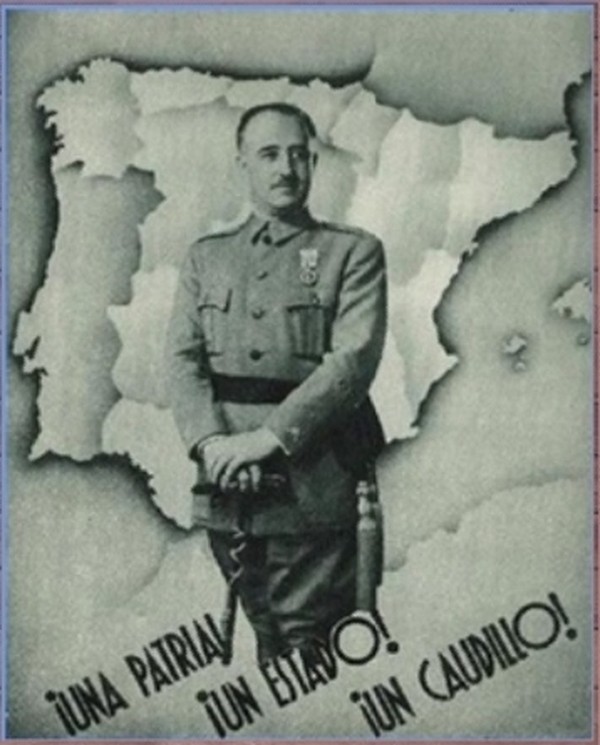
Una Patria! Un Estado! Un Caudillo! (One fatherland! One state! One strongman!)

I suspect this is not from the Spanish Civil War but afterwards.  Cropping Franco off at the knees making him look like Dorf the Dictator. I find it interesting that while there is a relatively bright contrast between the Spanish-French border there is less contrast between the Portugese-Spanish border – it is only slightly more pronounced than the internal borders. Franco presents him self simply : a lack of epaulets or furs or rows of medals.

The font seems very 1930s.

----------------

The next portray Franco is a less flattering way.
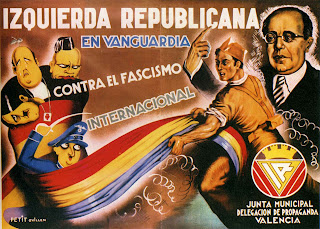
 Izquierda Republicana En Vanguardia Contra El Fascismo Internacional (Left Republican in vanguard against international fascism) by Petit Guillén Carteles  de la Republica y de la Guerra Civil #180
Left Republican in vanguard against international fascism! (Seriously, you would think they would have included an exclamation point or 2)

Izquierda Republicana En Vanguardia Contra El Fascismo Internacional (Left Republican in vanguard against international fascism) by Petit Guillén (signed at lower left)

from the upper left is Jose Maria Gil Robles (with a pear for a head and bald except for a stem on top) he wears a Sacred Heart necklace to note his Catholicism. Next to him is Benito Mussolini wearing a tiny hat. Below Gil Robles is Adolph Hitler looking sad with his head cocked horizontal.
from left to right : Gil Robles (no stem on top), Francisco Franco and unknown.

Below Hitler is a short, cartoony, Chaplinesque Francisco Franco with a swastika and a death's head on his hat and a sword in his raised hand.

They are all wrapped in the Spanish Republican flag (red, yellow and purple) being pulled by a Republican soldier. While Mussolini, Hitler and Gil Robles are bound together, Franco only has the flag wrapped on one side and he holds a sword that can probably cut fabric.

To the right, behind the soldier, and at the far right is Manual Azaña and his awkward, wrongly drawn hand and pointy finger gesturing upwards. Unlike Franco in the first image, I think here Azana looks little better than reality.

photograph of Manual Azaña (note that the artist wasn't exceptionally unflattering it is just that Manual Azaña looked like a muppet in real life.)

Surrounding Azaña is a crosshatch of white.  Part of the problem likely being those on the left (of the poster) were drawn by a skillful cartoonist while Azaña was likely drawn by the cartoonist copying a photograph and trying to draw realistically while his real talents line in his skill as a cartoonist.

At lower right is a logo "Junta Municipal Delegation de Propaganda Valencia" (Municipal Board Delegation of Propaganda Valencia) (as an aside it is a nice font)

A striking contrast in styles; cartoony for the villains and realistic for the politician and idealized for the Republican soldier.

----------------

el generalisimo by Pedero Carteles de la Republica y la Guerra Civil #551
el generalisimo by Pedrero (signed at lower left)

#551 in Carteles de la Republica Y la Guerra Civil
Junta Delegada de Defensa de Madrid

I imagine that  the title "el generalisimo" in all lower case was intended to be diminishing towards someone grandiose enough to call himself "el generalisimo."

Francisco Franco as death himself dressed in a long grey coat, a black and red cape, white gloves, and spurs. His hand on his sword and his cape carried by an obese army general, an obese capitalist and an obese friar toting a rifle. Again, Franco is shown wearing a swastika.

The helmet is more like a Prussian/German pickelhaube than a contemporary Spanish army helmet (at least as far as i've seen. In fact, while I've browsed through many photos from the Spanish Civil War the only helmets I've seen are on the Republican side. The overseas cap seems to have been worn on the Nationalist side.) Franco's white gloves remind me of the white gloves a plethora of animated cartoon characters like Mickey Mouse wear.

----------------

el generalisimo by Antonio Cañavate Carteles de la Republica Y la Guerra Civil #552
el generalisimo by Antonio Cañavate (signed)
I.E. el generalisimo
Junta Delegada de defensa de Madrid
Rivadeneyra, UGT  Madrid

I think this is the most effective. It is fun, interesting and harshly mocking. Francisco Franco on his My Little Pony (with a swastika brand). The chubby horse smiles at a butterfly as it rears up while striking a coy David-esque pose.
Napoleon Crossing the Alps by Jacques Louis David, 1801

Franco's chest is puffed out and he holds a wooden club (one of the knots is heart shaped). He wears an extravagant uniform complete with epaulets, a sash, side stripe pants, a hat with different colored feathers,He has a colorful horse blanket and a blunderbuss (outdated for a 100 years). I'm not sure why his skin is orange, perhaps to comment on his tan from his years in Morocco and the Canaries.

From the swirling clouds drop 2 bombs. The cactus in the background is made up of faces.

It is interesting that the swastika is attached to Franco by his opponents but Franco did not use it as a symbol used to represent the Nationalists. The symbol used by Franco is the old national flag - horizontal red, yellow, red stripes or the red and black Falange symbol and, of course, he used himself as a symbol.

In contrast, elements of the Spanish left also freely adopted the hammer & sickle for themselves (in particular : the PCE, Partido Comunista de Espana aka the Spanish Communist Party and PSU the Partido Socialista Unificado aka Unified Socialst Party and POUM Partido Obrero de Unificación Marxista aka the Worker's Party of Unified Marxists).

Keep in mind that at the time of the Spanish Civil War the Nazis were thugs and totalitarians but not yet genocidal mass murderers while the Soviet Union were also totalitarians and thugs but had also been responsible for the death of thousands of forced laborers constructing the White Sea Canal,  the Holodomor, a man-made famine killed millions, and Stalin's Great Purge had started. Different standards for different totalitarians I suppose.

Note the stark contrast in the message being sent : This poster and the "Izquerida Republicana" present Franco as a joke. A puffed up cartoon dandy. But the one between them shows Franco as a gigantic walking death.

Monday, September 4, 2017

movie notes : Valdemar Legacy (2010)


The Valdemar Legacy (2010) is Lovecraftian horror movie. It was pretty good. It had some tension and it maintained my interest.

The main problem with the movie is the structure. It begins with one set of characters but then has a long flashback with a different set of characters and ends with the first set of characters ready for Valdemar Legacy II. Now, if I had part II queued up after finishing part I then that might be ok; but I didn't.

Spanish language with subtitles and if you watch it with the Amazon Video subtitles turned on then it provides subtitles for the sound effects.

The character Jervás was played by Paul Naschy who I would swear I've seen in more than one movie but I can't figure out which.

----------------

from imdb's trivia section :
The first movie in all Spanish's cinema history made without Spanish government subsidies.

That seems both impossible and yet somehow plausible.

Sunday, September 3, 2017

Pickelhaube and other headgear


pickelhaube helmet

The spiked german helmet is called a Pickelhaube and upon learning that as a kid I couldn't decide if the name was awesome or hilarious – I later learned it basically translates to "pointy hat" and not "pickle holder" as I had assumed.  This isn't to suggest that you couldn't stick a pickle on to the spike to save it for later. 


Otto Von Bismark in pickelhaube 


Russian Cavalry


An imperial double headed eagle as tall as the rest of the helmet is pretty magnificent. I suppose the spectacular hat is to make up for the fact that he is the cavalry drummer and in about a decade the Russian army would face a Japanese army armed with machine guns.


Russian Army (from here)

While the practicality of a giant feathered plume on your hat might be questioned by some. I wonder if its use waned because it would go embarrassingly flaccid in the rain? 

French army helmet circa World War 1

The French WW1 helmet above has a decorative hump attached, although it was much less extravagant than the golden age. As the steel protective helmet took off the decorative features become less common.


Russian Lancer

The age of fantastic hats was also an age of proud facial hair. Although the fellow above may be making a statement with his lack symmetry.


German Lancer 1914
Note his great squared and flat topped lancer helmet. Just imagine all things he could have balanced up there. People may not be surprised at a head on a pedestal but what about a pedestal on top a head? That's a man with a dangerous outlook on the world.