Monday, December 2, 2013

movie notes : the Pruitt-Igoe Myth

The Pruitt-Igoe Housing Project being given up on as a failure and imploded after only 18 years after taking over $300 million (in 2013 dollars)  to build.
The Pruitt-Igoe Myth (2011) was imperfect but still an interesting documentary about rise and fall of the Pruitt-Igoe public housing project. One thing that stuck with me is that the introduction and conclusion assert that blaming modernist architecture, the welfare state and residents as causes of the decline of Pruitt-Igoe were mythical and that there were other external reasons for the decline. Interestingly, while watching it, it seemed that a fair amount of the material presented does point some blame in the direction of the so called myths.

I've strung together a few clips that I found interesting. Below is a partial transcript of those clips and some commentary.


The Myth of the Pruitt-Igoe Myth


clip one - introduction
The Pruitt-Igoe public housing development in St Louis, Missouri was opened in 1954 and demolished in 1972.
"What caused the failure? The Pruitt-Igoe myth begins here. … Some blame the architect, Modernist high rises like Pruitt-Igoe the say created a breeding ground for isolation, vandalism and crime … Others attacked the welfare state. Big government, the problem and Pruitt-Igoe the result. … Many stated flatly that the residents were too poor, uneducated or rural. That they caused their own problems and had taken Pruitt-Igoe with them. … Long after the dust settled and the site was cleared this was the Pruitt-Igoe that remained. The mythical Pruitt-Igoe with a fatal flaw, doomed to failure from the start."
here is your myth checklist :
  • modernist architecture
  • the welfare state
  • the residents caused their own problems


clip two -  conclusion (starts at 3:25)
"The implosion footage was so shocking just because there was still in people's minds the idea that this had been the solution. It was a very painful moment of truth to see that failure. That's why in many ways that Pruitt-Igoe is not just the national and even the world symbol for the failure of American public housing it's also been a symbol for the perceived failure of well intentioned government policies in general. And that's why I think its so important to look beyond the famous pictures of the towers being destroyed and really try to understand what failed and why. In some ways Pruitt-Igoe failed because housing alone couldn't deal with the most basic issues that were troubling the American city. There was just no way to build your way out of that tragedy. I think we have a responsibility to understand those failures and to learn from them and to do better." – Robert Fishman (urban historian)

"We don't want people to think of Pruitt-Igoe as a failure if they're going to then to translate that failure into all public housing or all government programs or all social welfare or all modernism. That is what Pruitt-Igoe has been freighted with. If we want to say that this one project, in this one place, for this one set of reasons declined to the point where people thought it was necessary to tear it down that's one thing. But that's simply not how we've told the story."

What a bizarre standard for judging failure!  If someone suggests a systemic problem then people should pretend Pruitt-Igoe was a roaring success? That attitude makes me doubt how much some people want to learn from the failure if they refuse to consider some potential causes. 
The bigger story is in fact the decline of the city overall. What happened to St Louis was tragic. It's kind of a slow motion Katrina in a way. St Louis lost half its population and had a devastated tax base and a drained economy over the course of 50 years from World War II even to the present. It's no wonder Pruitt-Igoe declined in those circumstances. I mean, it would be hard to imagine a public housing project surviving under those conditions" – Joseph Heathcott
Did other housing survive? Did other neighborhoods in St Louis survive? If so then it suggests that there might have been something unique to Pruitt-Igoe being a government project and in being a political project. 


clip three - planning and control (starts at 6:11)
"Before we moved into Pruitt-Igoe, the Welfare Department came to our home, they talked with my mother about moving into the housing project but the stipulation was that my father could not be with us. They would put us into the housing projects only if he left the state. My mother and father discussed it and they decided it was best for the 12 children for the father to leave the home. And that's how we got into the projects"  – Jacquelyn Williams (former resident) 
Gee, what could go wrong.  Surely, the Welfare Dept. didn't see itself as splitting a family apart and positioning the government and/or modernist architecture to be a replacement parent. I bet the Department was mostly concerned not with any consequences but if it could recruit enough residents to meet the bureaucracy's expectations. Unfortunately, the filmmakers didn't let us know if her parents came to regret that decision.

"The Welfare Department had a rule that no able bodied man could be in the house if a woman received aid for dependent children. If a man lost his job and was looking for work he still had to leave the home. There was even a night staff of men who worked for the welfare department whose job was to go to the homes of the welfare recipients and they searched to find if there was a man in the home."  – Joyce Ladner (sociologist)
"There were so many restrictions. We couldn't have a telephone. We couldn't have a television."  – Jacquelyn Williams (former resident) 

The rules of the housing project concerning TVs were changed a few years later. I'm not sure about the phone rule. Sometimes control is about control.


clip four - "unbreakable" (starts at 9:45)
"I think it created a mindset for the inhabitants that they weren't cared about and I think that manifested itself in a way that caused more harm to the tenants than an other entity. The vandalism that existed at Pruitt-Igoe came from that environment. Things allowed to just deteriorate and people not really caring. And so management decided, well instead of  trying to enhance their existence we'll just make things so they can't be destroyed. Everything had to be protected. Light fixtures; no light exposed and shields around them with mesh metal protecting the bulb. Y'know, the fact that it was indestructible made you want to try to destroy things."  – Brian King (former resident)
This does seem inherent to public housing as when most people destroy their own property they find that they have to spend their own money to replace it.  The modernist dream of regimenting people into designated communal areas led to a tragedy of the commons.
"There was a screen around the lightbulb that kept you from breaking them. Y'know, kids'll be kids, find a way to break 'em. … they took all the lights off the elevator, put 'em, recessed them up into the ceiling and then they tried to cover that up with plexiglass but sometimes people would try to set that plexiglass on fire. Sometimes instead of taking the trash and putting it inside the incinerator, they just set it on fire right out there in the middle of the floor… After I moved away from Pruitt-Igoe, I went on to become a police officer with St Louis City… I do remember people calling the police and trying to come into the buildings and the would drop just anything they could find. Trash; throw trash out the window. I remember that. I remember them throwing firebombs out onto the police cars. I remember they did that.  So there is enough blame to go around."  – Valerie Sills (former resident)
"I don't think that people rationalized that somebody's house burned down or people could be killed. I think they just saw that firetruck or that  police car or that ambulance as the enemy. It was just bitter people, angry people and that was a way of making a statement. We're not happy here and we want you to know it. And the way you gonna know it is these bricks and bottles will rain down on you no matter who it's saving , no matter how relevant or important it is. We want you to understand you're not welcome here."  – Brian King (former resident)

Contrary to Le Corbusier and the Modernists, communities are built through human interaction and individual decisions and do not spring into existence as soon as an architect declares something to be communal property.  I don't think it would be too harsh to suggest that some of the residents "caused their own problems" as I think most would consider their home being on fire to be a problem.

The movie suggests that the problems with Pruitt-Igoe were caused not by modernist architecture, the welfare state or some of the residents but by was racism, housing discrimination, segregation and the rise of suburbanism. This seems less convincing when one realizes that blacks lived in places other than Pruitt-Igoe and lived there successfully without lighting the place on fire or shattering their own light bulbs. It is true that a person can die if they have no food for a month but that does not mean that it isn't also true that a person can die from a lack of oxygen.

From the Housing & Urban Development publication Creating Defensible Space by Oscar Newman (April 1996) p11 (PDF)
"Across the street from Pruitt-Igoe was an older, smaller, rowhouse complex, Carr Square Village,  occupied by an identical population. It had remained fully occupied and trouble-free throughout the construction, occupancy, and decline of Pruitt-Igoe."

Thursday, November 14, 2013

How Orwellian : Women live longer than ever – women hardest hit

map of US life expectancy gender gap (here)


The headline is "U.S. Life Expectancy Map: The Gender Gap" with the subhead "Ladies Last" on this National Geographic piece by Amanda Fiegl

How long do you have? It depends on gender and geography. In the U.S., women live longer—81 years on average, 76 for men—but a recent study by the Institute for Health Metrics and Evaluation reveals a troubling trend. Though men's life spans have increased by 4.6 years since 1989, women have gained only 2.7 years, perhaps because a larger percentage of women have lacked adequate treatment for high blood pressure and cholesterol. "This is a wake-up call," says study co-author Ali Mokdad.

The question remains whether the "troubling trend" is that men's life expectancy has increased or if the troubling part is that women life expectancy increased less than men.

Despite the article's subhead reading "Ladies Last" the map is labeled "Margin by which women outlive men" with, apparently, no areas of the US where men outlive women. Poor, poor ladies last.

In looking for the context of the quote "This is a wake-up call"  this USA Today article shows that Ali Mokdad was referring not to men's increase or the comparative increase of women's but to some areas that have had a stagnation or decrease in life expectancy.

Amanda Fiegl's blinkered one-sidedness is similar to the WEF Gender Gap report mentioned previously.

Monday, November 11, 2013

Charles P. Pierce is an idiot


(a reprise from elsewhere from the day of the Boston Marathon Bombing (Apr 15, 2013)  but as far as I'm aware Charles P. Pierce is still an idiot.)

from Charles P. Pierce at Esquire : 
"Obviously, nobody knows anything yet, but I would caution folks jumping to conclusions about foreign terrorism to remember that this is the official Patriots Day holiday in Massachusetts, celebrating the Battles at Lexington and Concord, and that the actual date (April 19) was of some significance to, among other people, Tim McVeigh, because he fancied himself a waterer of the tree of liberty and the like."

Don't jump to conclusions about foreigners when you can jump to conclusions about your fellow citizens.
-----------------
that this is the official Patriots Day holiday in Massachusetts, celebrating the Battles at Lexington and Concord, and that the actual date (April 19) was of some significance to, among other people, Tim McVeigh.

Follow the logic : 
  • there is a bombing on April 15
  • April 15 is Patriot's Day in Massachusetts (third Monday in April since 1969)
  • Patriot's Day in Mass used to be on April 19
  • In 1995, Patriot's Day fell on April 17 and Tim McVeigh (b. 1968) said his act of mass murder was done on April 19, 1995 as that was the anniversary of the end of the Waco Seige.
  • Therefore there might be a connection between McVeigh's bombing on April 19 and the April 15 Boston Marathon bombing.
  • Connect the dots, Sheeple!


Although it may have missed the grasp of Charles P. Pierce, my guess would be that the date of the Boston Marathon bombing was chosen based on the date that the Boston Marathon was scheduled to be held. Imagine the Groundhog Day Liberation Front trying to bomb the Boston Marathon on Feb 2. 

Wednesday, November 6, 2013

Art as a Creative Endeavor : Ingres vs Romans

JAD Ingres painted 2 portraits of Madame Moitessier (born Marie-Clotilde-Inès de Foucauld). The first one he started working on is the seated portrait below. It was commissioned in 1844, drawn onto the canvas by 1847 but not completed until January of 1857.

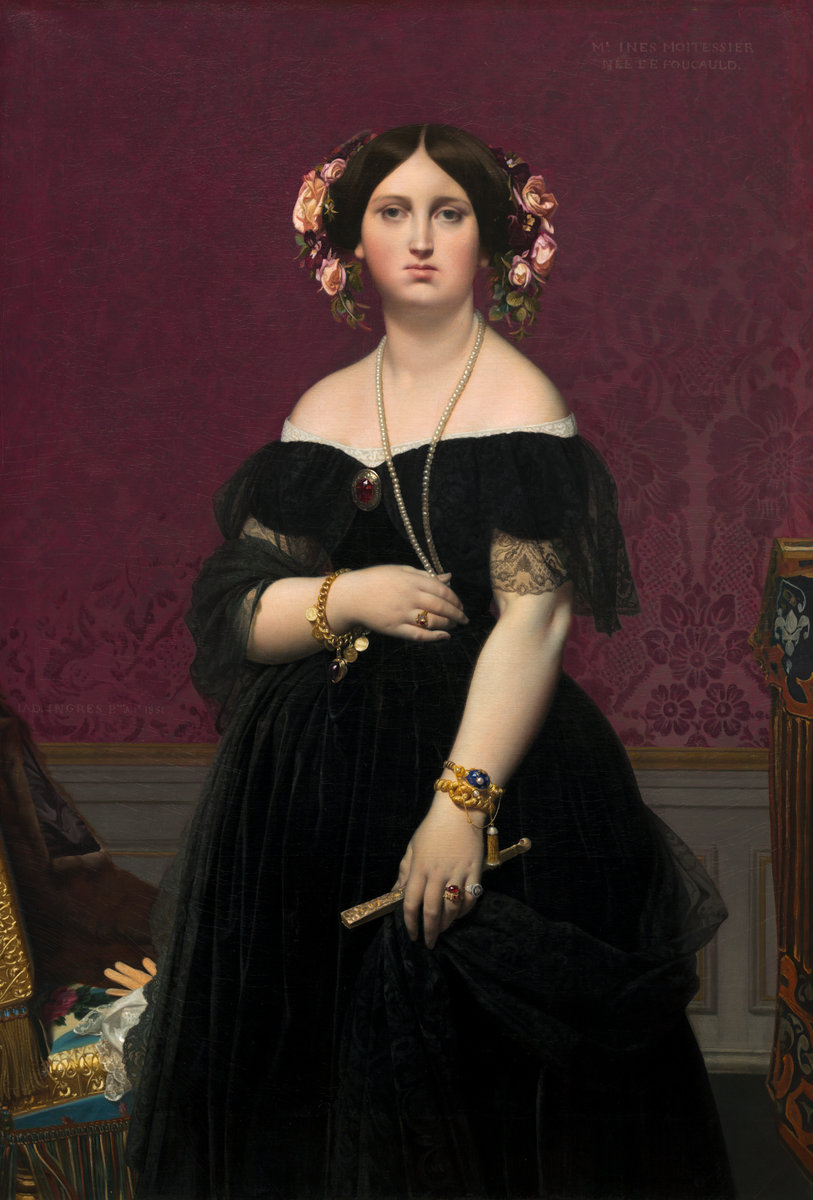
The second (or the first one completed) was started and finished in 1851 and is the portrait of her standing which is now at the US National Gallery of Art and mentioned previously.


.portrait of Madame Moitessier by JAD Ingres
click to embiggen
Portrait of Madame Moitessier Seated by Jean-Auguste-Dominique Ingres, 1851
oil on canvas, 120 cm × 92 cm (47 in × 36 in), British National Gallery, London, UK


Roman Fresco of Hercules and Telephus from the ruins of Herculaneum, 1st century AD

Roman fresco of Hercules and Telephus from Herculaneum which influenced the portrait of Madame Moitessier by JAD Ingres
Roman Fresco of Hercules and Telephus in color (Telephus is Hercules' son and is being suckled by the doe in bottom left) "Herakles Finding His Son Telephus"
79.5 x 63.375 in, Musei Nazionale, Naples, Italy
Ingres' original concept was to include Moitessier's daughter in the painting. However, the child did not sit well and progress on the painting took years. One wonders, would she have been the child behind the sitting woman (the pan flute makes me think it might be a satyr) or the child suckling a deer?

study for the seated portrait of Madame Moitessier by JAD Ingres
Study for the Portrait of Madame Moitessier Seated by Jean-Auguste-Dominique Ingres superimposed on the painting, c1846-48, graphite on paper 6.375 x 4.625 inches (16.2 x 11.8 cm)
The pencil drawing above superimposed onto the painting shows the oval head of Mme Moitessier's daughter, Clotilde-Marie-Catherine who was born March 19, 1843. That means at the time of the commission Clotilde was one year old, at the time of the pencil drawing she was 3 to 5 years old, and at the time of completion little Clotilde was nearly 14. The pose of the small child would be less suitable for a teenager.

Also worth noting is the second portrait in profile in the sitting portrait. It is ostensibly reflected in the mirror but to get that reflection the mirror would have to at a different angle instead of flush on the wall.

detail of the right hand in the portrait of Madame Moitessier by JAD Ingres
detail of the swollen octopus like hand
an attempt to show the scale of the 2 portraits of Madame Paul-Sigisbert Moitessier, née Marie-Clotilde-Inès de Foucauld, sitting and standing painted by JAD Ingres
an attempt to show the scale of the paintings

Sunday, November 3, 2013

French lesson

Standing Portrait of Madame Paul-Sigisbert Moitessier, née Marie Clotilde Inès de Foucauld by Jean Auguste Dominique Ingres, 1851 – 'terrible et belle tête' doesn't mean terrible and beautiful tits.
click to embiggen
Standing Portrait of Madame Moitessier by Jean-Auguste-Dominique Ingres, 1851
Oil on canvas 57.75 x 39.5 inches (146.7 x 100.3 cm)


I've come across a lot of foreign words over the years. I've roughly translated articles from foreign languages so I could read them and after a while one notices some words are shared between languages, some have a shared origin and so are similar, some words are easy to remember and sometimes you can guess the word based on the context.

For example, in French "terrible" means "terrible" and "et" means "and" in both French and Latin and the French word "Belle" besides being easy to remember is also similar to the Spanish and Italian words for beautiful.

Anyways, the painter Ingres decided to paint Mme Moitessier after meeting her and being struck by her appearance. He described as "terrible et belle tête."

It is usually best to double check a translation; "terrible et belle tête" despite fitting in with the context does not mean what I initially assumed. It turns out tête is French for head.

More phony egalitarianism

To continue a critique of the World Economic Forum's Global Gender Gap report started here.


 Kazakhstan - Health and Survival
women are doomed!

Bizarrely, 0.9796 is the highest score for any country listed in the Health and Survival category (p19). Even Kazakhstan (p240) which is listed with an inverted sex ratio at birth* (1.06 – more girls are born than boys while in every other country listed has more boys born than girls) and women have a much higher life expectancy than men (60 for women and 53 for men; a 1.13 ratio) their score still maxes out at 0.9796 – still shy of the "equality" score of 1. The WEF must really hate women to define their terms so women can never be equal.

Even keeping in mind that they truncate the subcategory scores at the "equal" levels (the Kazakh sex ratio of 1.06 is truncated to 0.94 and the Kazakh life expectancy of 1.13 is truncated to 1.06) I'm not sure how Kazakhstan could be scored at less than one.

Update : on page 36 are footnotes #6 and #7 which read :

6 This is not strictly accurate in the case of the health variable, where the highest possible value a country can achieve is 0.9796. However, for purposes of simplicity we will refer to this value as 1 throughout the chapter and in all tables, figures and Country Profiles.
7 Because of the special equality benchmark value of 0.9796 for the Health and Survival subindex, it is not strictly accurate that the equality benchmark for the overall index score is 1. This value is in fact (1 + 1 + 1 + 0.9796) / 4 = 0.9949. However, for purposes of simplicity, we will refer to the overall equality benchmark as 1 throughout this chapter.
So where does 0.9796 come from and why not make it conform to the standard of 1?  The weighting mentioned on p5-6 doesn't seem to do it or I may be doing it wrong.
0.693 * 0.94 =  0.65142
0.307 * 1.06 =  0.32542
0.65142 + 0.32542 = 0.97684

On page 35 they state "On average, in 2013, over 96% of the gap in health outcomes… has been closed. No country in the world has achieved gender equality."

The average Health and Survival score I came up with (using their truncated scores from p12-13) is 0.97115. That is 99.1% of the maximum possible score of 0.9796.   If they didn't truncate at their life expectancy equality maximum and used a definition of life expectancy "equality" that didn't depend on men living a shorter span then the global life expectancy average would be 1.0586 - in the real world that would be men suffering inequality.


(* as an aside, Kazakhstan sex ratio at birth appears to be incorrect. The CIA World Factbook also lists the sex ratio at birth to be 0.94 male(s)/female but for the sex ratio of the 0-14 years cohort as 1.01 male(s)/female; and the total population sex ratio as 0.92 male(s)/female (2013 est.). The total population ratio is consistent with the life expectancy while a massive die off of girls 0-14 years doesn't seem to be reflected in the life expectancy numbers. It appears the male/female sex ratio numbers were transposed. Update : the WEF and the CIA appear incorrect; the Kazakh sex ratio according to Kazakhstan government statistics has been 1.06 males/females for each year from 2006-2010 – pdf page 12)


World Economic Forum logo -Committed To Improving The State Of The World
WEF logo - Committed To Improving The State Of The World (unless you are a guy)

By the way, which country does the World Economic Forum rank as most equal when it comes to Life Expectancy? The number one ranking (page54) belongs to the Russian Federation where women's life expectancy is 65 and men's life expectancy is 55 (a ratio of 1.18:1). Equality!

In the interest of equality and bringing awareness to the magnitude and scope of gender-based disparities, I'll note that only in 6 countries is the female life expectancy not equal or greater than male and the worst life expectancy ratio listed for women is Trinidad and Tobago's 0.97 (or 1.03 as expressed men:women instead of women:men). Considerably less severe than the gender gap in Russia.

Only 18 out of 135 countries have a sex ratio score below their standard of "equality" 0.94. I will point out again that they considered measuring the gender gaps of both men and women but instead decided on page 5 that "We find the one-sided scale more appropriate for our purposes."


United Kingdom - Political Empowerment
Political Empowerment Rank 29, Score 0.275
Years with female head of state (last 50)
rank :8
score :  0.30
sample average :0.20
Female :12
Male :38
Female-to-male ratio :0.30

I see 2 problems with this aside from the worthwhileness of the subcategory in assuming the importance of a single person and that it is a score based largely on the distant past.

First, 12 divided by 38 is 0.31578 not 0.30. To claim precision to the ten-thousandths (as in the overall Political Empowerment category score p19) and then to round a subcategory seems odd. They appear to be using whole numbers in the subcategories but calculating with more more precise numbers (Thatcher's 11.5years /38.5 = 0.2987)

Second, Queen Elizabeth II is the head of state of the United Kingdom and has been since 1952. So the score should be 1 (as their policy is to truncate the score at the "equal" value)

Ah, I see that on page 4 they chose to redefine the head of state :
…we include the ratio of women to men in terms of years in executive office (prime minister or president) for the last 50 years.

Did Helen Clark the prime minister of New Zealand have a penis?
New Zealand - Political Empowerment
was Helen Clark a dude?
For everyone except the WEF, the head of state of New Zealand is the aforementioned Queen. Using the WEF's definition of head of state we find that the WEF thinks Helen Clark and Jenny Shipley were male as they list the number of years with a female head of state as zero (p296).  They must not consider the Governor-General to be the head of state as more than 10 years of Governors-General have been female. Perhaps New Zealand has a secret phallocratic government.