Thursday, August 10, 2017

Erasing the Past : Yale sculpture


Via the Yale Alumni Magazine :
If you were especially observant during your years on campus, you may have noticed a stone carving by the York Street entrance to Sterling Memorial Library that depict a hostile encounter: a Puritan pointing a musket at a Native American (top). When the library decided to reopen the long-disused entrance as the front door of the new Center for Teaching and Learning, says head librarian Susan Gibbons, she and the university’s Committee on Art in Public Spaces decided the carving’s “presence at a major entrance to Sterling was not appropriate.” The Puritan’s musket was covered over with a layer of stone (bottom) that Gibbons says can be removed in the future without damaging the original carving. 


 The obvious point seems to be that "Puritan pointing a musket at a Native American" seems inaccurate. They are both looking in the same direction and one would expect the puritan to be looking towards the indian if the intent was to aim at the indian.

They do get one point of credit for making the censorship of the past both largely unobtrusive and reversible.

The only quote of the head librarian Susan Gibbons is "presence at a major entrance to Sterling was not appropriate" Unfortunately there isn't any explanation of why it is inappropriate although one might assume that the "Puritan pointing a musket at a Native American" canard might be why.

I'll note that the Committee on Art in Public Spaces self description is "The committee will hear from members of the community about art and other symbolic representations related to diversity and consider ways Yale might better reflect our campus and our history."


movie notes : Crumb (1994)

from the commentary track of the documentary movie Crumb (1994) (around the 24 minute mark)

Terry Zwigoff, director :  This guy Skutch he's talking about [a high school bully from the Crumb childhood] is another guy I tried to track down and interview in the film and I actually found him. He was living outside Milford, Delaware; close to where he'd gone to high school. I got him on the phone and I said to him I'd doing a documentary about this guy Robert Crumb and his brother Charles and Max and do you remember him from high school. He said "yeah vaguely" I said what do you do for a living? I may come out there and interview you if; we're trying to raise more money at the time... He said he ran some sort of salvage operation; I couldn't tell from that whether it was some sort of like a  progressive recycling situation or just a city dump. I couldn't tell. We were so short on money I just sort of let that go. It could have been good, I don't know.

it is an interesting distinction to draw into importance. Now, I may be being uncharitable but it seems like he sees a "progressive recycling situation" as something wonderful while a city dump/scrap yard/salvage operation is simply and distinctly déclassé. But is there a difference?

There is to some. Not a practical difference; both are recycling. Both are about reuse. Both are about not being wasteful. The difference is an arbitrary one of social standing.

This is much like those who are fascinated by "tiny houses," even those with wheels so they are mobile but somehow the phrases "mobile home" or "trailer home" are studiously omitted.  The difference between a tiny house and a mobile home is often defined as being able to afford minimalism vs not being able to afford something other than a mobile home.

Again,  I may be being uncharitable (and a little unfair as I am not a mind reader) but he did feel it necessary to interrupt his fellow commentarian to put this little bit of information out there (and the above transcript is the full statement he made about the man).  I sense he was thinking of the meme of the bully in high school who peaks in those years and then declines into obscurity while the victims of the bully have a documentary film made about them.

Friday, June 9, 2017

a regulation beclowning


At Engadget.com one David Lumb beclowns :
In March, the FAA noted that over 100,000 hobby drone owners had registered their machines since the year began, bringing the total in the US over 770,000. Owners have filed their non-commercial UAVs with the agency ever since the DoT passed a law in December 2015 that made registration mandatory. But a Washington, D.C. court has struck down that legislation, freeing just-for-fun drone owners from notifying the government of their purchases -- for good and ill.

The Department of Transportation passes laws! One can argue that a regulation can have the force of law but the difference between the two is significant and important.  Unelected bureaucrats "passing laws" maybe somewhat accurate but that isn't how the system is supposed to be.

Imagine a cop directing traffic. He holds out his hand to signal the traffic from the side street to stop and waves in the other direction for traffic to start. Imaginary David Lumb, on the sidewalk, then announces that "the cop has passed a law mandating the flow of traffic! Who knows what other vast power over mere men that cop has."

The FCC is a fine example of unelected bureaucrats transforming an arm of the government into something beyond it's purview. Previous to FDR, the FCC (and its predecessor the FRC) was mostly about the technical aspects of radio : are the licensee staying in their frequency? what is their allowable broadcasting power? are the paying their license fee?  In the 1936 election over 90% of newspapers opposed FDR and in retaliation he propagated regulation to prevent newspapers from owning radio stations. The president made his priority clear with a single sentence memo sent to the FCC chairman : "Will you let me know when you propose to have a hearing on newspaper ownership of radio stations."

In addition, they introduced the fairness doctrine and its predecessor the Mayflower Doctrine.  In 1939 the FCC ruled against John Sheppard and the Yankee Network stating that "The licensee has assumed the obligation of presenting all sides of important public questions, fairly, objectively and without bias" (from the book American Broadcasting and the First Amendment by Lucas A. Powe, jr, 1987 p110)  The FCC took it upon itself to decide what is and is not a "important public question" and if it is presented fairly.  Sheppard kept his broadcasting license by promising to never editorialize.


Tuesday, April 11, 2017

Rooster helmet


I bet I can guess the nickname of the guy who owned this. Everybody would yell at him "Hey! Cockface!"

Sunday, April 9, 2017

They're not egalitarians : Kate Jenkins of the Australian Human Rights Commission


Via JF Beck;  The Australian Human Rights Commission's Kate Jenkins considers the World Economic Forum's Gender Gap report (pdf) to be a quality source :
In the World Economic Forum’s 2016 Gender Gap Report, Australia ranked number one for educational attainment. Yet that same report ranked Australia 46th for overall gender equality due to low levels of economic participation and political empowerment.
Incorrect assumptions are being made about the progress of gender equality both in Australia and internationally. 

While the WEF Gender Gap Report (pdf) claims to be interested in the question of whether countries "educate women and men in equal numbers" note that women in Australia (p90) are over represented in tertiary education with a score of 102 for women to 72 for men but they redefine what looks to regular people like a gender gap as "equality."

WEF Gender Gap report Education in Australia
Equality, apparently, means when one side does better than the other.

With regards to political empowerment the Gender Gap report has 3 criteria : Women in parliament, Women in ministerial positions, and Years with female head of state (over the last 50 years).  At first, I thought they were under the impression that Queen Elizabeth was a dude. It turns out that by head of state they mean PM and not the Queen or Governor General. Second they are criticizing the choices women make to run or not and who women vote for. Third, you can get a grasp of the Gender Gap's line of thinking by noting the other data points they include : "Quota for women on candidate lists in national elections, Quota for women on candidate lists in local elections, Voluntary political party quotas."

Australia women voting for the wrong sex and women choosing not to run in elections causes gender gaps.

Australia ranking 2 places below Mauritania in the political empowerment category is shameful.  Mauritania has a President that became president after leading a coup (and it wasn't the first coup he had participated in), press restrictions, female genital mutilation, child marriage, a legal system that can result in rape victims being arrested for adultery, laws mandating islam as the religion of the state and all citizens so converting to another religion leads to a loss of citizenship, apostasy is also a death penalty crime and chattel slavery. If they're losing in a comparison with Mauritania then Australia must be a real hell hole for women. 

WEF Gender Gap report political empowerment ranking to Mauritania over Australia
Political Empowerment rankings (p13) Mauritania has quotas for women on candidate lists in national elections so that makes Mauritanian women more politically empowered than women in Australia despite the chattel slavery, dictatorship, female genital mutilation 


The economic participation is covered by the now old wage gap discussions (education, experience, hours worked etc).  But  I will note that legislators are counted in both the "economic participation" category and counted again in the "political empowerment" category. Burundi is ranked as #1 in the economic participation category; possibly due to their poverty causing the necessity of women to work.

WEF Gender Gap report Economic participation in Australia


Kate of the AHRC didn't mention the WEF's 4th category : health. The WEF notes the Australian life expectancy is 74 for woman and only 71 for men which everyone can see is a gender gap. But to the WEF Gender Gap Report it is women falling behind because they have redefined "equality" as women living 6% longer than men. Consequently, Australian Life expectancy is ranked at 87th place dragging down their overall score.

WEF Gender Gap report Health in Australia
Equality, apparently, means one side doing better than the other by at least 6%

In fact, the country listed at the very top of the 2016 Gender Gap Report Table C11: Healthy life expectancy (p55) isn't the country where men & women's health is most equal but the country with the biggest gap in life expectancy on the entire list : Russia (66 years for women and 55 for men). These are not rigorous egalitarians.

Someone should ask Kate Jenkins if the Australian Human Rights Commission shares the Gender Gap Report's views that "equality" requires men to die years before women and if she thinks quotas in a slave owning dictatorship means more political empowerment than Australia's system.

(previous reports on the Gender Gap Report can be found under the Phony Egalitarianism tag)

Update May 19, 2017 : On the first of May, I twittered in the general direction of Kate Jenkins citing the WEF Gender Gap report claim that equality of life expectancy should be a 1:1.06 ratio and asking :
@Kate_Jenkins_ You cite the WEF Gender Gap report; you agree with them that men must die years before women for there to be equality?
But no response. Related :
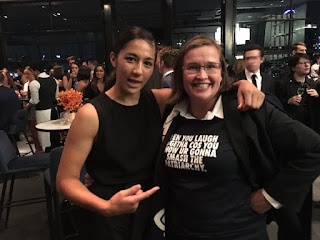
Kate Jenkins and her crazy eyes wearing her "Wen you laugh togetha cos you know ur gonna smash the patriarchy" shirt.
Kate Jenkins (right) in her poorly spelled smash the patriarchy shirt


Saturday, April 8, 2017

Art as a Creative Endeavor : Andy Warhol's Prince

Seen here


photograph of Prince, 1981 by Lynn Goldsmith
(I couldn't find a clean copy of the photo –this one is close –so this is taken from the lawsuit against the photographer by the Andy Warhol Foundation hence the oval around the eyes)


Prince by Andy Warhol, 1984

animated gif below the fold