A few years ago I bought an old medical dictionary (The American Illustrated Medical Dictionary, 20th edition, printed in 1946). I soon discovered that it wasn't very helpful because terminology has changed so much. Looking things up on the internet was usually both easier and better. Occasionally I'd use it to look something up if I didn't have the internet available or I'd flip it open & read a few entries when I was bored.
It has 1668 pages and boasts 885 illustrations. Of the 885 illustrations some are portraits of notable people (which is a pretty much a waste of space in a dictionary, I'd say). A random page has 44 entries on it. Assuming that is typical then there are about 73,000 entries in the book. The title page notes that 240 illustrations are portraits leaving 645 useful diagrams. That is 1 useful illustration for every 113 entries. One would imagine that scarcity would drive the editors to come up with criteria that would insure only the most significant entries and the entries that could best be explained with an illustration would get an illustration. On the other hand, someone might insist that 4 different types of hymens absolutely must be illustrated. Oh, and that the entry on elephantitis should definitely include an illustration of elephantitis of the scrotum.
Tuesday, March 10, 2009

Friday, March 6, 2009
A Public Service Announcement : a difference between men and women
A difference between men and women - a public service announcement
Women tend to look at themselves or other women, very carefully and examine each and every conceivable area. Then they score each area and think, for example, "okay, these shoes are 88% sexy, 14% slutty (in the good way), 18% slutty (in the bad way), 22% cute, 94% nice, 40% voluptuous, 21% fat, 9% unfashionable, 6% retro, 52% cool, an 60% sure another girl will like them/be jealous of them/hate her for having them" She then moves on to the next item/physical feature and scores it (again, using a potentially infinite number of variables). Then she averages all of the scores for all of the features together, weights the average based upon an unknown formula (it is known to be partially based upon her current mood and whether she likes the woman being examined or not) and then comes to a conclusion.
Men look at women differently. If a woman asks a guy to tell her if she looks good in an outfit he :
step 1) looks at her and more likely than not gets completely distracted by one single feature (ie a boob, luscious lips, legs, if she is smiling etc)
step 2) asks himself "Does (that feature he was distracted by) look good?" This is generally a simple yes or no question.
step 3) Either blurt out the answer or take a moment to make the answer more than a one word sentence and if the answer is "no" then he has to guess if she really wants his opinion or not and the consequences of the wrong answer.
(ie a woman asks "do you like my shoes?" guy looks at shoes, notes that they are on her feet, notes the color (in case she asks), looks at her legs, follows her leg upward, looks at her hips, checks for cleavage, decides he likes the way she stands with her hands on her hips and he thinks about her boobs and thinks they look good and answers "yes, those shoes look good.")
Of course, occasionally guys get stuck on the wrong part and declare that an otherwise gorgeous woman looks practically like Ernest Borgnine and they say things like "Salma Hayek has a weird chin. Blechh!"
Women tend to look at themselves or other women, very carefully and examine each and every conceivable area. Then they score each area and think, for example, "okay, these shoes are 88% sexy, 14% slutty (in the good way), 18% slutty (in the bad way), 22% cute, 94% nice, 40% voluptuous, 21% fat, 9% unfashionable, 6% retro, 52% cool, an 60% sure another girl will like them/be jealous of them/hate her for having them" She then moves on to the next item/physical feature and scores it (again, using a potentially infinite number of variables). Then she averages all of the scores for all of the features together, weights the average based upon an unknown formula (it is known to be partially based upon her current mood and whether she likes the woman being examined or not) and then comes to a conclusion.
Men look at women differently. If a woman asks a guy to tell her if she looks good in an outfit he :
step 1) looks at her and more likely than not gets completely distracted by one single feature (ie a boob, luscious lips, legs, if she is smiling etc)
step 2) asks himself "Does (that feature he was distracted by) look good?" This is generally a simple yes or no question.
step 3) Either blurt out the answer or take a moment to make the answer more than a one word sentence and if the answer is "no" then he has to guess if she really wants his opinion or not and the consequences of the wrong answer.
(ie a woman asks "do you like my shoes?" guy looks at shoes, notes that they are on her feet, notes the color (in case she asks), looks at her legs, follows her leg upward, looks at her hips, checks for cleavage, decides he likes the way she stands with her hands on her hips and he thinks about her boobs and thinks they look good and answers "yes, those shoes look good.")
Of course, occasionally guys get stuck on the wrong part and declare that an otherwise gorgeous woman looks practically like Ernest Borgnine and they say things like "Salma Hayek has a weird chin. Blechh!"
Friday, February 13, 2009
Valentine's Day

Hercules and Omphale (getting frisky) by François Boucher circa 1724. How frisky? Two cupid frisky.

Here is a statue of Omphale dressed in a lion skin holding a club at her side and it is not Omphale sitting while standing erect and happy to see you.
I also learned from wiki that "Hercule et Omphale" is a short pornographic poem by Guillaume Apollinaire from a book called "Les onze mille verges" (The eleven thousand penises). That is one hell of a book title (assuming it isn't a sequel) but the poem doesn't impress me.
Thursday, January 29, 2009
Art as a Creative Endeavor : Francesco Primaticco vs Niccolo dell' Abbate

Ulysses and Penelope by Francesco Primaticco

Venus and Cupid by Niccolo dell' Abbate
Or maybe not that creative.
I suspect that "Ulysses and Penelope" is the original and "Venus and Cupid" is the facsimile for the following reasons :
- Ulysses touching Penelope's face looks romantic but Cupid's hand looks like he is waiting for her to spit out a quarter.
- Cupid has a mullet.
- Unlike Penelope who appears to be fidgeting with her hands, Venus appears to be making a rude gesture with an erect thumb on one hand between two open fingers on the other.
Sunday, January 4, 2009
Happy Nude Year
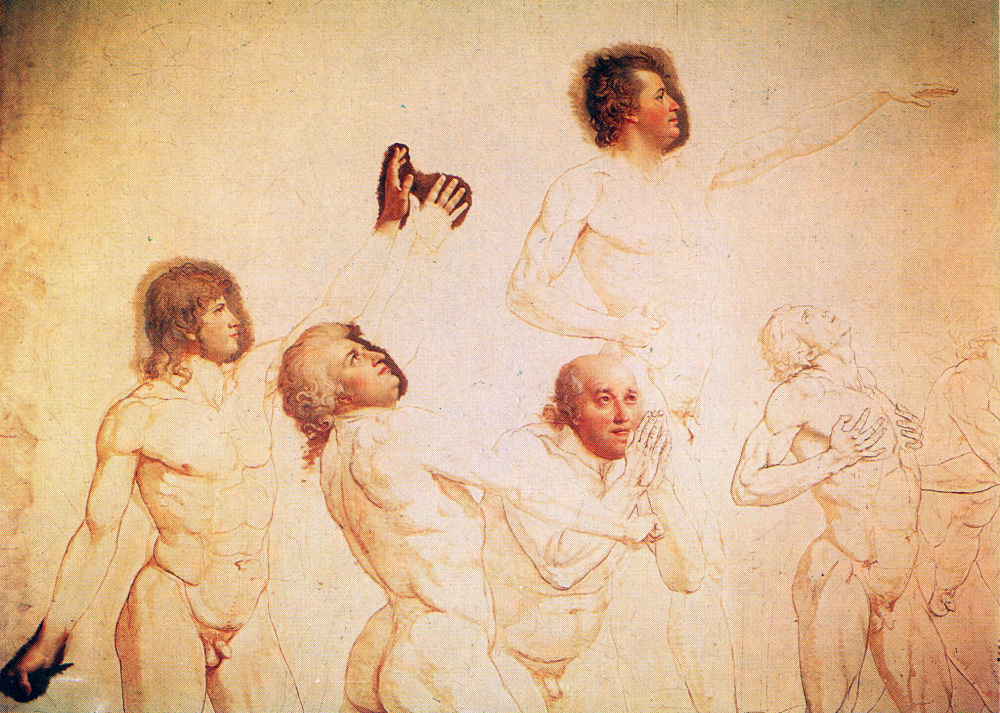
Part of Jacque Louis David's study for the painting "Serment du Jeu de Paume" (Oath at the Tennis Court) which had been initially intended to be an enormous life sized testament to the idea of the republic. I hadn't realized the French Revolution had so much to do with the Rights of Man to go without pants.
The final painting was hung at the Versailles tennis court where the oath took place. That's kind of like someone having their portrait painted and then hanging it around their neck (not that there is anything wrong with that).
Wednesday, December 24, 2008
Subscribe to:
Posts (Atom)