spoilers below
Tuesday, July 30, 2013

Monday, July 29, 2013
Mutants need love too
 |
| Rembrandt's Ledikant |
etching, height 125mmx width 224 mm
The subject matter is pretty unambiguous to most people. The book Rembrandt and His Work (1899) describes it as "A very rare plate, which need not be described". The dutch genre was apparently called "boelering" which is dutch for "cohabitation." Rembrandt was 40 years old at the time so I would suggest he qualifies as a dirty old man.
Both sixes in the date are printed backwards. That is to say they were not etched onto the plate backwards.
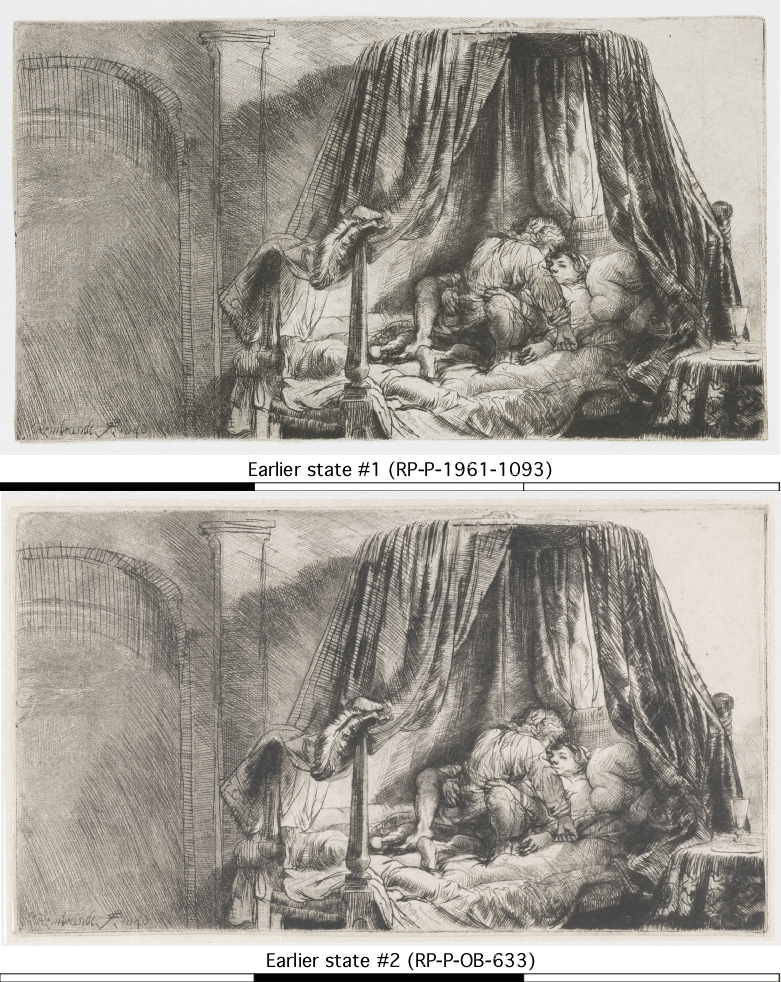
There are several different states to the etching. With each revision was it unnoticed that she has 3 hands (one right and 2 left hands)? Assuming, she doesn't have 4 arms and that the second right hand simply isn't shown. Or maybe the intent was to imply a kind of motion.
From a Descriptive Catalogue of the Prints of Rembrandt (1836) :
First impression There is a margin at top and the plate measures 6 in by 8.9 in
At the bottom of the door leading from the recess is written Rembrandt f 1646
Second impression The margin is cut off it is extremely rare and measures 5 in by 8.9 in
There is much of the bur in this impression
Third impression It is very scarce the recess and door with the name are cut off it measures 5 in by 6.9 in
It has been suggested that the final state was trimmed out of shame to take off Rembrandt's name.
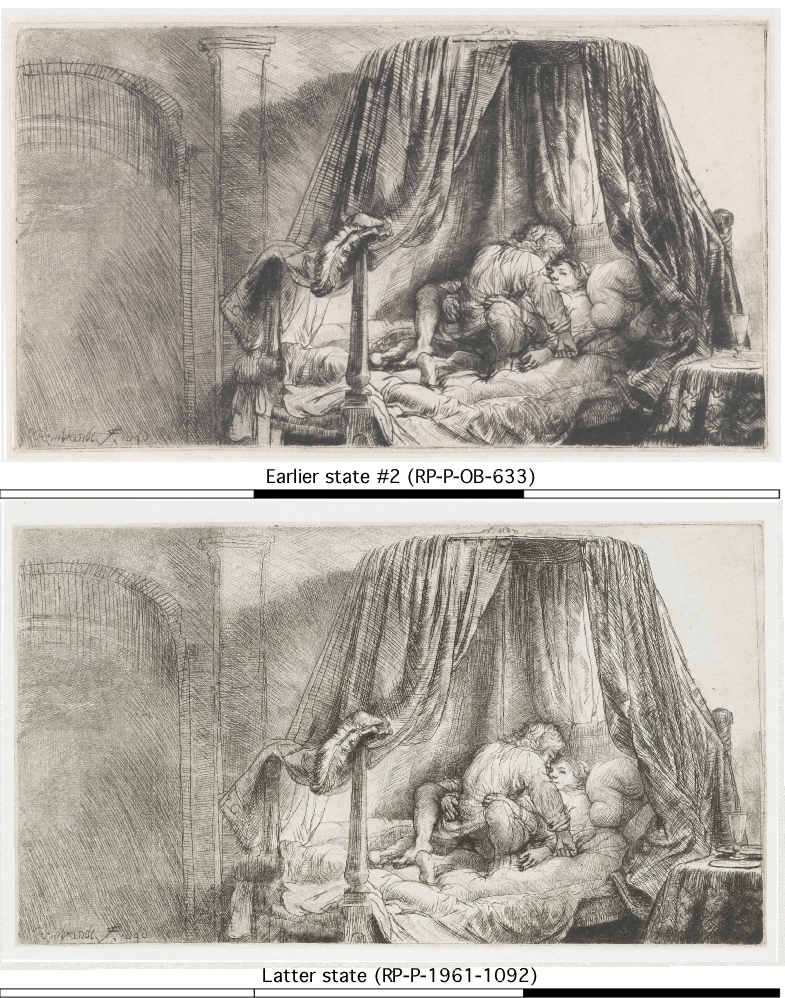
The British Museum says there are at least 4 states to the plate. The Rijksmusuem possesses at least 3 different states of the print :
- RP-P-1961-1093
- RP-P-OB-633
- man's arm burnished
- add a bit of smile to the woman's face
- (animation showing the differences between RP-P-1961-1093 and RP-P-OB-633)
- RP-P-1961-1092
- darkened the leftmost bedpost
- crosshatching on the side table
- add shadow of the plate on table
- altered the bedding hanging down
- refined the curtain rod
- (This is the image shown at the top of the post. Animation showing the differences between RP-P-OB-633 and RP-P-1961-1092. Or an animation comparing all three).
 |
| an attempt to show the size and scale of the etching |
Tuesday, July 16, 2013
Painting in a painting : Vermeer
 |
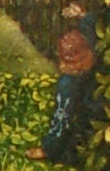
| somebody's Last Judgement (detail of Vermeer's Woman Holding a Balance ) |
The source of this Last Judgement painting is unknown. It isn't bad.
 |
| the full painting Vermeer's Woman Holding a Balance oil on canvas, 15.875" x 14" c1662-1665 |
 |
| an attempt to show the size and scale of the painting |
Saturday, July 13, 2013
Schuttersfeest by Meester van Frankfurt

Schuttersfeest (Festival of the Archers) by Meester van Frankfurt, 1493
oil on canvas, height 176cm x width 141cm
Koninklijk Museum voor Schone Kunsten Antwerpen, Antwerp, Belgium
The Artist
In the lower right quadrant is a man and a woman in white holding a dog : he is the artist. The Master of Frankfurt (aka Meester van Frankfurt)
 |
| The artist and his wife and her dog. |
 |
| Did he wear the exact same clothes every day? |
drummer
What's a black guy doing in the Hapsburg Netherlands (and what would eventually be Antwerp, Belgium)?
 |
| sure, give the black guy the flesh colored tights |
The jesters
The jester in red & black appears to be wearing roller skates. The link above notes that the small white line going from the bird on the red & black jester's should to the eye of the jester in green Shrek hat might look like a scratch on the painting but it is not. It is paint showing the black bird bending down, lifting his tail feathers and spraying poop into the eye of the green jester.

Hey, look over there…
 |
| "Hey, baby, I really like your apples…" |
Getting frisky
 |
| K - I - S - S - I - N - G |
 |
| she is squeezing his thigh and looking at him with lust in her eyes |
Saint George
 |
| A statue of a knight in armor with a lance (Saint George?) and a banner bearing the cross of Saint George (from the upper left corner of the picture) |
Schuttersstuk
This is not typical of the schuttersstuk genre. The usual schuttersstuk focuses almost exclusively on the portraits of the militia members. In this, it is difficult to tell who is a militia member and who is not. They are probably the men with an insignia on their arm, those holding bows and who knows who else.
In common with other schuttersstuk, it was apparently commissioned by the Antwerp Crossbow Guild. The dutch wiki page describes the painting as allegorical but I haven't seen an explanation of the meaning.
 |
| a member of the militia, a heavy drinker, with an insignia on his arm carrying heavy drink containers. |
Scale
 |
| an attempt to show the size and scale of the painting |
Thursday, July 11, 2013
Dutch Afro

Officieren van de Haarlemse Kloveniersdoelen by Hendrik Gerritsz Pot, 1630
oil on canvas, height 214cm x width 276cm
Note the flag carrier in white towards the right and his afro. Everyone else seems to have more closely cropped hair but who knows what they have hiding under their hats.
oil on canvas, height 214cm x width 276cm
 |
| dutch afro |
Note the flag carrier in white towards the right and his afro. Everyone else seems to have more closely cropped hair but who knows what they have hiding under their hats.
Also of interest, a painting of a painting : the top of a group portrait can be seen through the window.
I think the metal hand rails with the upturn at the end is designed discourage people from sliding down them.
 |
| an attempt to show the size and scale of the painting |
Wednesday, July 3, 2013
Transformation of Antiques magazine cover into the Apparition of a Face (1974) by Salvador Dali
 |
| click to embiggen |
Transformation of Antiques magazine cover into the Apparition of a Face (1974) by Salvador Dali
Paranoiac-critical conversion
11.5" x 8.75"
11.5" x 8.75"
Dali modified the magazine cover to show a woman's face. Below is the original image from the cover of Antiques the Magazine January 1974.
 |
below the fold is a slow blinking animated gif contrasting the source image with Dali's modified image.
Subscribe to:
Posts (Atom)